






































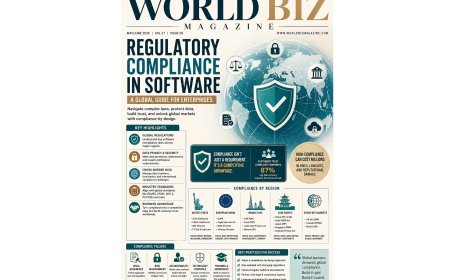









































































































































































The Future of Software Compliance: Global Standards and Strategies
A complete guide to regulatory compliance in software for global businesses and tech companies.


Regulatory Compliance in Software
A Global, Region-by-Region Guide for Enterprises
World Biz Magazine | Global Technology Policy, Compliance & Digital Governance
Regulatory compliance in software has evolved into a strategic imperative for global businesses. As organizations operate across borders, they must navigate a complex web of data protection laws, cybersecurity standards, and digital governance frameworks.
Failure to comply is no longer just a legal issue it directly impacts market access, investor confidence, customer trust, and intellectual property protection.
This article provides a comprehensive, region-by-region breakdown of software compliance requirements across major global markets.
What Is Software Regulatory Compliance?
Software regulatory compliance refers to adherence to laws, standards, and policies governing:
- Data privacy and protection
- Cybersecurity practices
- Cross-border data transfer
- Intellectual property protection
- Industry-specific regulations (finance, healthcare, telecom)
Global benchmarks include:
- General Data Protection Regulation
- Health Insurance Portability and Accountability Act
- ISO standards such as ISO/IEC 27001
Regional Compliance Breakdown
United States (UAS)
The U.S. follows a sector-specific regulatory model rather than a single unified law.
Key Regulations:
- California Consumer Privacy Act (CCPA)
- Health Insurance Portability and Accountability Act (HIPAA)
- Sarbanes-Oxley Act (SOX)
Key Requirements:
- Consumer data rights (access, deletion)
- Strong cybersecurity controls for healthcare and finance
- Audit trails and financial transparency
Business Impact:
- Compliance varies by state and industry
- High penalties for violations
- Critical for SaaS, fintech, and healthtech companies
Europe (European Union)
Europe enforces one of the strictest data protection regimes globally.
Key Regulations:
- General Data Protection Regulation (GDPR)
- Digital Services Act
- NIS Directive
Key Requirements:
- Explicit user consent for data collection
- Right to be forgotten
- Data breach reporting within 72 hours
- Data localization and transfer restrictions
Business Impact:
- Applies globally if EU user data is processed
- Heavy fines (up to 4% of global revenue)
- Drives global compliance standards
Middle East
The Middle East is rapidly evolving with modern data protection laws aligned with global standards.
Key Countries & Laws:
- UAE
- UAE Personal Data Protection Law
- Saudi Arabia
- Saudi Personal Data Protection Law
- Qatar
- Qatar Data Privacy Law
Key Requirements:
- Data protection and consent frameworks
- Cross-border data transfer restrictions
- Cybersecurity compliance for critical sectors
Business Impact:
- Strong push for digital transformation
- Compliance required for government contracts
- Increasing alignment with GDPR-like standards
Asia-Pacific
Asia presents a diverse regulatory landscape, ranging from strict data control to flexible innovation frameworks.
Key Countries & Laws:
- China
- Cybersecurity Law of China
- Personal Information Protection Law
- India
- Digital Personal Data Protection Act
- Japan
- Act on the Protection of Personal Information
- Singapore
- Personal Data Protection Act Singapore
Key Requirements:
- Data localization (China)
- Consent-driven data use (India, Singapore)
- Strong corporate accountability (Japan)
Business Impact:
- Complex multi-country compliance strategy required
- Critical for global SaaS and cloud providers
- Regulatory fragmentation increases operational cost
Other Key Markets
United Kingdom
- UK GDPR
- Post-Brexit adaptation of EU GDPR
Canada
- Personal Information Protection and Electronic Documents Act
Australia
- Privacy Act 1988
Brazil
- Lei Geral de Proteção de Dados (LGPD)
Key Compliance Themes Across Regions
1. Data Privacy Is Universal
Almost all regions enforce user consent and data protection.
2. Data Localization Is Rising
Countries like China and Saudi Arabia require local data storage.
3. Cybersecurity Is Mandatory
Security standards are now embedded in regulations.
4. Cross-Border Data Transfer Is Restricted
International businesses must manage data flow carefully.
Risks of Non-Compliance
- Heavy financial penalties
- Market access restrictions
- Legal liabilities
- Loss of customer trust
- Intellectual property exposure
Strategic Business Implications
1. Compliance as a Competitive Advantage
Companies that comply faster gain access to global markets.
2. Increased Operational Costs
Multi-region compliance requires legal, technical, and operational investment.
3. Impact on Software Architecture
- Data localization - regional servers
- Privacy laws - encryption & access controls
Enterprise Best Practices
- Adopt global standards like ISO/IEC 27001
- Build compliance into software architecture
- Use region-specific data storage strategies
- Conduct regular audits and risk assessments
- Implement privacy-by-design frameworks
World Biz Magazine Insights
- Compliance is no longer optional it is market entry strategy
- The strictest regulation (often GDPR) becomes the global benchmark
- Companies are shifting toward “compliance-first architecture”
- Regulatory alignment is shaping cloud, AI, and SaaS ecosystems
- Future competition will be defined by trust, transparency, and governance
Conclusion
Regulatory Compliance as a Strategic Growth Engine
Regulatory compliance in software has moved far beyond a legal checkbox it is now a core pillar of global business strategy. In an interconnected digital economy, organizations must design systems that are not only innovative and scalable, but also compliant across multiple jurisdictions.
From the stringent requirements of the General Data Protection Regulation in Europe to sector-driven frameworks like the Health Insurance Portability and Accountability Act in the United States, compliance expectations are shaping how software is built, deployed, and managed worldwide.
The rise of data localization laws, cross-border transfer restrictions, and cybersecurity mandates signals a clear shift: compliance is now directly tied to market access and competitive advantage.
For enterprises, the path forward lies in adopting a compliance-by-design approach embedding regulatory requirements into architecture, workflows, and governance models from the outset. Organizations that proactively align with global standards will not only mitigate risk but also unlock new opportunities in regulated markets.
Ultimately, the future belongs to companies that can balance innovation with accountability, delivering secure, transparent, and compliant digital solutions at scale.
Disclaimer
This publication is intended for informational and analytical purposes only. The content reflects general industry practices, global regulatory frameworks, and publicly available information. It does not constitute legal, regulatory, or professional advisory.
No Legal Liability:
World Biz Magazine makes no representations or warranties regarding the accuracy, completeness, or applicability of the information provided. Readers and organizations are strongly advised to seek independent legal counsel and compliance experts before making regulatory or business decisions.
Jurisdictional Variability Notice:
Regulatory requirements vary significantly across regions and are subject to continuous updates. Laws such as the California Consumer Privacy Act, General Data Protection Regulation, and other international frameworks may evolve, and organizations must ensure they rely on the most current legal guidance.
Third-Party References:
All laws, regulations, and frameworks referenced including General Data Protection Regulation and Health Insurance Portability and Accountability Act remain the property and authority of their respective governing bodies and are cited for informational purposes only.
Risk Acknowledgment:
Compliance implementation involves technical, operational, and legal risks. World Biz Magazine shall not be held responsible for any direct or indirect consequences arising from the use of this information.
What's Your Reaction?
 Like
0
Like
0
 Dislike
0
Dislike
0
 Love
0
Love
0
 Funny
0
Funny
0
 Angry
0
Angry
0
 Sad
0
Sad
0
 Wow
0
Wow
0