
















































































































































































































Cloud Hosting vs On-Premises Solutions: Which Infrastructure Model Is Best?
Differences between cloud hosting and on-premises infrastructure including costs, security, scalability, and the future of enterprise IT systems.

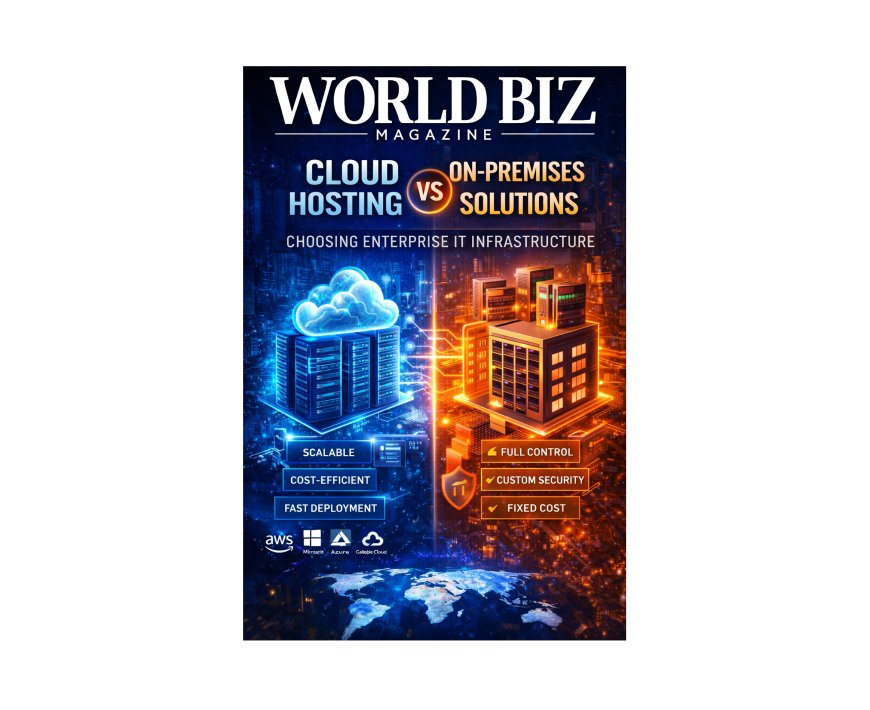
Cloud Hosting vs On-Premises Solutions
The Strategic Technology Choice Reshaping the Global Digital Economy
World Biz Magazine | Technologies in Digital Economy & E-Commerce
In the modern digital era, businesses depend heavily on reliable IT infrastructure to run applications, store data, and deliver digital services. From global e-commerce platforms to financial institutions and media companies, the question of where and how digital infrastructure should be hosted has become a major strategic decision.
Organizations today generally choose between two main infrastructure models:
- Cloud hosting
- On-premises solutions
Both approaches have advantages and limitations depending on cost, scalability, regulatory requirements, and long-term technology strategies.
Technology giants such as Amazon Web Services, Microsoft, Google, and IBM have driven the rapid expansion of cloud infrastructure, while many large enterprises and government institutions continue to operate critical systems using on-premises data centers.
For business leaders, choosing between cloud hosting and on-premises infrastructure is no longer purely an IT decision it is a strategic business choice that affects cost efficiency, innovation speed, and global competitiveness.
Understanding Cloud Hosting
Cloud hosting refers to a model where computing resources such as servers, storage, and databases are provided through remote data centers and accessed via the internet.
In this model, companies do not need to build or maintain their own physical servers. Instead, they rent computing capacity from cloud providers.
Major cloud infrastructure providers include:
- Amazon Web Services
- Microsoft (Azure)
- Google (Google Cloud)
- Alibaba Group (Alibaba Cloud)
These companies operate massive global data center networks capable of supporting millions of businesses simultaneously.
Cloud hosting allows companies to deploy applications rapidly without purchasing hardware or building data centers.
Understanding On-Premises Infrastructure
On-premises infrastructure refers to IT systems that are physically installed and operated within a company’s own facilities or data centers.
Organizations using on-premises systems own and manage their servers, networking equipment, and storage infrastructure.
Historically, this model dominated corporate IT systems before cloud computing emerged.
Industries such as banking, defense, healthcare, and government agencies often rely on on-premises infrastructure because of strict regulatory and security requirements.
Companies using on-premises systems maintain complete control over:
- hardware infrastructure
- software configuration
- data storage and security policies
Global Market Overview
The cloud computing industry has become one of the fastest-growing sectors in the technology economy.
The global cloud computing market exceeded $600 billion in 2023 and is projected to surpass $1 trillion by the early 2030s.
Meanwhile, enterprise spending on on-premises infrastructure remains significant, particularly in industries where data sovereignty and security compliance are critical.
However, global technology spending trends clearly show that many businesses are migrating toward cloud infrastructure.
Key Differences Between Cloud and On-Premises
|
Factor |
Cloud Hosting |
On-Premises Solutions |
|
Infrastructure Ownership |
Provider owned |
Company owned |
|
Initial Cost |
Low |
High |
|
Scalability |
Highly scalable |
Limited by hardware |
|
Deployment Speed |
Rapid |
Slower |
|
Maintenance |
Managed by provider |
Managed internally |
|
Security Control |
Shared responsibility |
Full organizational control |
These differences shape how companies approach digital transformation strategies.
Cost Considerations
One of the biggest reasons companies adopt cloud hosting is cost efficiency.
Cloud infrastructure operates on a pay-as-you-go model, allowing organizations to pay only for the computing resources they use.
This eliminates the need for large upfront investments in hardware and data centers.
On-premises infrastructure, in contrast, requires:
- purchasing servers and storage equipment
- building or renting data center facilities
- hiring IT staff to maintain systems
However, for organizations with stable workloads, on-premises systems can sometimes be more cost-effective over the long term.
Scalability and Flexibility
Cloud infrastructure offers unmatched scalability.
Companies can increase computing capacity instantly during peak demand periods.
For example, global e-commerce platforms often rely on cloud infrastructure to handle massive traffic spikes during major sales events.
Platforms such as Amazon and Alibaba Group depend heavily on cloud infrastructure to support millions of simultaneous users.
On-premises systems require purchasing additional hardware to increase capacity, which can take weeks or months to implement.
Security and Compliance
Security remains one of the most debated topics in cloud adoption.
Cloud providers invest billions of dollars into advanced cybersecurity systems, making cloud environments highly secure.
However, some organizations prefer on-premises infrastructure because it allows complete control over sensitive data.
Industries where on-premises systems remain common include:
- government agencies
- financial institutions
- defense organizations
- healthcare systems
Data sovereignty laws in certain countries also require that sensitive data be stored within national borders.
The Rise of Hybrid Cloud Strategies
Many organizations now adopt hybrid infrastructure models that combine both cloud and on-premises systems.
In hybrid environments:
- critical systems remain on-premises
- scalable workloads run on cloud infrastructure
This approach allows companies to benefit from cloud flexibility while maintaining control over sensitive data.
Hybrid cloud solutions are supported by major technology providers including Microsoft and IBM.
Industry Adoption Trends
Cloud adoption has accelerated across nearly every industry.
Technology companies and digital startups were early adopters, but traditional sectors are increasingly migrating to cloud infrastructure.
Industries leading cloud adoption include:
- e-commerce
- media and streaming platforms
- software development
- fintech companies
Companies such as Netflix rely almost entirely on cloud infrastructure to deliver global streaming services.
Government Policies and Regulation
Governments worldwide are shaping cloud infrastructure adoption through digital policies and regulatory frameworks.
Key regulatory areas include:
Data Sovereignty
Some governments require data generated within their borders to be stored domestically.
Cybersecurity Regulations
Countries are implementing stricter cybersecurity standards for cloud infrastructure.
Digital Infrastructure Investment
Many governments are investing heavily in cloud infrastructure to support national digital economies.
These policies are influencing where cloud providers build data centers and how businesses deploy digital infrastructure.
Global Investment Trends
The rapid growth of cloud computing has attracted massive investment from technology companies and venture capital firms.
Major cloud infrastructure investments include:
- hyperscale data centers
- edge computing networks
- AI-powered cloud platforms
Companies such as Amazon, Microsoft, and Google are investing billions annually in expanding global data center infrastructure.
Future Industry Outlook
The next decade will see major transformations in how businesses deploy digital infrastructure.
Several trends are shaping the future:
Edge Computing
Edge computing brings processing power closer to users, reducing latency for digital services.
AI-Optimized Cloud Platforms
Artificial intelligence will automate resource allocation and infrastructure management.
Serverless Computing
Serverless architectures allow developers to run applications without managing servers.
Multi-Cloud Strategies
Many enterprises are adopting multi-cloud environments using multiple cloud providers simultaneously.
World Biz Magazine Industry Insights
Cloud infrastructure is becoming one of the most important pillars of the global digital economy.
Companies that embrace scalable cloud technologies can innovate faster, deploy services globally, and adapt quickly to market changes.
However, on-premises systems will continue to play a role in industries requiring strict data control and regulatory compliance.
The future of enterprise infrastructure is likely to be hybrid and multi-cloud, combining the strengths of both models.
Conclusion
The debate between cloud hosting and on-premises solutions reflects the broader transformation of the global technology landscape.
Cloud infrastructure offers flexibility, scalability, and rapid innovation, making it the preferred model for many modern digital platforms.
At the same time, on-premises systems remain relevant for organizations that require full control over data security and infrastructure management.
As businesses navigate digital transformation, choosing the right infrastructure strategy will be critical to achieving long-term competitiveness in the global digital economy.
Disclaimer
World Biz Magazine provides industry insights, research analysis, and business commentary for informational purposes only. Technology strategies and infrastructure models discussed in this article represent general industry perspectives and should not be interpreted as specific technical or financial advice. Organizations should conduct independent research and consult qualified professionals when making infrastructure or technology investment decisions.
What's Your Reaction?
 Like
0
Like
0
 Dislike
0
Dislike
0
 Love
0
Love
0
 Funny
0
Funny
0
 Angry
0
Angry
0
 Sad
0
Sad
0
 Wow
0
Wow
0