
















































































































































































































Monolithic vs Microservices Architecture for E-Commerce: Which Model Wins?
A detailed analysis of monolithic vs microservices architecture for e-commerce platforms and how modern retailers build scalable digital infrastructure.

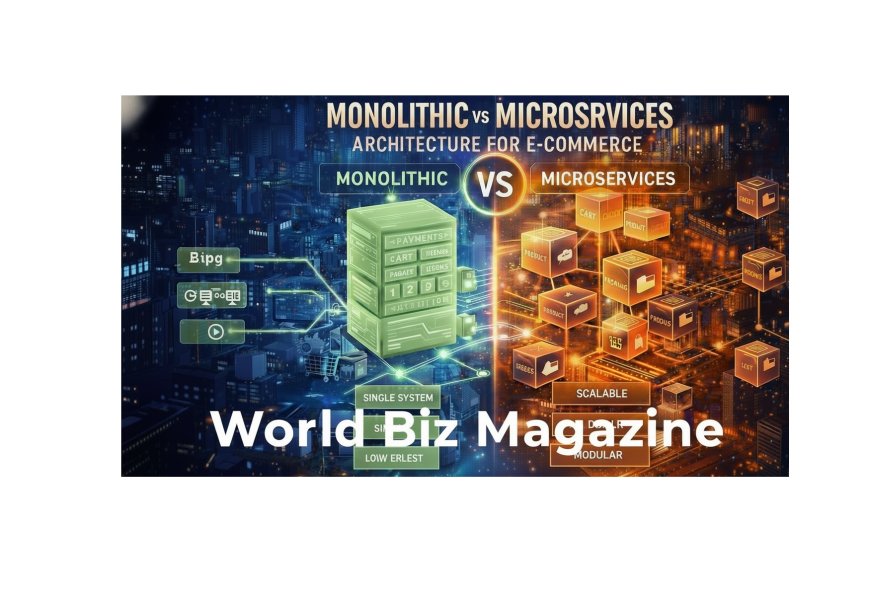
Monolithic vs Microservices Architecture for E-Commerce
Choosing the Right Technology Foundation for Scalable Digital Retail
World Biz Magazine | Technologies in Digital Economy & E-Commerce
The global e-commerce industry has entered a phase where technology architecture is no longer just a backend decision it is a strategic business choice. As digital retail continues to expand toward multi-trillion-dollar scale, companies must decide how to build and manage their technology platforms to handle millions of users, transactions, and product interactions.
Two architectural approaches dominate modern e-commerce development:
- Monolithic architecture
- Microservices architecture
These models represent fundamentally different philosophies for designing software systems that power online stores, marketplaces, payment gateways, and logistics networks.
Major technology companies such as Amazon, Netflix, Shopify, and Alibaba Group have played key roles in shaping how modern digital commerce platforms are built.
Understanding the differences between monolithic and microservices architectures is essential for startups, enterprises, and technology leaders operating in the rapidly evolving digital retail ecosystem.
Understanding E-Commerce Architecture
E-commerce architecture refers to the software structure that supports an online retail platform. It determines how various components of the system interact, including:
- product catalog management
- shopping cart systems
- payment processing
- order management
- inventory tracking
- logistics integration
- customer analytics
The architecture also determines how easily a system can scale, adapt to market changes, and integrate with emerging technologies such as artificial intelligence and omnichannel retail platforms.
What Is Monolithic Architecture?
Monolithic architecture is the traditional software model where the entire application is built as a single, unified codebase.
In a monolithic system:
- all components operate within one application
- all modules share the same database
- deployment occurs as a single package
This model was widely used in the early years of online retail.
Many legacy e-commerce platforms originally relied on monolithic frameworks, including systems built on Magento and early enterprise commerce solutions.
Key Characteristics of Monolithic Architecture
- Single Codebase
All system functions including payments, catalog management, and checkout are built inside one application.
- Simplified Development
Developers work on one centralized system rather than multiple services.
- Unified Deployment
Updates are deployed as a complete application.
- Shared Database
All modules access the same data storage.
Advantages of Monolithic Systems
Simpler Development
For startups and small businesses, monolithic systems are easier to build and maintain.
Lower Initial Cost
Monolithic architecture often requires fewer infrastructure resources during early development stages.
Easier Testing
Testing is simpler because all components are part of the same application.
Limitations of Monolithic Architecture
As digital platforms grow, monolithic systems often face serious scalability challenges.
Limited Scalability
Scaling requires deploying the entire application rather than individual components.
Slower Development Cycles
Small updates require redeploying the entire platform.
Higher Risk of System Failure
A bug in one component can potentially affect the entire application.
What Is Microservices Architecture?
Microservices architecture is a modern software design approach where applications are built as a collection of independent services.
Each service performs a specific function and communicates with others through APIs.
Major technology companies pioneered this model to support massive digital platforms.
For example, Amazon famously transitioned to microservices to handle the scale of its global marketplace.
Key Characteristics of Microservices
- Independent Services
Each function operates as its own service.
Examples include:
- payment service
- recommendation engine
- user authentication
- product catalog
- API-Based Communication
Services interact through application programming interfaces.
- Independent Deployment
Each service can be updated without affecting the rest of the platform.
- Distributed Databases
Different services may use separate data storage systems.
Advantages of Microservices
Scalability
Microservices allow companies to scale individual services independently.
For example, during high shopping traffic, only checkout and payment services need additional resources.
Faster Innovation
Development teams can update specific services without redeploying the entire platform.
Improved Reliability
If one service fails, the rest of the platform can continue operating.
Technology Flexibility
Different services can be built using different programming languages or technologies.
Challenges of Microservices
While microservices offer flexibility and scalability, they also introduce complexity.
Higher Infrastructure Costs
Microservices require advanced cloud infrastructure and monitoring systems.
Major cloud providers such as Amazon Web Services, Microsoft, and Google provide tools to manage distributed microservices environments.
Complex System Management
Microservices require sophisticated orchestration and monitoring systems.
Increased Security Complexity
Each service must be secured individually.
Monolithic vs Microservices: A Strategic Comparison
|
Feature |
Monolithic Architecture |
Microservices Architecture |
|
Deployment |
Single application |
Independent services |
|
Scalability |
Limited |
Highly scalable |
|
Development Speed |
Slower for large systems |
Faster innovation cycles |
|
Infrastructure Cost |
Lower initially |
Higher infrastructure needs |
|
Complexity |
Simple |
Highly complex |
Industry Adoption Trends
The shift toward microservices architecture has accelerated over the last decade.
Large-scale digital platforms now rely heavily on distributed service architectures.
Companies adopting microservices include:
- Amazon
- Netflix
- Alibaba Group
However, smaller businesses and startups still frequently use monolithic architectures due to simplicity and cost advantages.
Impact on the Global E-Commerce Industry
The architecture choice directly affects how companies compete in the digital marketplace.
Microservices architectures enable:
- rapid feature deployment
- global scalability
- integration with AI and machine learning
- omnichannel retail strategies
This flexibility is increasingly important as online retail evolves toward:
- social commerce
- real-time logistics tracking
- personalized shopping experiences
Cloud Computing and Microservices
The growth of microservices architecture has been closely tied to the expansion of cloud computing infrastructure.
Cloud platforms allow companies to deploy scalable microservices across global data centers.
Major providers include:
- Amazon Web Services
- Microsoft
- Google
These platforms provide container orchestration technologies such as Kubernetes that simplify microservices deployment.
When Should Businesses Choose Monolithic Architecture?
Monolithic systems remain practical in several scenarios:
- startups building their first platform
- small-scale e-commerce stores
- companies with limited technical teams
In these cases, the simplicity of a monolithic system can accelerate development and reduce operational costs.
When Should Businesses Choose Microservices?
Microservices are ideal for organizations that require:
- large-scale platform performance
- global customer bases
- rapid product innovation
- integration with multiple third-party services
This architecture is particularly valuable for marketplaces, global retail platforms, and high-traffic online stores.
The Future of E-Commerce Architecture
The next generation of e-commerce infrastructure is expected to combine microservices with emerging technologies such as:
Serverless Computing
Serverless architecture allows developers to run services without managing servers.
Artificial Intelligence
AI-powered microservices will power recommendation engines and automated customer support.
Edge Computing
Edge infrastructure will reduce latency for global digital platforms.
Composable Commerce
Many companies are moving toward modular commerce platforms where businesses assemble customized technology stacks from multiple service providers.
World Biz Magazine Industry Insights
The evolution from monolithic to microservices architecture reflects a broader transformation in the digital economy.
Modern e-commerce platforms must support:
- global user bases
- high transaction volumes
- real-time analytics
- omnichannel customer experiences
Microservices architectures are increasingly becoming the standard foundation for large-scale digital commerce ecosystems.
However, the choice between architectures ultimately depends on the company’s size, technical resources, and growth strategy.
Conclusion
The debate between monolithic and microservices architecture is not about which system is universally better it is about choosing the right solution for a specific business context.
Monolithic systems remain efficient for smaller applications and early-stage platforms, while microservices architectures offer the scalability and flexibility required for global e-commerce operations.
As digital commerce continues to expand, companies that adopt flexible and scalable architectures will be best positioned to innovate, adapt, and compete in the evolving digital marketplace.
Disclaimer
World Biz Magazine provides industry analysis, research insights, and business commentary for informational purposes only. Technology strategies and architectural approaches discussed in this article represent general industry perspectives and should not be interpreted as specific technical or investment advice. Organizations should consult qualified professionals when making technology or infrastructure decisions.
What's Your Reaction?
 Like
0
Like
0
 Dislike
0
Dislike
0
 Love
0
Love
0
 Funny
0
Funny
0
 Angry
0
Angry
0
 Sad
0
Sad
0
 Wow
0
Wow
0