










































































































































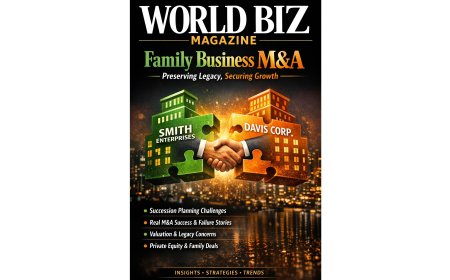





























































Family Business Mergers & Acquisitions: Preserving Legacy While Scaling Growth
Family-owned business M&A, including succession planning, risks, opportunities, and real-world success and failure case studies.

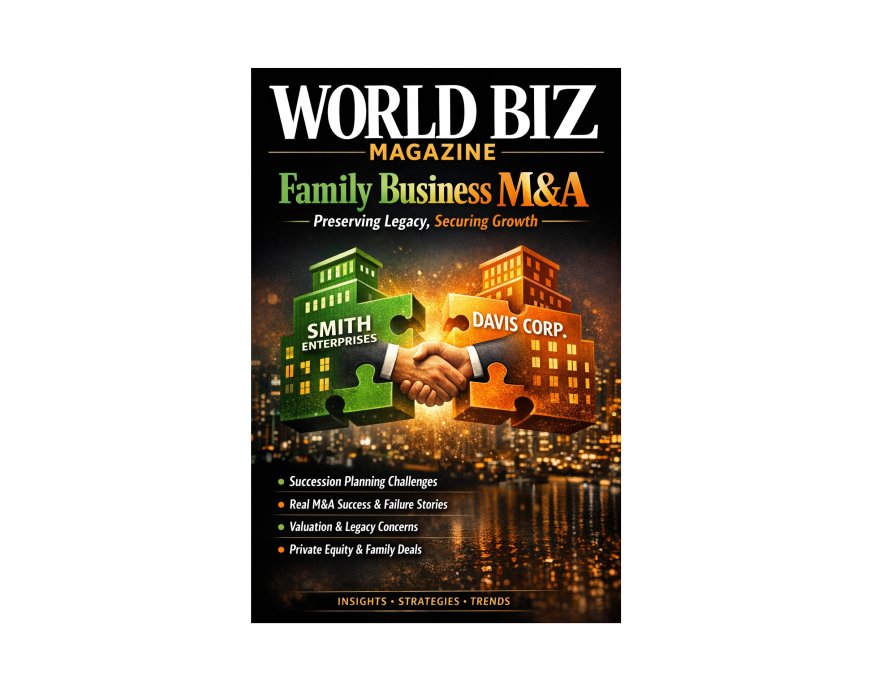
Family-Owned Business M&A
Balancing Legacy, Growth, and Strategic Transformation in Modern Deal-Making
World Biz Magazine | Industry Today Special Report
Where Business Meets Legacy
Family-owned businesses form the backbone of many economies, representing a significant share of global GDP and employment. Built over generations, these enterprises are often defined not just by financial performance, but by heritage, identity, and long-term vision.
However, as markets evolve and competition intensifies, many family businesses face a pivotal decision:
to grow independently or to pursue mergers and acquisitions (M&A).
Unlike traditional corporate deals, family-owned business M&A is deeply influenced by emotional, cultural, and legacy considerations making it one of the most complex and nuanced areas in modern finance.
Why Family-Owned Businesses Pursue M&A
1. Succession Planning and Generational Transition
One of the most common triggers for M&A in family businesses is the challenge of succession. Not all heirs are willing or capable of taking over leadership.
Selling or merging allows families to:
- Secure financial stability
- Avoid internal conflicts
- Ensure continuity of the business
2. Access to Capital and Growth Opportunities
Family businesses often face limitations in raising capital. M&A provides access to:
- Financial resources
- Expansion opportunities
- New markets and technologies
3. Competitive Pressure
Globalization and digital transformation have intensified competition. Partnering with larger entities helps family businesses:
- Scale operations
- Improve efficiency
- Stay relevant
Unique Characteristics of Family Business M&A
Family-owned deals differ significantly from traditional M&A transactions:
- Emotional Attachment: Decisions are influenced by legacy and family values
- Long-Term Perspective: Focus on sustainability over short-term gains
- Governance Complexity: Family dynamics impact decision-making
- Brand Identity: Strong emphasis on preserving reputation
These factors require careful negotiation and alignment of interests.
Types of M&A in Family Businesses
1. Full Sale
The family exits completely, often to private equity firms or corporations.
2. Partial Sale
The family retains ownership while bringing in strategic or financial partners.
3. Strategic Merger
Two companies combine to create a stronger entity, often preserving family involvement.
Success Stories in Family Business M&A
1. Ferrero acquiring Nestlé USA Confectionery
The Ferrero family successfully expanded its global footprint by acquiring Nestlé’s U.S. confectionery business. This deal:
- Strengthened Ferrero’s position in North America
- Preserved family leadership
- Demonstrated strategic expansion through M&A
2. BMW and the Quandt Family
The Quandt family maintained control of BMW while navigating strategic partnerships and acquisitions. Their approach highlights:
- Long-term vision
- Strong governance
- Successful integration of external opportunities
3. Walmart and the Walton Family
Although not a traditional M&A exit, the Walton family’s strategic acquisitions and partnerships have helped Walmart evolve into a global retail leader while retaining family influence.
Failure Stories and Lessons Learned
1. Quaker Oats Company acquiring Snapple
This acquisition is often cited as a failure due to:
- Cultural mismatch
- Poor integration strategy
- Misalignment with brand identity
The deal resulted in significant financial losses, highlighting the importance of strategic fit.
2. Family-Owned Businesses Losing Identity Post-Acquisition
In many cases, family businesses that sell to large corporations face:
- Loss of brand identity
- Cultural dilution
- Employee disengagement
These outcomes emphasize the need to balance financial goals with legacy preservation.
Risks in Family Business M&A
1. Emotional Decision-Making
Family ties can complicate rational business decisions.
2. Valuation Conflicts
Families may overvalue their business due to emotional attachment.
3. Cultural Integration Issues
Differences between family and corporate cultures.
4. Loss of Control
Selling ownership can reduce influence over operations.
5. Legacy Risk
Concerns about how the business will be managed post-sale.
Mitigation Strategies
- Engage professional advisors (legal, financial, strategic)
- Establish clear governance structures
- Align family and business objectives
- Conduct thorough due diligence
- Negotiate terms that preserve brand and legacy
Opportunities in Family-Owned Business M&A
1. Strategic Partnerships
Combining strengths with larger players.
2. Global Expansion
Access to international markets.
3. Innovation and Technology
Adopting modern business practices.
4. Wealth Creation
Unlocking the financial value of the business.
The Role of Private Equity in Family Business M&A
Private equity firms are increasingly active in family-owned business transactions. They offer:
- Capital for growth
- Operational expertise
- Strategic guidance
Many families opt for partial exits, allowing them to retain involvement while benefiting from professional management.
Future Outlook: Family Business M&A in 2035
1. Increased Deal Activity
More family businesses will explore M&A due to generational shifts.
2. Hybrid Ownership Models
Combination of family control and external investment.
3. Focus on ESG and Sustainability
Values-driven investment decisions.
4. Digital Transformation
Technology-driven growth strategies.
5. Global Expansion
Cross-border M&A becoming more common.
World Biz Magazine Insights
- Family businesses require unique M&A strategies
- Emotional and cultural factors are critical
- Partial exits are becoming increasingly popular
- The future lies in strategic partnerships and hybrid models
Conclusion: Preserving Legacy While Embracing Change
Family-owned business M&A is not just about financial transactions it is about balancing tradition with transformation.
The most successful deals are those that:
- Respect legacy
- Align strategic goals
- Deliver sustainable growth
In a rapidly evolving global economy, family businesses that embrace M&A strategically can secure their future while honoring their past.
Because in family enterprises,
the true value lies not just in assets but in legacy.
Disclaimer
This article is for informational purposes only and does not constitute financial or investment advice. Readers should consult professional advisors before making decisions.
What's Your Reaction?
 Like
0
Like
0
 Dislike
0
Dislike
0
 Love
0
Love
0
 Funny
0
Funny
0
 Angry
0
Angry
0
 Sad
0
Sad
0
 Wow
0
Wow
0