











































































































































































































Urban vs Suburban Housing Demand 2026-2030: Global Market Trends & Price Forecast
A comprehensive analysis of global urban and suburban real estate markets, including housing price trends, inflation impact, country-by-country insights, major investors, and future outlook to 2030.

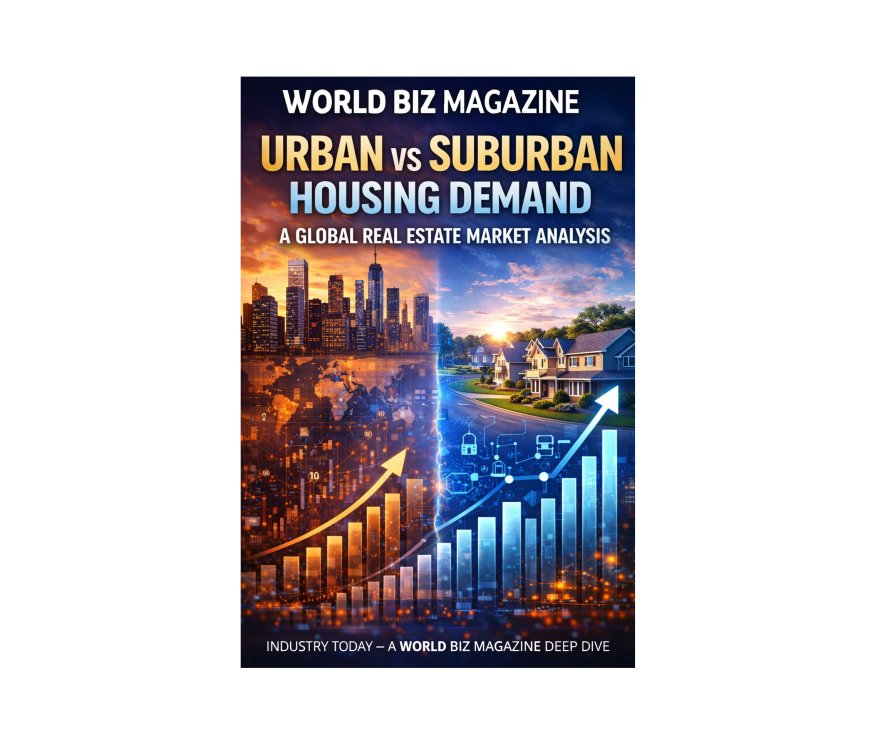
Urban vs Suburban Housing Demand: A Global Real Estate Market Analysis
Industry Today - A World Biz Magazine Report
The global housing landscape is experiencing a profound transformation. After decades of urban migration and high-density residential growth, shifting demographic preferences catalyzed by technological changes, evolving lifestyles, economic pressures, and post-pandemic behavior are reshaping demand between urban and suburban housing markets. This comprehensive World Biz Magazine analysis delves into trends, market forces, policy impacts, region-by-region dynamics, investment flows, price movements, and detailed forecasts through 2030.
Industry Overview
The residential housing market consists of urban, suburban, and rural segments. Historically, urban centers have dominated demand due to employment access, services, and social infrastructure. However, recent patterns show rising suburban and exurban demand, driven by:
- Remote and hybrid work models
- Affordability pressures in city cores
- Desire for larger living spaces
- Improved transportation and digital connectivity
Understanding this balance is crucial for developers, policymakers, investors, and urban planners worldwide.
Key Contacts & Key Players
Global Developers & Real Estate Firms
- CBRE Group - Market research and transaction services
- Knight Frank - International real estate advisory
- Savills - Residential pricing and trend insights
- Dalian Wanda Group - Integrated urban and suburban developments
- Trammell Crow Residential - U.S. residential market specialist
Institutional Investors
- Blackstone Real Estate Partners
- Brookfield Asset Management
- Prologis Residential Division
- Canadian Pension Plan Investment Board (CPP Investments)
- AXA IM - Real Assets
Government & Regulatory Bodies
- Urban and regional planning ministries
- Housing and urban affairs departments
- Central banks (impact mortgage and credit conditions)
These actors shape supply, price dynamics, infrastructure investment, and market regulation.
Market Size & Demand Trends
Global Residential Market Value
- Total estimated global housing value: $250+ trillion (all segments)
- Urban vs. suburban split varies by region and maturity of economies.
Recent Shifts
- Urban demand rebound: Post-pandemic stabilization in many major cities
- Suburban surge: Driven by lifestyle preferences and remote work flexibility
- Rural fringe growth: In markets with digital connectivity
Demand dynamics are continually influenced by affordability, job markets, transport accessibility, and changing household preferences.
Policy Impact & Political Decisions
Urban Policy Measures
Governments often focus on:
- Urban regeneration and infrastructure upgrades
- Transit-oriented development
- Affordable housing incentives within city centers
Suburban and Regional Policies
Policies that support balanced regional development include:
- Tax incentives for suburban housing developments
- Infrastructure investments in mobility corridors
- Zoning reforms to expand mid-density housing
Impact of Regulations
- Taxation frameworks: Capital gains, property taxes, and housing levies affect investment flows.
- Rent controls and tenant protections: Particularly in European and North American urban markets.
- Mortgage lending policies: Central banks’ interest rate decisions affect buyer affordability across regions.
Political emphasis on housing affordability and quality of life directly shapes where demand allocates.
Price Movements & Inflation Effects
10-Year Price Flow Overview
|
Region |
2014-2019 |
2020-2022 |
2023-2025 |
|
Urban Core |
Strong, steady growth |
High volatility |
Cooling/Moderation |
|
Suburban |
Moderate |
Rapid growth |
Competitive pricing |
|
Exurban & Fringe |
Emerging growth |
Increased interest |
Stabilizing growth |
Key Drivers:
- Interest rate hikes (2022-2024) slowed urban pricing momentum.
- Suburban affordability drove migrations from city cores.
- Inflation affected construction costs, property taxes, and developer margins.
Country-by-Country Analysis & Investment Patterns
North America
- United States & Canada:
Urban markets stabilize post-pandemic. High suburban demand due to remote work. Key metros (New York, Toronto) see renewed urban interest, while Sun Belt cities (Austin, Phoenix) experience robust growth.
Europe
- Western Europe:
Urban living remains attractive but moderated by cost pressures. Suburban catchments near major cities gain due to transport investments. - Eastern Europe:
Growth in secondary cities and suburbs supported by regional economic development.
Asia-Pacific
- China:
Urban demand influenced by tightening property policies. Suburban growth near mega cities like Shanghai and Beijing. - Australia & Singapore:
Strong suburban markets supported by lifestyle trends and housing policy shifts.
Middle East
- Dubai & Riyadh:
Urban residential growth complemented by planned suburban expansions and new satellite communities.
Latin America
Mixed trends urban cores remain main demand drivers, but suburban demand rising where infrastructure improves.
New Projects & Emerging Players
The housing sector is experiencing innovation in:
- PropTech platforms - digital listings, automated valuations, blockchain contracts
- Green and sustainable developments - energy-efficient and net-zero communities
- Modular and prefab construction - cost and time efficiencies
Emerging developers and regional players are capitalizing on new preferences for space, affordability, and connectivity.
Investment Flows & Major Investors
Institutional Investment Trends
Institutional capital continues to be allocated to residential portfolios, especially:
- Build-to-rent assets
- Mixed-use communities
- Urban regeneration zones
- Suburban lifestyle complexes
Large funds from pensions to sovereign wealth view residential real estate as essential long-term, income-generating assets.
Private Investment
High net worth and individual investors remain active in primary and secondary housing markets, particularly in stable economies with predictable regulatory frameworks.
Forecast Through 2030
Urban vs Suburban Demand Outlook
|
Segment |
2025 |
2026 |
2027 |
2028 |
2029 |
2030 |
|
Urban Residential Growth |
+3% |
+4% |
+5% |
+4% |
+4% |
+5% |
|
Suburban Residential Growth |
+4% |
+5% |
+6% |
+5% |
+5% |
+6% |
|
Fringe/Exurban Growth |
+2% |
+3% |
+4% |
+3% |
+4% |
+4% |
Demand Drivers to 2030:
- Hybrid work patterns reliably increase suburban and commuter zone demand
- Urban infrastructure and cultural amenities retain core city valuations
- Sustainability and livability metrics shape buyer preferences
Economic Influences:
- Stable mortgage environments conducive to growth
- Refinement of zoning and planning laws unlocking supply
- Demographic shifts (aging populations, household formation)
Winners & Losers in Residential Investment
Regions Gaining Investment
- U.S. Sunbelt & Secondary Cities: Rising affordability and job growth
- Canada’s suburban corridors: Strong demand and quality of life
- Western Europe’s transport-linked suburbs: Linked to rail and transit
- Asia: Strategic satellite city growth near mega urban centers
Regions Losing Momentum
- High-cost urban cores with restrictive supply (certain European and Asian cities)
- Countries with weak infrastructure or regulatory uncertainties
Comparisons With Other Sectors
Unlike volatile sectors such as technology or commodities, residential real estate provides defensive, long-term value. Compared to commercial real estate, housing markets are more resilient due to fundamental demand for shelter and demographic drivers.
Future Outlook & World Biz Magazine Insight
World Biz Magazine Insight:
The boundary between urban and suburban living will blur as hybrid lifestyles become normative. Demand will be shaped by:
- Transit-oriented developments
- Digital and work-from-anywhere ecosystems
- Sustainability and smart community planning
Suburban demand will likely outpace urban growth rates through much of the late 2020s, while urban centers with strong economic fundamentals will remain coveted.
Conclusion
Urban and suburban housing demand reflects deeper socio-economic shifts from remote work to lifestyle preferences to infrastructure investment. While urban centers will continue to attract cultural and economic activity, suburban markets are poised for accelerated growth due to affordability and changing work behaviors. With thoughtful policy, balanced development, and strategic investment, residential real estate will remain a central economic pillar through 2030 and beyond.
Disclaimer
This article is intended for informational and industry research purposes only. Market forecasts and insights are based on current data and research at the time of publication and do not constitute financial, legal, or investment advice. Readers should conduct independent analysis and consult professional advisors before making strategic decisions. World Biz Magazine is not responsible for outcomes affected by regulatory changes, economic volatility, or unforeseeable events.
What's Your Reaction?
 Like
1
Like
1
 Dislike
0
Dislike
0
 Love
0
Love
0
 Funny
0
Funny
0
 Angry
0
Angry
0
 Sad
0
Sad
0
 Wow
0
Wow
0