

















































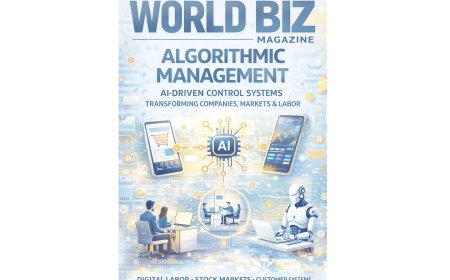







































































































































Algorithmic Management: Risks, Governance & the Future of AI-Controlled Platforms
A deep analysis of AI-driven management systems, covering transparency risks, antitrust concerns, labor regulation, and financial market stability through 2030.

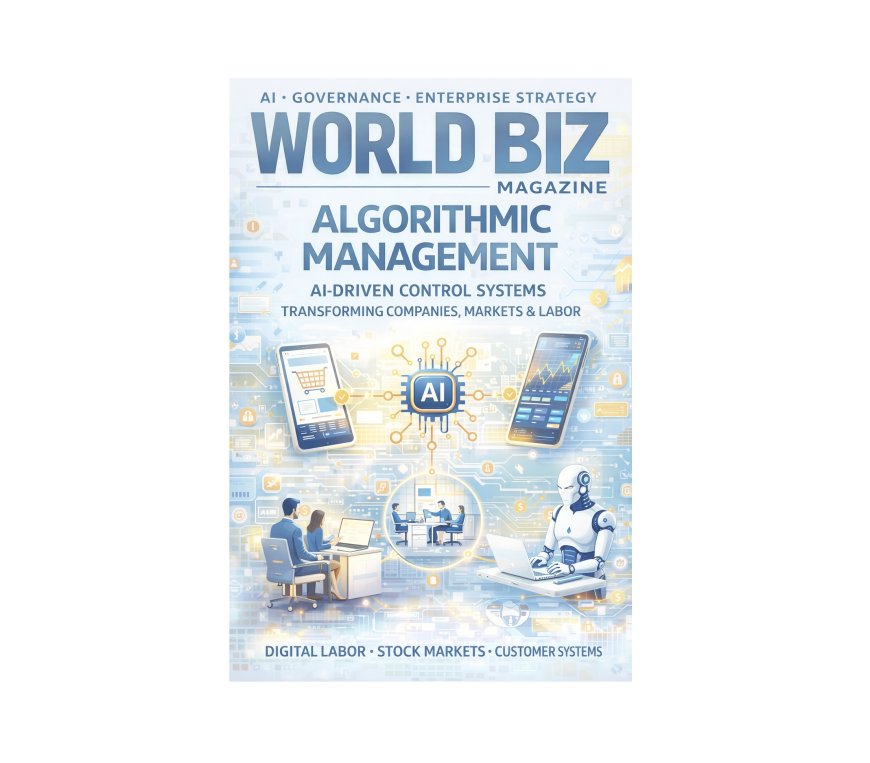
The Invisible Boss: How Algorithmic Management Is Reshaping Work, Markets, and Your Future
How AI-Driven Control Systems Are Redefining Digital Labor, Markets & Governance
World Biz Magazine | Technology • Strategy • Digital Policy
Imagine your manager. Now, imagine that manager never blinks. It never sleeps, never takes a vacation, and never forgets a single mistake you made. It monitors your every move, sets your pay in real-time based on a formula you can't see, and one day, without warning, it locks you out of your workplace forever. You try to appeal, but there is no human to talk to only an automated email address that never replies.
This isn't a sci-fi dystopia. For millions of people around the world drivers, delivery workers, freelancers, and even some office employees this is just another Tuesday. Their boss isn't a person. It's an algorithm.
Welcome to the age of Algorithmic Management. It’s the invisible infrastructure running the modern platform economy, and it’s spreading far beyond gig work into the very heart of our financial systems, corporate boardrooms, and social lives. This is the story of how software became management, and what that means for all of us.
What Is Algorithmic Management? The Architecture of Control
At its core, algorithmic management is deceptively simple: it’s the use of automated systems powered by data and artificial intelligence to perform the functions traditionally handled by human managers. It’s management by software architecture.
Think of a traditional factory floor. You had a foreman walking the line, watching workers, checking output, and assigning tasks. Now, imagine that foreman digitized, scaled to millions of workers across continents, operating 24/7, and making decisions in milliseconds. That’s the power, and the peril, of algorithmic management.
These systems aren't just one thing. They are a layered stack of digital authority:
- The Data Collection Layer: This is the all-seeing eye. It tracks everything. For a driver, it’s location, speed, route adherence, acceptance rate, and customer ratings. For a freelancer, it’s response time, project completion rate, and client feedback. For a social media creator, it’s engagement, shares, and watch time. Every click, every swipe, every pause is data.
- The Decision Engine: This is the brain. Machine learning models ingest the firehose of data and make instant, automated decisions. Who gets the next ride order? What price should the customer pay? Which seller wins the valuable "Buy Box" on an e-commerce site? Whose video gets shown to millions, and whose gets buried?
- The Enforcement Layer: This is the hand. It doesn't just decide; it acts. It sends a warning to a driver for a late arrival. It temporarily suspends a seller with too many returns. It permanently deactivates the account of a creator who violated a vague community guideline. It holds a freelancer's payment because a risk flag was triggered.
- The Feedback Loop: The system learns from every action it takes. A deactivation here, a price hike there all of it is fed back into the model to make it "smarter," more efficient, and, ideally, more profitable.
This architecture is the secret sauce that allows platforms like Uber, Amazon, and Upwork to scale to global dominance without needing an army of human managers. It’s a breathtaking feat of engineering. But it’s also a profound shift in the nature of power.
The Digital Plant Floor - Where Algorithms Run the Show
Algorithmic management isn't a futuristic concept; it’s the operational reality of the modern digital economy. Let’s take a tour of the sectors it now governs.
The Gig Economy: The Original Algorithmic Workplace
This is where the public first met their invisible boss. Ride-hailing and food delivery apps are the purest form of algorithmic management.
- Task Allocation: The algorithm decides which driver gets a ride request, often based on proximity but also on factors the driver can't see, like their acceptance rate or historical performance.
- Dynamic Pricing: The system constantly analyzes supply and demand, triggering "surge pricing" to lure more drivers to busy areas. Your fare isn't set by the company; it's set by a real-time algorithm.
- Performance Evaluation: Drivers are scored on customer ratings, cancellation rates, and trip acceptance. Fall below a certain threshold, and the algorithm may limit your access to the platform or, in the worst case, deactivate you permanently. There is no HR department to plead your case.
E-Commerce Marketplaces: The Invisible Merchandiser
On platforms like Amazon or Alibaba, sellers are at the mercy of an algorithmic gatekeeper.
- Visibility & Ranking: The "Buy Box" that coveted spot that leads to most sales is awarded by an algorithm. It considers price, shipping speed, seller rating, and inventory levels. Win the algorithm, win the sale. Lose it, and your products vanish into the digital abyss.
- Performance Scoring: Sellers are constantly monitored for defect rates, cancellation rates, and shipping time. A few bad reviews can trigger an algorithmic suspension, wiping out a small business's livelihood overnight.
- Pricing Pressure: Algorithms monitor competitor pricing in real-time, forcing sellers into automated price wars to stay visible.
Social Media: The Curator-in-Chief
For creators, the algorithm is the audience.
- Reach & Monetization: An algorithm decides which videos go viral and which ones get zero views. It determines who is eligible for monetization and demonetizes content based on rules it enforces inconsistently.
- Content Moderation: Billions of posts are flagged, reviewed, and removed by AI, often with little human oversight. Creators can lose their accounts and their income with a vague notification: "This content violated our guidelines." No explanation. No appeal.
Freelance Platforms: The Reputation Algorithm
On platforms like Upwork or Fiverr, your professional life is reduced to a data point.
- Job Matching: Algorithms match freelancers with projects based on their profiles, but also on opaque "job success scores" calculated from client feedback and contract history.
- Payment & Trust: The system holds funds in escrow and uses algorithms to detect risky behavior, sometimes freezing payments to freelancers based on a false positive.
The Algorithmic Manager - A Tale of Two Perspectives
Like any powerful tool, algorithmic management looks very different depending on where you stand.
To the Platform, It’s a Miracle of Efficiency.
For a CEO and their shareholders, this is the ultimate business model.
- Unprecedented Scale: You can manage a global workforce of millions without a proportional explosion in HR staff.
- Radical Cost Efficiency: You automate supervision, performance review, and even firing. The cost of managing a worker trends toward zero.
- Dynamic Optimization: Prices, routes, and incentives are optimized in real-time, squeezing every last drop of margin out of every single transaction.
- Consistent Enforcement: Rules are applied uniformly across the globe. There’s no manager playing favorites. The code is the law.
To the Worker, It’s an Opaque, Unfeeling Tyrant.
But flip the coin, and you see the human cost of this efficiency. This is where the narrative gets complicated and deeply emotional.
- Algorithmic Opacity: This is the core complaint. Workers are managed by a system they cannot see, understand, or predict. Why did that order go to the other driver? Why was my account suspended? Why did my pay for that trip drop by 20%? The answer is always the same: "Based on algorithmic factors." It’s a black box.
- Sudden Deactivation: The ultimate sword of Damocles. A driver who has completed 10,000 trips with a 4.9-star rating can be deactivated based on a single, unverified accusation from a passenger. Their income, their livelihood, vanishes in an instant, with no recourse. This creates a constant state of anxiety and powerlessness.
- Digital Surveillance: Knowing that every second of your workday is being tracked, measured, and judged creates immense psychological pressure. It’s the panopticon brought to life. Workers start to game the system, not to be more productive, but to appease the algorithm.
- Income Volatility: Dynamic pricing sounds efficient, but for the worker, it means income is a chaotic, unpredictable rollercoaster, subject to forces far beyond their control.
This tension between corporate efficiency and human dignity is the central conflict of the algorithmic age.
The impact of algorithmic management, however, doesn't stop with gig workers. It cascades through the entire economy, creating different risk profiles in different sectors. To truly understand the stakes, we have to look at the big picture.
World Biz Magazine Risk Matrix: Algorithmic Management Across Sectors
|
Risk Category |
Customer-Facing Algorithms (e.g., Social Media, Retail) |
Financial Algorithms (e.g., High-Frequency Trading) |
Corporate Ops Algorithms (e.g., Supply Chain) |
Workforce Algorithms (e.g., Gig Economy) |
|
Primary Goal |
Personalization & Engagement |
Speed & Arbitrage |
Cost Optimization |
Task Control & Standardization |
|
The Human Cost |
Manipulation, loss of autonomy |
Systemic instability, job loss |
Brittle systems, strategic blindness |
Income insecurity, powerlessness, anxiety |
|
Transparency Risk |
You don't know why you see what you see. |
The strategy is a closely guarded secret. |
Internal decisions are opaque to outsiders. |
Workers are blind to their own evaluation. |
|
Regulatory Risk |
Consumer protection, privacy laws (GDPR). |
Securities fraud, market manipulation. |
Corporate governance, competition law. |
Labor law, worker classification, "right to explain." |
|
Bias Risk |
Algorithmic exclusion, predatory pricing. |
Can amplify existing market inequalities. |
Can embed bias in resource allocation. |
Rating bias can penalize based on location or demographics. |
|
Systemic Risk |
Erosion of public trust in information. |
Flash crashes, market contagion. |
Supply chain collapse from over-optimization. |
Social unrest, instability of the gig workforce. |
|
The Core Question |
Are we being served or manipulated? |
Is the market stable or just fast? |
Are we efficient or just fragile? |
Is this flexibility or exploitation? |
The Financial Sector: The Highest Stakes
While gig workers face daily precarity, the highest systemic risk lies in financial algorithms. High-frequency trading (HFT) algorithms can execute millions of orders in a second. They provide liquidity, but they can also trigger "flash crashes" that wipe out billions in value in minutes. When these algorithms interact, they can create feedback loops that no human can stop in time. The risk here isn't to an individual worker's income; it's to the stability of the entire global financial system. Regulators are in a perpetual game of catch-up, trying to understand "black-box" trading strategies that even their creators may not fully comprehend.
The Regulatory Reckoning - Fighting the Black Box
For years, platforms argued that they were just tech companies providing a neutral service. That argument is crumbling. As algorithmic management has tightened its grip, governments are finally starting to push back.
The central conflict is the fight for transparency. Regulators are demanding to know what’s inside the black box.
- The Right to Explanation: In the EU, the General Data Protection Regulation (GDPR) hinted at a right not to be subject to a solely automated decision. Now, the upcoming EU AI Act goes further, classifying many algorithmic management systems as "high-risk" and mandating human oversight, documentation, and transparency. A worker must have the right to know why a decision was made and to challenge it.
- Algorithm Audits: We are seeing the emergence of a new profession: the algorithm auditor. Regulators and even platforms themselves are starting to mandate independent audits to check for bias, fairness, and compliance.
- Worker Classification: The biggest political battle is over the very nature of the worker. If an algorithm dictates your schedule, monitors your performance, and can fire you, are you really an "independent contractor"? Governments in California, Spain, and the UK are increasingly saying no, pushing to reclassify gig workers as employees entitled to benefits, minimum wage, and collective bargaining rights.
The platforms argue this will destroy the flexibility of the gig economy. Labor advocates argue that flexibility without security is just a fancy word for precarity.
The Future Trajectory to 2030 - The Race for Accountability
As we look toward the end of the decade, several trends are clear. Algorithmic management will only become more pervasive, but the debate over its governance will intensify.
- The Rise of Hybrid Governance: The era of pure, unchecked algorithmic authority is ending. The future will be hybrid. We will see the rise of "human-in-the-loop" systems for high-stakes decisions like account deactivation. Human review panels, composed of both platform representatives and independent experts, may become a standard appeal mechanism.
- Explainability as a Competitive Advantage: In a regulated world, the platforms that can explain their algorithms will win. "Explainable AI" (XAI) is becoming a hot field. Companies will compete not just on the power of their algorithms, but on their ability to demonstrate that they are fair, transparent, and accountable. Algorithmic fairness could become the new brand loyalty.
- Worker Data Rights: Just as consumers gained rights over their data, workers will too. Expect to see new laws giving workers ownership over the performance data they generate, and the right to take it with them if they leave a platform. This "data portability" could level the playing field.
- The Audit Society: By 2030, a regular "algorithm audit" could be as common as a financial audit for large platforms. Certifying that your AI is free from bias and complies with regulations will be a prerequisite for doing business in many markets.
Strategic Recommendations for Enterprises
Organizations deploying algorithmic management systems should:
- Establish AI ethics committees
- Implement human-in-the-loop decision layers
- Conduct bias audits regularly
- Create transparent appeal mechanisms
- Monitor regulatory changes globally
- Maintain algorithm kill-switch controls
- Invest in cybersecurity resilience
2030 Outlook
By 2030:
- Algorithmic management will dominate enterprise coordination.
- AI governance compliance will become a competitive differentiator.
- Transparent algorithm certification may influence investor ratings.
- Cross-border AI regulation will intensify.
- Hybrid algorithm-human management structures will prevail.
The key competitive edge will not merely be smarter algorithms but more accountable ones.
Algorithmic management is more than a piece of software. It is a mirror reflecting our collective choices about efficiency, fairness, and power. It offers us a world of seamless convenience, global scale, and optimized markets. But it also threatens to create a two-tiered society: a small group of humans who design and own the algorithms, and a vast population managed by them, subject to rules they cannot see and decisions they cannot appeal.
The question for the next decade isn't whether we will use algorithms to manage work and markets. We will. The question is how. Will we accept the algorithm as an unaccountable, invisible boss? Or will we demand a new social contract one that harnesses the power of automation while protecting the dignity, rights, and agency of the humans it was built to serve?
The architecture of our digital future is being written in code right now. The challenge is to ensure that somewhere in that code, there’s a place for the human heart.
What's Your Reaction?
 Like
0
Like
0
 Dislike
0
Dislike
0
 Love
0
Love
0
 Funny
0
Funny
0
 Angry
0
Angry
0
 Sad
0
Sad
0
 Wow
0
Wow
0