
































































































































Global Investment Cycles Explained: How Capital Flows Shape Economic Growth
A detailed guide to global investment cycles, including expansion, peak, contraction, and recovery phases shaping global finance.

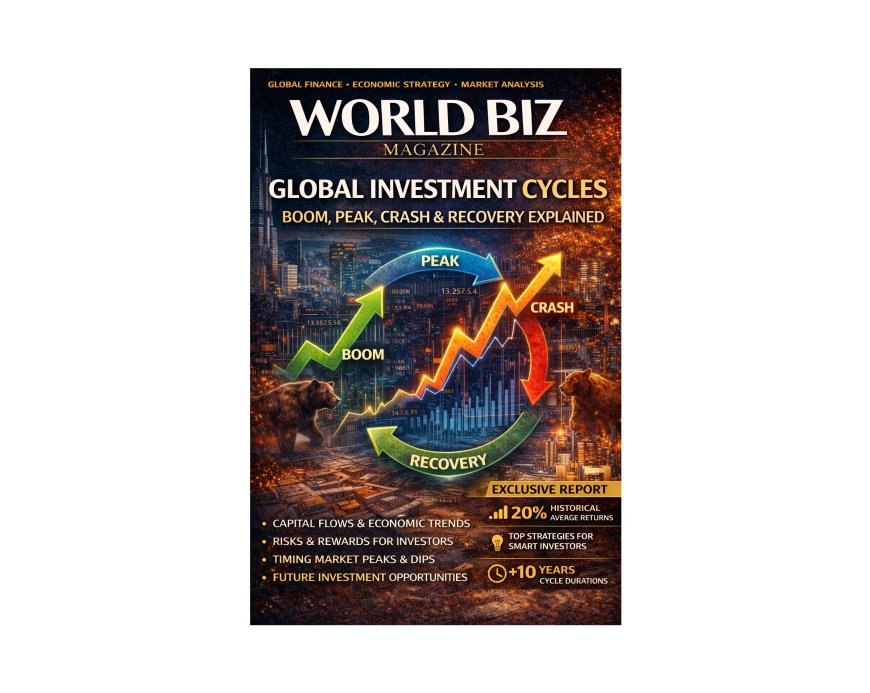
Global Investment Cycles: Understanding the Rhythms of Capital, Growth, and Economic Transformation
World Biz Magazine | Global Finance, Investment Strategy & Economic Intelligence Report
The Cyclical Nature of Global Investment
Global investment does not move in a straight line it follows cycles shaped by economic conditions, policy decisions, technological innovation, and investor sentiment. These investment cycles influence everything from stock markets and real estate to infrastructure development and venture capital.
Periods of rapid expansion are often followed by corrections or slowdowns, creating a dynamic pattern of boom, peak, contraction, and recovery.
Understanding these cycles is essential for governments, investors, and businesses aiming to maximize returns and manage risks.
What Are Global Investment Cycles?
Global investment cycles refer to the recurring patterns of expansion and contraction in investment activity across economies and markets.
These cycles are driven by:
- Interest rates
- Economic growth
- Market confidence
- Technological shifts
In simple terms: Investment cycles reflect how and when capital flows into and out of markets over time
The Four Phases of Investment Cycles
1. Expansion Phase (Growth Cycle)
Characteristics:
- Rising investment levels
- Strong economic growth
- Increasing corporate profits
Drivers:
- Low interest rates
- High investor confidence
This phase fuels rapid economic expansion
2. Peak Phase (Market Saturation)
Characteristics:
- Maximum investment levels
- Overvaluation risks
- Rising inflation
Warning Signs:
- Asset bubbles
- Tightening monetary policy
The market becomes overheated and vulnerable
3. Contraction Phase (Downturn)
Characteristics:
- Declining investments
- Reduced economic activity
- Falling asset prices
Causes:
- Interest rate hikes
- Financial shocks
This phase leads to market correction and risk reduction
4. Recovery Phase (Rebound)
Characteristics:
- Gradual increase in investment
- Stabilizing markets
- Renewed confidence
Sets the stage for the next growth cycle
Types of Investment Cycles
Business Cycles
- Linked to overall economic activity
Financial Market Cycles
- Driven by stock and bond markets
Real Estate Cycles
- Influenced by property demand and credit
Commodity Cycles
- Driven by supply-demand dynamics
Each cycle interacts with others, creating complex global patterns
Key Drivers of Global Investment Cycles
Interest Rates
Lower rates encourage borrowing and investment.
Economic Growth
Strong GDP growth attracts capital inflows.
Government Policy
Fiscal and monetary policies shape investment environments.
Technological Innovation
New technologies create investment opportunities.
Geopolitical Stability
Stable regions attract long-term investment.
Sectoral Impact of Investment Cycles
Technology
- Booms during innovation waves
- High volatility
Real Estate
- Cyclical with credit availability
Energy
- Linked to commodity prices
Manufacturing
- Driven by global demand
Each sector responds differently to cycle phases
Risks in Investment Cycles
|
Risk |
Impact |
Mitigation |
|
Asset bubbles |
Market crashes |
Diversification |
|
Overinvestment |
Inefficiency |
Strategic planning |
|
Sudden downturns |
Financial losses |
Risk management |
|
Policy shifts |
Market uncertainty |
Adaptive strategies |
Global Investment Cycles in Emerging Markets
Emerging economies:
- Experience stronger growth cycles
- Face higher volatility
Opportunity + risk coexist
Historical Examples of Investment Cycles
- Dot-com boom and bust (2000)
- Global financial crisis (2008)
- Post-pandemic recovery (2020–2022)
History shows cycles are inevitable and recurring
Future Trends in Global Investment Cycles
- Rise of AI and digital economy investments
- Green energy transition cycles
- Regional investment hubs
- Increased market interconnectedness
Future cycles will be technology and sustainability-driven
World Biz Magazine Insights
Cycles Are Becoming Shorter and More Intense
Technology accelerates market movements.
Smart Capital Follows Early Signals
Successful investors anticipate cycle shifts.
Innovation Drives New Investment Waves
AI, fintech, and green energy will lead future cycles.
Global Competition for Capital is Increasing
Countries compete to attract investment during growth phases.
Diversification is the Ultimate Strategy
Balancing investments across sectors and regions reduces risk.
Conclusion
Global investment cycles are the heartbeat of the world economy, shaping growth, innovation, and financial stability.
While cycles bring opportunities during expansion, they also introduce risks during downturns.
The key to success lies in:
- Understanding cycle dynamics
- Timing investments strategically
- Building resilience against volatility
In a rapidly evolving global economy, those who master investment cycles will not only survive market fluctuations they will lead the next wave of economic transformation.
Disclaimer
This article is published by World Biz Magazine for informational and analytical purposes only.
- Economic trends, cycle patterns, and projections are based on current data and may vary due to market conditions and geopolitical developments.
- This content does not constitute financial or investment advice.
- Readers are advised to conduct independent research and consult professionals before making investment decisions.
What's Your Reaction?
 Like
0
Like
0
 Dislike
0
Dislike
0
 Love
0
Love
0
 Funny
0
Funny
0
 Angry
0
Angry
0
 Sad
0
Sad
0
 Wow
0
Wow
0