














































































































































































Portfolio Investment vs FDI: Understanding Global Capital Flows
A World Biz Magazine analysis of FDI vs portfolio investment, examining global capital flows, economic development, and investment trends.

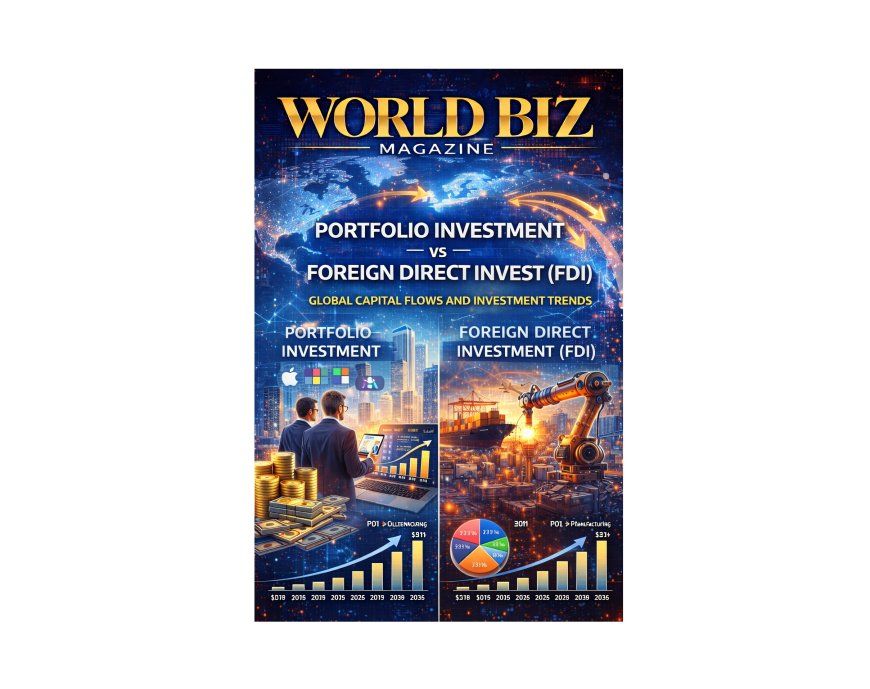
Portfolio Investment vs Foreign Direct Investment (FDI)
Understanding Global Capital Flows and Their Impact on Economic Development
World Biz Magazine | Global Economy & Investment Special Report
International capital flows play a central role in shaping the modern global economy. Countries rely on foreign investment to stimulate economic growth, support industrial development, finance infrastructure, and expand technological innovation. Two major forms of international capital investment dominate global financial markets: Foreign Direct Investment (FDI) and Portfolio Investment.
While both involve cross-border investment flows, they differ significantly in purpose, structure, risk profile, and long-term economic impact. Governments, policymakers, and multinational corporations closely monitor the balance between these investment types because each influences financial stability, economic growth, and international trade differently.
This World Biz Magazine Industry Today report explores the differences between portfolio investment and FDI, examining global trends, investor behavior, economic implications, policy considerations, and the future outlook for international capital flows through 2035.
Understanding Foreign Direct Investment (FDI)
Foreign Direct Investment refers to long-term investments made by companies or investors into business operations located in another country.
Unlike financial market investments, FDI typically involves direct ownership or significant influence over a foreign enterprise.
Common Forms of FDI
Greenfield Investments
Building new factories, offices, or facilities in foreign markets.
Mergers and Acquisitions
Purchasing existing companies or assets abroad.
Joint Ventures
Partnerships between foreign investors and local businesses.
FDI often involves technology transfer, employment creation, and infrastructure development.
Understanding Portfolio Investment
Portfolio investment refers to financial investments made in foreign securities such as stocks, bonds, and financial assets without gaining managerial control over the companies involved.
Portfolio investors aim to generate financial returns rather than participate directly in business operations.
Common Portfolio Investment Instruments
· equity stocks
· government bonds
· corporate bonds
· mutual funds
· exchange-traded funds (ETFs)
These investments are typically more liquid and can move quickly between markets.
Key Differences Between FDI and Portfolio Investment
|
Factor |
Foreign Direct Investment |
Portfolio Investment |
|
Ownership |
Significant ownership or control |
No direct control |
|
Investment Horizon |
Long-term |
Short to medium term |
|
Capital Mobility |
Relatively stable |
Highly mobile |
|
Economic Impact |
High |
Moderate |
|
Risk Exposure |
Lower volatility |
Higher volatility |
While FDI provides long-term economic benefits, portfolio investment contributes to financial market liquidity
Global Investment Market Overview
International capital flows have expanded dramatically in recent decades.
Global Investment Flows
|
Year |
Global FDI |
Portfolio Investment |
|
2015 |
$1.9T |
$1.5T |
|
2020 |
$1.0T |
$2.0T |
|
2024 |
$1.5T |
$2.3T |
|
2035 Forecast |
$2.5T+ |
$3T+ |
Portfolio investment flows tend to fluctuate more rapidly due to market volatility and interest rate changes.
Economic Impact of Foreign Direct Investment
FDI contributes significantly to long-term economic development.
Key Benefits
· job creation
· industrial development
· technology transfer
· export growth
· infrastructure expansion
Many emerging economies depend heavily on foreign direct investment to strengthen their manufacturing sectors.
Economic Role of Portfolio Investment
Portfolio investment plays a crucial role in global financial markets.
Key Contributions
· capital market liquidity
· access to international capital
· financial market development
· diversification opportunities for investors
However, sudden capital outflows can sometimes destabilize emerging markets.
Countries Attracting FDI
Several countries remain major destinations for foreign direct investment.
Top FDI Destinations
|
Country |
Key Investment Sector |
|
United States |
technology and finance |
|
China |
manufacturing |
|
India |
digital economy |
|
Singapore |
financial services |
|
Germany |
industrial manufacturing |
These economies offer strong infrastructure and favorable investment environments.
Global Portfolio Investment Hubs
Portfolio investment often flows toward countries with large financial markets.
Major Financial Investment Centers
· United States
· United Kingdom
· Japan
· Switzerland
· Hong Kong
These markets host major stock exchanges and global financial institutions.
Policy Influence on Capital Flows
Government policies significantly influence both types of investment.
Key Policy Factors
· tax regulations
· foreign ownership restrictions
· financial market regulations
· trade policies
· political stability
Countries that maintain transparent financial systems tend to attract more foreign investment.
Geopolitical Influence on Investment
Global investment patterns increasingly reflect geopolitical developments.
Major Influences
· trade tensions
· economic sanctions
· regional conflicts
· supply chain restructuring
These factors can redirect investment flows toward politically stable regions.
Sectoral Investment Trends
Both FDI and portfolio investment are concentrated in certain industries.
Major Investment Sectors
|
Sector |
FDI Strength |
Portfolio Investment |
|
Technology |
very strong |
strong |
|
Manufacturing |
very strong |
moderate |
|
Energy |
strong |
moderate |
|
Finance |
moderate |
very strong |
Technology companies attract large volumes of both direct and portfolio investment.
Emerging Investment Destinations
Several emerging economies are attracting increasing investment flows.
Fast-Growing Markets
· Vietnam
· Indonesia
· Mexico
· Saudi Arabia
· United Arab Emirates
These economies benefit from strong economic growth and strategic geographic locations.
Countries Losing Investment Momentum
Some countries face declining capital inflows due to political or economic risks.
Declining Investment Markets
· Russia due to sanctions
· unstable economies experiencing inflation crises
· regions affected by geopolitical conflicts
Investment stability is closely linked to political and economic conditions.
FDI vs Portfolio Investment Comparison
Investment Comparison Overview
|
Factor |
Foreign Direct Investment (FDI) |
Portfolio Investment |
|
Ownership |
Direct ownership or control of foreign business |
No control over company |
|
Investment Horizon |
Long-term strategic investment |
Short to medium-term |
|
Capital Mobility |
Relatively stable |
Highly mobile |
|
Economic Impact |
Strong industrial impact |
Financial market liquidity |
|
Risk Exposure |
Lower volatility |
Higher market volatility |
|
Typical Investors |
Multinational corporations |
Institutional investors |
Insight:
FDI builds long-term industrial capacity, while portfolio investment drives financial market liquidity and capital market development.
Global Capital Flow Trends (2015-2035)
Estimated Global Investment Flows
|
Year |
FDI |
Portfolio Investment |
|
2015 |
$1.9T |
$1.5T |
|
2018 |
$1.6T |
$1.8T |
|
2020 |
$1.0T |
$2.0T |
|
2023 |
$1.4T |
$2.2T |
|
2025 |
$1.6T |
$2.3T |
|
2030 Forecast |
$2.1T |
$2.7T |
|
2035 Forecast |
$2.5T+ |
$3T+ |
Key Trend:
Portfolio investment flows fluctuate more rapidly due to financial market conditions, while FDI tends to be more stable and long-term.
Sector Distribution of FDI vs Portfolio Investment
Global Investment Distribution by Sector
|
Sector |
FDI Share |
Portfolio Investment |
|
Manufacturing |
35% |
10% |
|
Services |
40% |
30% |
|
Technology |
15% |
20% |
|
Energy |
7% |
10% |
|
Financial Markets |
3% |
30% |
Insight:
FDI dominates industrial sectors such as manufacturing and infrastructure, while portfolio investment concentrates heavily in financial markets and technology companies.
Future Trends in Global Investment
Several trends will shape the future of international capital flows.
Digital Economy Investments
Artificial intelligence, data centers, and semiconductor manufacturing are attracting significant capital.
Renewable Energy Projects
Global energy transition is driving investment into renewable infrastructure.
Financial Market Integration
Global capital markets are becoming increasingly interconnected.
Global Investment Outlook to 2035
Key Growth Drivers
1. global digital transformation
2. emerging market expansion
3. renewable energy investments
4. infrastructure development
5. financial market innovation
Investment Forecast
|
Investment Type |
2035 Outlook |
|
Foreign Direct Investment |
$2.5T+ |
|
Portfolio Investment |
$3T+ |
Both forms of investment will remain essential components of the global economic system.
World Biz Magazine Insights
Foreign Direct Investment and Portfolio Investment represent two complementary forces within global capital markets. While FDI builds long-term economic foundations through infrastructure, manufacturing, and technology investments, portfolio investment supports financial market liquidity and international capital mobility.
Countries that balance these two investment channels effectively can achieve sustainable economic growth while maintaining financial stability.
Conclusion
Understanding the distinction between Foreign Direct Investment and Portfolio Investment is essential for policymakers, investors, and business leaders navigating the global economy. Each investment type plays a unique role in shaping economic development, financial markets, and international trade.
As global capital flows continue evolving, countries that create stable regulatory environments and open financial markets will remain attractive destinations for international investment.
Disclaimer
The information presented in this article is intended for informational and educational purposes only. Market statistics, projections, and forecasts are based on publicly available industry data and analytical estimates at the time of publication. While every effort has been made to ensure accuracy, World Biz Magazine does not guarantee future market performance or investment outcomes. Readers should consult professional advisors before making financial or strategic decisions based on the information contained in this report. All trademarks and company names mentioned belong to their respective owners.
What's Your Reaction?
 Like
0
Like
0
 Dislike
0
Dislike
0
 Love
0
Love
0
 Funny
0
Funny
0
 Angry
0
Angry
0
 Sad
0
Sad
0
 Wow
0
Wow
0