































































































































































Why Mergers & Acquisitions Matter: Corporate Strategy, Risks, and Opportunities
Key reasons behind M&A deals, from market expansion to innovation and competitive advantage in global markets


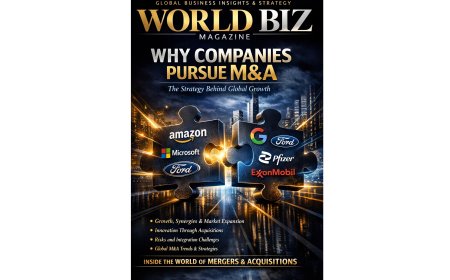
Why Companies Pursue M&A
Strategic Motives, Value Creation, and the Global Race for Growth
World Biz Magazine | Industry Today Special Report
Delivering global insights on the trends shaping tomorrow’s economy.
M&A as a Catalyst for Corporate Evolution
In today’s hyper-competitive global economy, companies are under constant pressure to grow faster, innovate smarter, and scale efficiently. Organic growth alone is often too slow to meet these demands. As a result, mergers and acquisitions (M&A) have become a central strategy for corporations seeking rapid expansion and competitive advantage.
From tech giants acquiring startups to industrial conglomerates consolidating markets, M&A activity reflects a broader reality:
growth is no longer just built it is bought.
Understanding why companies pursue M&A provides critical insight into corporate strategy, market dynamics, and the future of global business.
Accelerating Growth Beyond Organic Limits
One of the primary reasons companies engage in M&A is to accelerate growth beyond what can be achieved organically.
Instead of spending years building new capabilities, companies can acquire:
- Established customer bases
- Proven products and services
- Existing revenue streams
Example: Facebook acquiring Instagram
Facebook’s acquisition of Instagram in 2012 allowed it to dominate mobile social media rapidly, bypassing years of internal development.
Achieving Synergies and Cost Efficiency
Synergies are often the financial backbone of M&A deals. These include:
- Cost savings (shared operations, reduced overhead)
- Revenue synergies (cross-selling, expanded markets)
Example: Disney acquiring 21st Century Fox
This deal created massive content and distribution synergies, strengthening Disney’s global media dominance.
Expanding Market Presence
M&A enables companies to enter new geographic markets or strengthen their position in existing ones.
Example: Walmart acquiring Flipkart
Walmart used this acquisition to gain a strong foothold in India’s rapidly growing e-commerce market.
Accessing Technology and Innovation
Innovation is a major driver of M&A, particularly in technology sectors. Instead of developing new technologies internally, companies often acquire startups.
Example: Google acquiring YouTube
This acquisition gave Google a dominant position in online video and digital advertising.
Diversification of Business Portfolio
Companies pursue M&A to reduce risk by diversifying into new industries or product lines.
Example: Amazon acquiring Whole Foods Market
Amazon expanded into physical retail and grocery, diversifying beyond its core online business.
Gaining Competitive Advantage
Acquiring competitors or complementary businesses helps companies:
- Increase market share
- Eliminate competition
- Strengthen pricing power
Example: Exxon merging with Mobil
This merger created one of the world’s largest energy companies, consolidating industry power.
Economies of Scale
Larger organizations benefit from:
- Lower production costs
- Stronger supplier bargaining power
- Improved operational efficiency
M&A enables companies to scale rapidly and compete more effectively on a global level.
Talent and Human Capital Acquisition
In knowledge-driven industries, acquiring talent is as valuable as acquiring assets.
Example: Microsoft acquiring LinkedIn
This deal not only expanded Microsoft’s platform ecosystem but also gave access to valuable professional data and talent networks.
Financial Engineering and Value Creation
Private equity firms and financial acquirers use M&A to:
- Restructure businesses
- Improve efficiency
- Increase valuation
This approach focuses on buying undervalued assets and enhancing their worth.
Responding to Market Disruption
In rapidly changing industries, M&A helps companies stay relevant.
- Adapting to digital transformation
- Entering emerging sectors
- Competing with new entrants
Companies that fail to adapt risk losing market share.
Risks Associated with M&A
Despite its advantages, M&A carries significant risks:
Integration Challenges
Merging systems, cultures, and operations can be complex.
Overvaluation
Paying too much for acquisitions reduces returns.
Cultural Clashes
Different corporate cultures can lead to conflicts.
Regulatory Hurdles
Large deals may face antitrust scrutiny.
Execution Risk
Failure to realize expected synergies.
Mitigation Strategies
- Conduct thorough due diligence
- Focus on cultural alignment
- Implement structured integration plans
- Maintain realistic valuation models
- Ensure strong leadership and governance
Global Trends in M&A Activity
- Rise of cross-border acquisitions
- Increased competition between strategic and financial buyers
- Growth in technology-driven deals
- Expansion into emerging markets
M&A is becoming more dynamic and globalized.
Future Outlook: M&A in 2035
AI-Driven Deal Making
Artificial intelligence will enhance deal sourcing and analysis.
ESG-Focused Acquisitions
Sustainability will influence strategic decisions.
Industry Convergence
Boundaries between industries will blur.
Increased Mega Deals
Larger, transformative acquisitions will shape industries.
Digital Transformation Acceleration
Technology-driven M&A will dominate.
Conclusion: Growth Through Strategic Transformation
M&A is more than a financial transaction it is a strategic transformation tool.
Companies pursue M&A to:
- Accelerate growth
- Innovate faster
- Expand globally
- Strengthen competitive positioning
In a rapidly evolving global economy, the ability to execute successful M&A strategies will define the winners of tomorrow.
Because in modern business,
the fastest path to growth is often through acquisition.
World Biz Magazine Insights
- M&A is a core strategy for global expansion
- Technology and innovation are key drivers
- Successful deals depend on execution and integration
- Future M&A will be shaped by AI, ESG, and global competition
Disclaimer
This article is for informational purposes only and does not constitute financial or investment advice. Readers should consult professional advisors before making decisions.
What's Your Reaction?
 Like
0
Like
0
 Dislike
0
Dislike
0
 Love
0
Love
0
 Funny
0
Funny
0
 Angry
0
Angry
0
 Sad
0
Sad
0
 Wow
0
Wow
0