









































































































































































































Open-Source vs Commercial Software: The Strategic Technology Debate Reshaping Enterprises
A complete guide to open-source vs commercial software with expert insights and global business implications

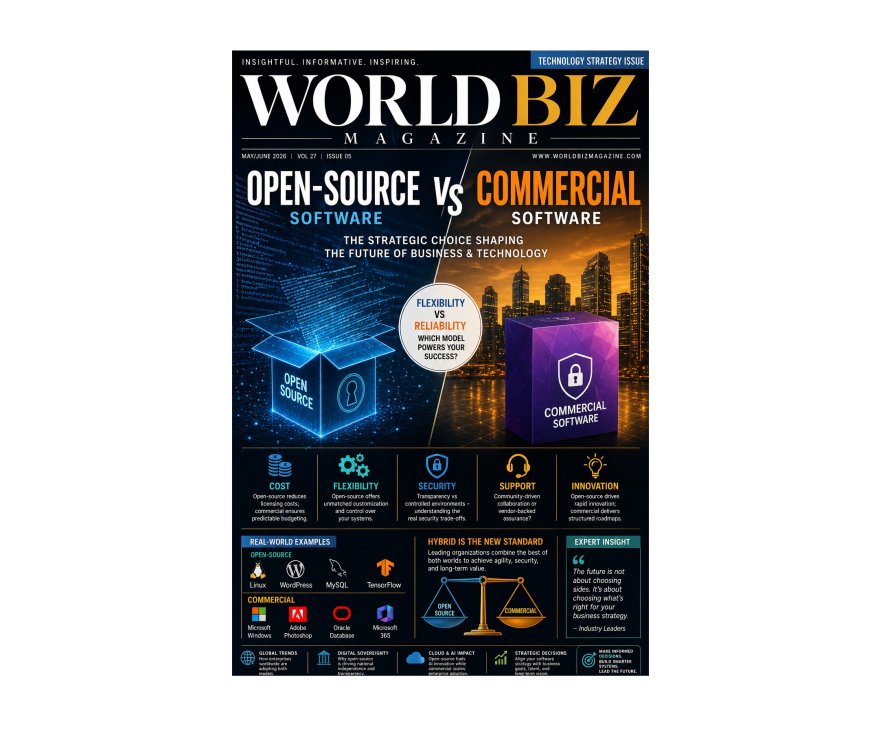
Open-Source vs Commercial Software
Strategic Choices in the Digital Economy
World Biz Magazine | Technology Strategy & Enterprise Systems
The debate between open-source and commercial software is no longer a purely technical discussion it is a strategic business decision. From startups building scalable platforms to governments deploying national digital infrastructure, the choice between these two models influences cost structures, innovation cycles, security posture, and long-term control.
This analysis explores both paradigms through a global business lens, supported by real-world examples and strategic insights.
Understanding the Two Models
Open-Source Software (OSS)
Open-source software is built on transparency and collaboration. Its source code is publicly available, allowing anyone to inspect, modify, and distribute it.
Prominent examples include:
- Linux (enterprise servers, cloud infrastructure)
- Apache HTTP Server (web hosting backbone)
- WordPress (over 40% of global websites)
These platforms are typically maintained by global developer communities or nonprofit foundations.
Commercial Software
Commercial software is proprietary, owned by companies that control licensing, updates, and distribution. Users pay for access, support, and premium features.
Leading examples include:
- Microsoft Windows
- Adobe Photoshop
- Oracle Database
These solutions are backed by dedicated support, structured development, and enterprise-grade service agreements.
Key Differences That Matter
Cost Structure
Open-source software is typically free to use, making it attractive for startups and developing economies. However, indirect costs such as customization, integration, and maintenance can accumulate.
Commercial software involves upfront licensing or subscription fees but often reduces internal technical overhead.
Example:
A startup may deploy WordPress at minimal cost, while a multinational enterprise might invest in Adobe Experience Manager for advanced scalability and support.
Flexibility and Customization
Open-source solutions offer unmatched flexibility. Organizations can modify the codebase to fit unique workflows.
Commercial software, while feature-rich, often restricts customization to predefined options.
Case Insight:
Tech companies like Google built their infrastructure on customized versions of Linux, enabling massive scalability.
Security and Transparency
Open-source advocates argue that transparency enhances security anyone can audit the code. However, it also means vulnerabilities are publicly visible.
Commercial vendors provide controlled environments, regular patches, and dedicated security teams.
Real-World Event:
The Log4Shell vulnerability in an open-source library highlighted both the risks and rapid global response capabilities of OSS communities.
Support and Accountability
Commercial software offers structured support, service-level agreements (SLAs), and accountability.
Open-source relies on community support unless paired with paid enterprise services.
Example:
Red Hat monetizes open-source by offering enterprise-grade support for Linux distributions.
Innovation Speed
Open-source ecosystems often innovate faster due to global collaboration.
Commercial software innovation is more controlled, driven by corporate roadmaps and profitability.
Example:
TensorFlow accelerated AI adoption globally by providing free, powerful tools.
Industry Use Cases
Startups & SMEs
Startups favor open-source due to cost efficiency and flexibility.
- Example Stack:
- Linux
- MySQL
- WordPress
This stack enables rapid product development with minimal capital.
Enterprises & Corporations
Large organizations often adopt hybrid models.
- Use open-source for infrastructure
- Use commercial tools for mission-critical operations
Example:
Banks may run servers on Linux while relying on Oracle Database for secure financial transactions.
Governments & Public Sector
Governments increasingly adopt open-source to reduce dependency on foreign vendors and enhance transparency.
Example:
Several EU nations promote open-source adoption for digital sovereignty.
Strategic Trade-Offs
|
Factor |
Open-Source |
Commercial |
|
Cost |
Low upfront |
High upfront |
|
Control |
High |
Limited |
|
Support |
Community-driven |
Vendor-backed |
|
Customization |
Extensive |
Restricted |
|
Security |
Transparent |
Controlled |
|
Scalability |
High (with expertise) |
High (managed) |
The Rise of Hybrid Models
Modern enterprises are moving toward hybrid strategies combining open-source flexibility with commercial reliability.
Example:
- Amazon Web Services offers managed services built on open-source technologies
- Microsoft integrates open-source tools within its ecosystem, including support for Linux on Azure
This convergence reflects a broader shift: the future is not “either/or,” but “best of both.”
Risks and Misconceptions
- “Open-source is always free” - False (hidden operational costs exist)
- “Commercial software is always secure” - False (security depends on implementation)
- “Open-source lacks professionalism” - Outdated perception
Future Outlook
The global software landscape is evolving toward openness, interoperability, and cloud-driven ecosystems. Open-source is becoming the backbone of innovation, while commercial platforms are adapting by embracing openness.
Artificial intelligence, cybersecurity, and cloud computing will further blur the boundaries between these models.
Conclusion
The choice between open-source and commercial software is not binary it is strategic.
- Open-source offers freedom, innovation, and cost efficiency
- Commercial software delivers reliability, support, and structured scalability
For modern organizations, the optimal approach lies in aligning software strategy with business goals, technical capabilities, and long-term vision.
World Biz Magazine Insights
Strategic Interpretation for Decision-Makers
The open-source vs commercial software debate is no longer about ideology it is about control versus convenience, speed versus structure, and independence versus accountability.
Open Source Is Powering the Digital Backbone
From cloud infrastructure to AI frameworks, open-source technologies like Linux and TensorFlow are now foundational to global innovation. Even the world’s largest tech companies rely heavily on open ecosystems to scale efficiently.
Insight: Open-source is not “alternative” anymore it is core infrastructure.
Commercial Software Is Evolving, Not Declining
Proprietary platforms such as Microsoft Windows and enterprise tools like Oracle Database continue to dominate mission-critical environments due to reliability, compliance, and structured support.
Insight: Commercial software remains essential for risk-managed environments, especially in finance, healthcare, and government sectors.
Hybrid Strategy Is the Real Winner
Organizations are increasingly blending both models leveraging open-source for flexibility and commercial platforms for stability.
Example:
Microsoft now actively supports Linux and open-source tools within its ecosystem, signaling a fundamental industry shift.
Insight: The future is not “open vs closed” it is integration-driven ecosystems.
Talent Is the Hidden Cost Driver
Open-source reduces licensing costs but increases dependency on skilled developers and DevOps teams. Commercial software shifts that burden to vendors.
Insight: The real question is not “Which is cheaper?” but “Where do you want the complexity to live?”
Digital Sovereignty Is Reshaping Choices
Governments and enterprises are adopting open-source to reduce dependency on foreign vendors and increase control over data.
Insight: Software decisions are becoming geopolitical and strategic, not just technical.
Disclaimer
Editorial Disclaimer:
This article is published by World Biz Magazine for informational and analytical purposes only. The content is based on industry research, publicly available data, and expert insights. It does not constitute financial, legal, or technical advisory.
Accuracy & Liability:
While every effort has been made to ensure accuracy, World Biz Magazine does not guarantee completeness or reliability. Readers are advised to conduct independent due diligence before making business or technology decisions.
Third-Party References:
All referenced software, companies, and technologies including Linux, Microsoft Windows, and Microsoft are the property of their respective owners and are mentioned for illustrative purposes only.
What's Your Reaction?
 Like
0
Like
0
 Dislike
0
Dislike
0
 Love
0
Love
0
 Funny
0
Funny
0
 Angry
0
Angry
0
 Sad
0
Sad
0
 Wow
0
Wow
0