


























































































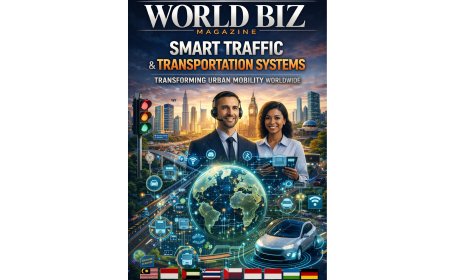



































































Urban Mobility & Smart Cities: Building the Future of Intelligent, Connected, and Sustainable Urban Living
A comprehensive guide to urban mobility and smart city development, covering transportation innovation, AI, sustainability, and future trends.

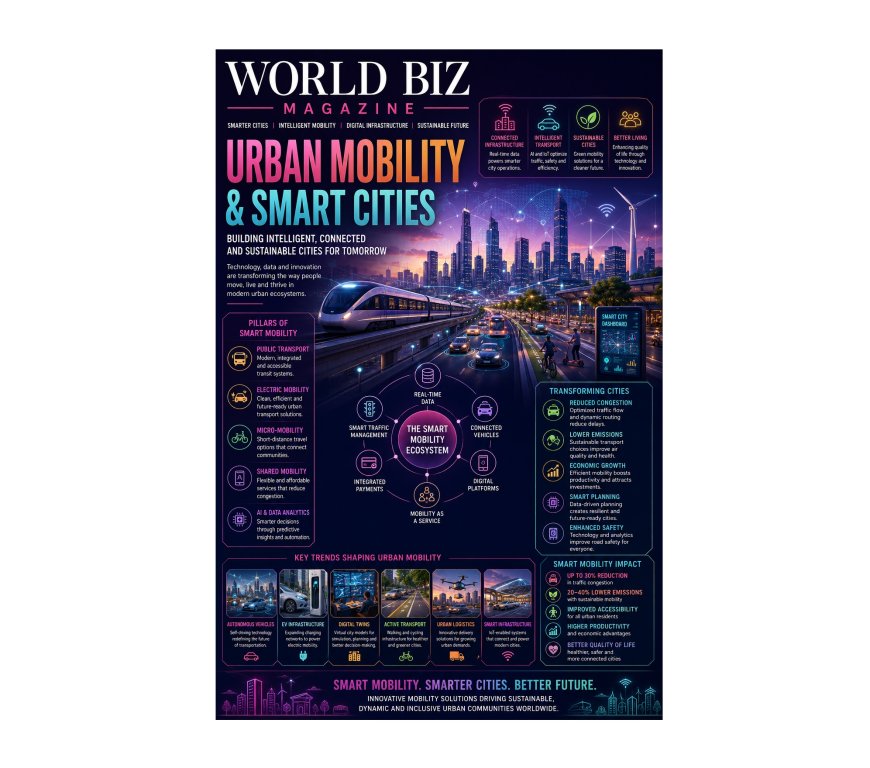
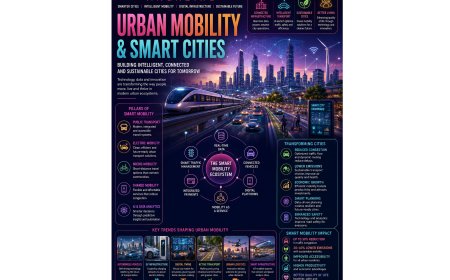
Urban Mobility & Smart Cities
How Intelligent Transportation Systems, Digital Infrastructure, and Sustainable Urban Planning Are Transforming the Future of Cities
World Biz Magazine | Infrastructure, Technology & Urban Development
The twenty-first century is increasingly being defined by urbanization. Cities around the world continue to grow at an unprecedented pace, becoming centers of economic activity, innovation, commerce, education, and social development. As urban populations expand, however, cities face mounting challenges related to transportation congestion, environmental sustainability, public services, infrastructure capacity, and quality of life. Addressing these challenges requires more than traditional urban planning approaches. It demands the integration of technology, data, sustainability, and intelligent infrastructure into the very fabric of urban environments.
This transformation has given rise to the concept of smart cities urban ecosystems that leverage digital technologies, connected infrastructure, artificial intelligence, data analytics, and innovative mobility solutions to improve efficiency, sustainability, and citizen well-being. At the heart of every smart city lies urban mobility, the systems and services that enable people and goods to move safely, efficiently, and sustainably throughout metropolitan areas.
Urban mobility is no longer limited to roads, buses, and trains. Modern mobility strategies incorporate electric vehicles, autonomous transportation, intelligent traffic management systems, shared mobility platforms, micro-mobility services, integrated public transit, and real-time data networks. Together, these innovations are reshaping how cities function and how residents interact with urban environments.
As governments, investors, technology providers, and urban planners invest billions of dollars into next-generation city infrastructure, urban mobility has emerged as one of the most critical pillars supporting the future development of smart cities worldwide.
Understanding Urban Mobility
Urban mobility refers to the movement of people and goods within urban environments.
It encompasses a wide range of transportation systems including:
- Public transportation
- Private vehicles
- Rail systems
- Ride-hailing services
- Cycling infrastructure
- Pedestrian networks
- Micro-mobility solutions
- Freight and logistics systems
The primary goal of urban mobility is to provide efficient, accessible, affordable, and sustainable transportation options for urban populations.
Effective mobility systems are essential for:
- Economic productivity
- Social inclusion
- Environmental sustainability
- Urban competitiveness
As cities grow larger and more complex, mobility planning becomes increasingly important.
What Defines a Smart City?
A smart city utilizes technology and data-driven solutions to improve urban operations and enhance quality of life.
Smart cities integrate:
- Digital infrastructure
- Connected devices
- Sensors
- Artificial intelligence
- Data analytics
- Cloud computing
- Communication networks
These technologies enable city leaders to make informed decisions while improving efficiency across multiple sectors.
Key smart city components include:
- Transportation
- Energy systems
- Water management
- Public safety
- Healthcare
- Waste management
- Environmental monitoring
Urban mobility serves as one of the most visible and impactful applications of smart city technology.
The Growing Importance of Urban Mobility
Urbanization continues accelerating worldwide.
As populations increase, cities face challenges such as:
- Traffic congestion
- Air pollution
- Infrastructure strain
- Longer commute times
- Increased energy consumption
Traditional transportation systems often struggle to accommodate growing demand.
Urban mobility solutions help address these challenges through:
- Improved transportation efficiency
- Better infrastructure utilization
- Reduced environmental impact
- Enhanced accessibility
Cities that successfully modernize mobility systems are often better positioned for long-term economic growth.
Intelligent Transportation Systems
Intelligent Transportation Systems (ITS) represent a cornerstone of smart mobility.
These systems use technology to improve transportation performance and safety.
Components include:
Smart Traffic Signals
Adaptive traffic management systems optimize traffic flow in real time.
Connected Vehicles
Vehicles communicate with infrastructure and other vehicles to improve safety and efficiency.
Traffic Monitoring Systems
Sensors and cameras provide continuous traffic data.
Dynamic Route Management
Real-time navigation systems reduce congestion and travel times.
ITS solutions help cities maximize existing infrastructure capacity without requiring major physical expansion.
Public Transportation in Smart Cities
Public transportation remains a critical component of urban mobility.
Modern smart cities are investing heavily in:
Metro Systems
High-capacity rail networks reduce congestion and support sustainable mobility.
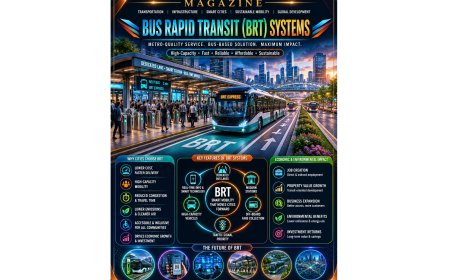
Bus Rapid Transit (BRT)
Dedicated corridors improve transit efficiency and reliability.
Light Rail Networks
Providing flexible transportation solutions within urban areas.
Integrated Ticketing Systems
Digital payment platforms simplify multi-modal travel.
Public transit investments improve accessibility while reducing dependence on private vehicles.
Electric Mobility Revolution
Electric vehicles (EVs) are playing an increasingly important role in urban transportation.
Benefits include:
- Reduced emissions
- Lower operating costs
- Improved air quality
- Reduced noise pollution
Governments and municipalities are supporting EV adoption through:
- Charging infrastructure
- Financial incentives
- Regulatory support
- Fleet electrification programs
Electric mobility is becoming a key component of sustainable urban development strategies.
Shared Mobility Services
The rise of digital platforms has transformed transportation access.
Shared mobility services include:
- Ride-hailing
- Car-sharing
- Bike-sharing
- Scooter-sharing
These services provide flexible alternatives to private vehicle ownership.
Benefits include:
- Reduced congestion
- Lower transportation costs
- Improved accessibility
- Better infrastructure utilization
Shared mobility continues evolving as technology platforms become more sophisticated
Micro-Mobility Solutions
Micro-mobility refers to small, lightweight transportation options designed for short-distance travel.
Examples include:
- E-scooters
- Bicycles
- Electric bicycles
- Personal mobility devices
These solutions help address first-mile and last-mile transportation challenges.
Micro-mobility contributes to:
- Reduced traffic congestion
- Lower emissions
- Improved urban accessibility
Many cities are incorporating dedicated infrastructure to support these services.
Artificial Intelligence and Urban Mobility
Artificial intelligence is increasingly shaping transportation systems.
Applications include:
Traffic Prediction
AI analyzes traffic patterns to optimize mobility.
Autonomous Vehicles
Self-driving technologies may transform future transportation networks.
Predictive Maintenance
Infrastructure and vehicle maintenance can be optimized using AI analytics.
Passenger Demand Forecasting
Transportation providers improve service planning through predictive insights.
AI is expected to become a major driver of mobility innovation.
Data-Driven Urban Planning
Smart cities rely heavily on data.
Urban mobility generates vast amounts of information through:
- Sensors
- GPS systems
- Mobile devices
- Connected infrastructure
Data analytics enables city planners to:
- Identify congestion patterns
- Optimize transportation networks
- Improve public services
- Support infrastructure investments
Data-driven decision-making improves operational efficiency and strategic planning.
Sustainability and Environmental Impact
Sustainability is a central objective of smart city development.
Transportation remains one of the largest contributors to urban emissions.
Smart mobility initiatives support environmental goals through:
- Public transit expansion
- Vehicle electrification
- Shared mobility adoption
- Active transportation infrastructure
Reducing transportation-related emissions is critical for achieving climate objectives.
Urban Freight and Logistics
Smart mobility extends beyond passenger transportation.
Urban logistics systems support:
- Retail distribution
- E-commerce delivery
- Industrial supply chains
Emerging solutions include:
- Smart logistics platforms
- Electric delivery vehicles
- Automated distribution systems
- Urban consolidation centers
Efficient logistics improve economic performance while reducing environmental impacts.
Challenges Facing Smart Mobility
Despite rapid progress, several challenges remain.
Infrastructure Investment Requirements
Smart mobility projects often require significant capital investment.
Cybersecurity Risks
Connected systems increase exposure to digital threats.
Regulatory Complexity
New technologies often require updated policy frameworks.
Public Adoption
Behavioral changes may take time.
Data Privacy Concerns
Protecting citizen information remains essential.
Successfully addressing these challenges is critical for long-term success.
Global Smart City Leaders
Several cities have emerged as leaders in smart mobility innovation.
Common characteristics include:
- Advanced public transportation systems
- Strong digital infrastructure
- Sustainability initiatives
- Technology partnerships
- Integrated urban planning
These cities often serve as models for future development worldwide.
The Future of Urban Mobility
Several trends are expected to shape future urban transportation systems.
These include:
- Autonomous vehicles
- AI-driven mobility platforms
- Smart infrastructure
- Electrified transportation
- Mobility-as-a-Service (MaaS)
- Digital twins
- Sustainable city planning
- Hyper-connected transportation ecosystems
The convergence of technology and infrastructure will continue transforming urban mobility.
World Biz Magazine Insights
Urban mobility is rapidly evolving from a transportation challenge into a strategic economic and technological opportunity. The world's most competitive cities are increasingly investing in integrated mobility ecosystems that combine public transportation, digital infrastructure, electric mobility, AI-powered systems, and sustainability initiatives. The future of urban development will depend not only on building smarter cities but also on creating mobility networks that are accessible, resilient, efficient, and capable of supporting growing populations while improving quality of life.
Conclusion
Urban mobility and smart cities are reshaping the future of how people live, work, travel, and interact within urban environments. As cities continue growing and infrastructure demands increase, intelligent transportation systems, data-driven planning, and sustainable mobility solutions will become increasingly important.
From electric vehicles and autonomous transportation to integrated public transit and AI-powered traffic management, innovation is transforming urban mobility at an unprecedented pace. These developments are not only improving transportation efficiency but also supporting broader economic, environmental, and social objectives.
As governments, technology providers, investors, and city planners collaborate to build the next generation of urban infrastructure, smart mobility will remain a foundational element of sustainable and prosperous cities worldwide.
Disclaimer
This article is published for informational, educational, and industry analysis purposes only and does not constitute investment, financial, legal, engineering, infrastructure, technology, transportation, or professional advice. Urban development priorities, regulations, technologies, and investment opportunities vary across regions and jurisdictions. Readers should consult qualified professionals before making infrastructure, investment, policy, or strategic decisions related to urban mobility or smart city development.
What's Your Reaction?
 Like
0
Like
0
 Dislike
0
Dislike
0
 Love
0
Love
0
 Funny
0
Funny
0
 Angry
0
Angry
0
 Sad
0
Sad
0
 Wow
0
Wow
0