






































































































































































































The Structure, Functions, and Importance of Global Financial Markets
Understand how financial markets drive economic growth, investment opportunities, liquidity, and wealth creation worldwide.

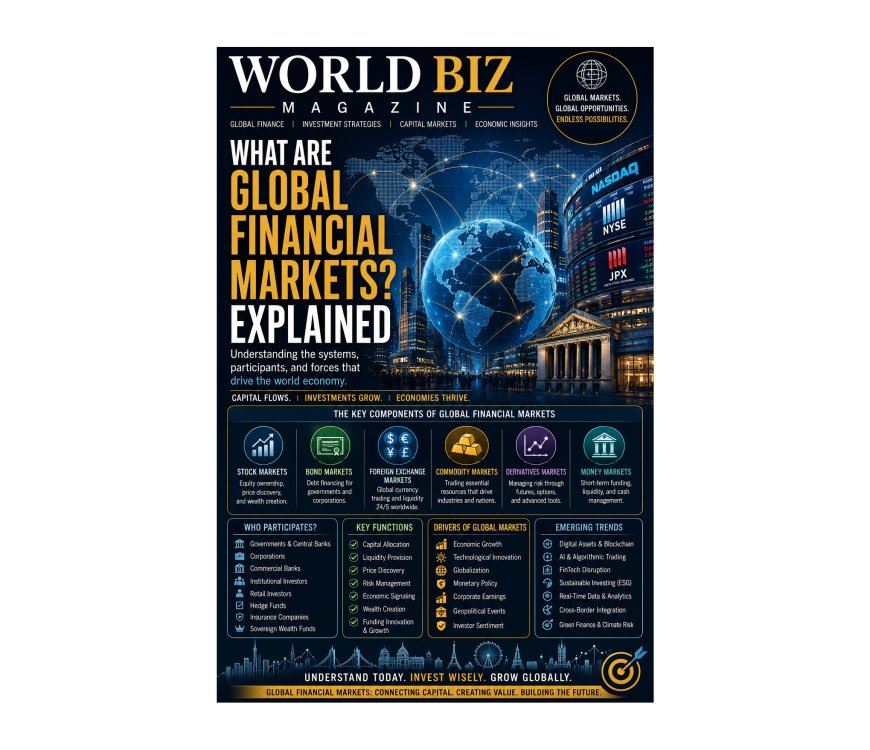
What Are Global Financial Markets? Explained
Understanding the World's Financial Ecosystem and Its Role in Economic Growth, Investment, and Wealth Creation
World Biz Magazine | Global Finance, Capital Markets & Investment Intelligence
Global financial markets form the backbone of the modern economy, connecting investors, businesses, governments, financial institutions, and consumers through a vast network of capital flows and financial transactions. Every day, trillions of dollars move across global markets as participants buy and sell stocks, bonds, currencies, commodities, derivatives, and other financial instruments. These markets serve as the primary mechanism through which capital is allocated, risks are managed, investments are financed, and economic growth is supported across nations.
The importance of global financial markets has increased dramatically over the past several decades. Advances in technology, globalization, financial innovation, and digital connectivity have transformed local financial systems into a highly interconnected international marketplace. Today, events occurring in one major economy can rapidly influence asset prices, investor sentiment, and economic conditions worldwide. Financial markets have become increasingly integrated, creating both opportunities and challenges for investors, policymakers, and businesses operating in a globalized environment.
At their core, financial markets facilitate the exchange of capital between those who need funding and those who have capital available to invest. Governments issue bonds to finance infrastructure and public services. Corporations raise funds to expand operations, develop products, and pursue growth opportunities. Investors allocate savings into financial assets with the expectation of generating returns. Banks, pension funds, insurance companies, sovereign wealth funds, and asset managers all participate in this ecosystem, contributing to market liquidity and economic development.
Understanding how global financial markets operate is essential for investors, business leaders, policymakers, and anyone seeking to comprehend the forces shaping economic activity in today's interconnected world.
Understanding Global Financial Markets
Global financial markets are systems and platforms where financial assets are bought, sold, traded, and exchanged between participants.
These markets enable the transfer of funds from investors and savers to entities seeking capital.
Participants include:
- Governments
- Corporations
- Banks
- Investment funds
- Insurance companies
- Institutional investors
- Retail investors
- Central banks
Financial markets perform a critical economic function by facilitating capital formation, price discovery, risk management, and liquidity.
Without efficient financial markets, economic growth and business expansion would be significantly constrained.
Why Financial Markets Matter
Financial markets influence nearly every aspect of economic activity.
They determine:
- Investment flows
- Interest rates
- Currency values
- Capital availability
- Business financing conditions
- Consumer confidence
Strong financial markets encourage investment, entrepreneurship, innovation, and economic development.
Conversely, disruptions within financial markets can contribute to economic instability, reduced lending activity, and financial crises.
Their role extends far beyond trading activities, affecting employment, wealth creation, and national prosperity.
The Primary Functions of Financial Markets
Global financial markets serve several essential functions.
Capital Allocation
Markets direct capital toward productive investments and economic opportunities.
Liquidity Creation
Investors can buy and sell assets efficiently without significantly affecting prices.
Price Discovery
Asset prices reflect market expectations, economic conditions, and investor sentiment.
Risk Transfer
Financial instruments allow participants to hedge and manage risks.
Economic Signaling
Markets provide valuable information about economic trends and future expectations.
Together, these functions support efficient economic activity and financial stability.
Major Types of Global Financial Markets
Financial markets encompass several interconnected sectors.
Each serves a distinct purpose within the broader financial system.
Stock Markets
Stock markets facilitate the buying and selling of shares representing ownership interests in companies.
Public companies raise capital by issuing shares to investors.
Major global stock exchanges include:
- New York Stock Exchange
- Nasdaq
- London Stock Exchange
- Tokyo Stock Exchange
Stock markets help companies access growth capital while providing investors opportunities for wealth creation.
They remain among the most visible components of global financial markets.
Bond Markets
Bond markets enable governments and corporations to borrow funds from investors.
Investors purchase bonds in exchange for:
- Interest payments
- Principal repayment at maturity
Bond markets are significantly larger than equity markets in many jurisdictions.
They play a crucial role in:
- Government financing
- Corporate funding
- Infrastructure development
Interest rates and bond yields often serve as key indicators of economic conditions.
Foreign Exchange Markets
The foreign exchange (Forex) market is the largest financial market globally.
It facilitates currency trading between nations and market participants.
Currencies are exchanged for purposes such as:
- International trade
- Investment
- Tourism
- Hedging
Major currencies include:
- U.S. Dollar
- Euro
- British Pound
- Japanese Yen
- Chinese Yuan
Foreign exchange markets operate continuously across global time zones and process trillions of dollars in daily transactions.
Commodity Markets
Commodity markets facilitate trading in physical resources.
Examples include:
- Oil
- Natural gas
- Gold
- Silver
- Agricultural products
- Industrial metals
Commodity prices significantly influence inflation, industrial production, and economic performance.
Investors often use commodities for diversification and inflation protection.
Derivatives Markets
Derivatives derive their value from underlying assets.
Examples include:
- Futures contracts
- Options
- Swaps
- Structured products
Derivatives help investors manage risks associated with:
- Interest rates
- Currency movements
- Commodity prices
- Equity market fluctuations
Although complex, derivatives play a vital role in modern financial systems.
Money Markets
Money markets focus on short-term borrowing and lending activities.
Financial instruments generally mature within one year.
Examples include:
- Treasury bills
- Commercial paper
- Certificates of deposit
- Repurchase agreements
Money markets help maintain liquidity within financial systems and support short-term financing needs.
Key Participants in Global Financial Markets
A diverse range of institutions and investors participate in global markets.
These include:
Governments
Issue debt and influence market conditions through fiscal policies.
Central Banks
Manage monetary policy and financial stability.
Commercial Banks
Facilitate lending, investment, and market transactions.
Institutional Investors
Include pension funds, mutual funds, insurance companies, and asset managers.
Corporations
Raise capital and manage financial risks.
Retail Investors
Participate through brokerage accounts and investment platforms.
The interaction among these participants drives market activity.
The Role of Central Banks
Central banks play a central role in financial markets.
Their responsibilities often include:
- Interest rate management
- Inflation control
- Currency stability
- Financial supervision
Major central banks include:
- Federal Reserve System
- European Central Bank
- Bank of England
- Bank of Japan
Central bank decisions can significantly influence asset prices and investment behavior worldwide.
Financial Market Globalization
Financial globalization has connected markets across continents.
Capital now moves rapidly between countries seeking attractive returns and opportunities.
Benefits include:
- Increased investment access
- Greater liquidity
- Economic integration
- Enhanced capital availability
However, globalization also increases exposure to external shocks and financial contagion.
Market interconnectedness creates both opportunities and vulnerabilities.
Technology and Digital Transformation
Technology has transformed global financial markets.
Key innovations include:
- Electronic trading platforms
- High-frequency trading
- Artificial intelligence
- Blockchain technology
- Digital payment systems
- Online investment platforms
Technology has improved efficiency, transparency, and market accessibility.
Digital transformation continues reshaping how financial markets operate.
Financial Regulation and Market Stability
Financial markets require regulatory oversight to maintain integrity and stability.
Regulatory objectives include:
- Investor protection
- Market transparency
- Risk management
- Financial system resilience
Regulatory authorities monitor institutions and markets to reduce systemic risks.
Strong regulation helps build confidence and support sustainable market development.
Risks Within Global Financial Markets
Despite their benefits, financial markets face various risks.
These include:
- Market volatility
- Credit risk
- Liquidity risk
- Currency risk
- Interest rate risk
- Geopolitical uncertainty
Risk management remains a critical priority for investors and financial institutions.
Diversification and prudent oversight help mitigate these challenges.
Emerging Trends Shaping Global Markets
Several trends are influencing the future of financial markets.
These include:
- Sustainable investing (ESG)
- Digital assets
- Artificial intelligence
- FinTech innovation
- Decentralized finance (DeFi)
- Climate-related financial risks
Market participants increasingly adapt to changing technologies and investor preferences.
Innovation continues transforming financial services and investment strategies.
The Future of Global Financial Markets
Future financial markets are expected to become increasingly digital, data-driven, and interconnected.
Key developments may include:
- Greater automation
- Real-time settlement systems
- AI-powered investment management
- Expanded digital asset ecosystems
- Enhanced cross-border integration
While innovation will create new opportunities, maintaining financial stability and investor confidence will remain critical priorities.
The evolution of global financial markets will continue shaping economic growth and wealth creation for decades to come.
World Biz Magazine Insights
Global financial markets represent the circulatory system of the modern economy, channeling capital, facilitating trade, supporting innovation, and enabling economic growth on an unprecedented scale. Their influence extends far beyond trading floors and investment portfolios, affecting businesses, governments, and households worldwide. As technology accelerates financial innovation and globalization deepens market integration, understanding how these markets function has become increasingly important for investors, policymakers, and business leaders. Those who successfully navigate the complexities of global finance will be best positioned to capitalize on emerging opportunities while managing the risks associated with an interconnected world.
Conclusion
Global financial markets play a fundamental role in allocating capital, supporting investment, facilitating economic growth, and managing financial risks. Through interconnected systems that include stock markets, bond markets, foreign exchange markets, commodity exchanges, and derivatives platforms, these markets enable the efficient movement of capital across industries and national borders.
As technology, globalization, and financial innovation continue transforming the investment landscape, financial markets will remain central to economic development and wealth creation. Understanding their structure, participants, functions, and emerging trends provides valuable insights into the forces shaping the global economy.
Ultimately, global financial markets are more than mechanisms for trading assets they are foundational institutions that drive prosperity, innovation, and economic progress throughout the world.
Disclaimer
This article is published for informational, educational, and industry analysis purposes only and does not constitute financial, investment, legal, tax, regulatory, or professional advice. Financial markets involve risks, including potential loss of capital. Readers should consult qualified financial professionals before making investment or financial decisions.
What's Your Reaction?
 Like
1
Like
1
 Dislike
0
Dislike
0
 Love
0
Love
0
 Funny
0
Funny
0
 Angry
0
Angry
0
 Sad
0
Sad
0
 Wow
1
Wow
1