

































































































































































































Political Risk Insurance for Real Estate Investments: Protecting Global Property Assets
A comprehensive guide to political risk insurance, real estate investment protection, sovereign risks, and emerging market opportunities.

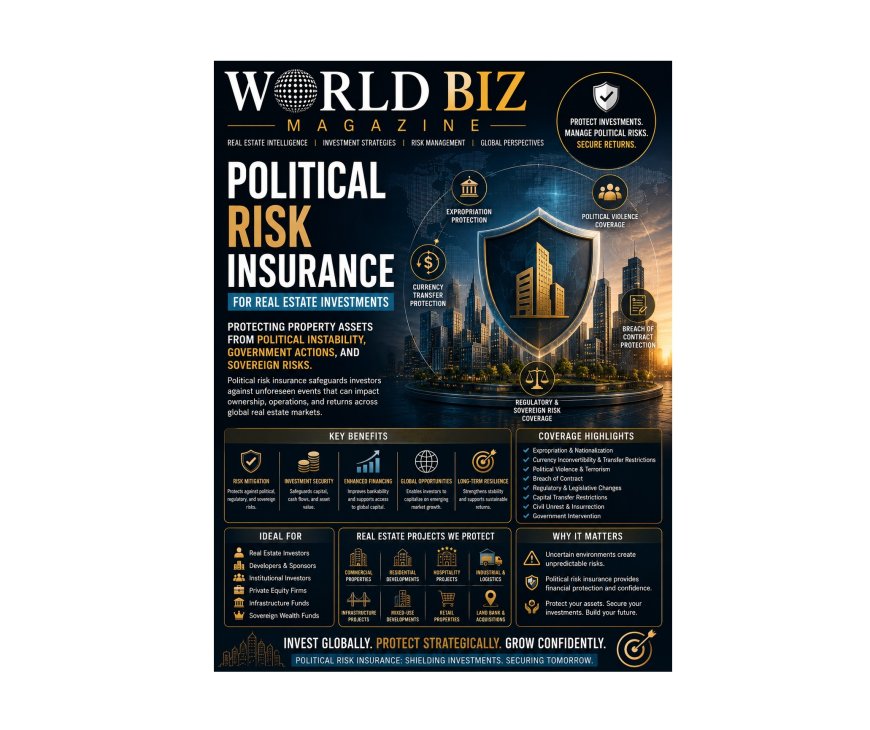
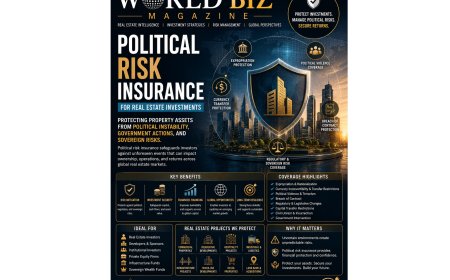
Political Risk Insurance for Real Estate Investments
Protecting Property Assets from Government Actions, Political Instability, and Sovereign Risks in Global Real Estate Markets
World Biz Magazine | Real Estate, Insurance & Global Investment
Real estate has long been considered one of the most attractive asset classes for investors seeking long-term income generation, capital appreciation, portfolio diversification, and inflation protection. Over the past several decades, globalization has significantly expanded investment opportunities beyond domestic markets, allowing institutional investors, private equity firms, sovereign wealth funds, developers, and high-net-worth individuals to participate in real estate projects across emerging and frontier economies. While international property investments can offer substantial returns, they also expose investors to risks that are often absent in mature and politically stable markets. Among the most significant of these challenges are political and sovereign risks.
Political developments can dramatically affect the profitability, viability, and ownership rights associated with real estate investments. Government policy changes, expropriation measures, currency controls, civil unrest, contract disputes, regulatory interventions, nationalization efforts, and political instability can create substantial financial losses for property owners and developers. Even projects located in economically promising markets may become vulnerable when political environments change unexpectedly.
Political Risk Insurance (PRI) has emerged as an important risk management tool designed to protect investors against losses arising from government actions and political events. While traditionally associated with infrastructure, energy, and multinational corporate investments, political risk insurance is becoming increasingly relevant within the real estate sector as investors pursue opportunities in developing economies and politically complex jurisdictions.
As global capital continues flowing into international property markets, understanding political risk insurance has become essential for investors seeking to balance opportunity with protection. Properly structured political risk coverage can strengthen investment confidence, improve financing opportunities, and provide critical safeguards against unpredictable geopolitical events.
Understanding Political Risk Insurance
Political Risk Insurance is a specialized insurance product designed to protect investors against financial losses resulting from politial events, government actions, or sovereign risks.
Unlike traditional property insurance, which focuses on physical damage and operational losses, political risk insurance addresses non-commercial risks that originate from political or governmental factors.
Coverage typically applies to:
- Real estate developments
- Commercial property investments
- Infrastructure projects
- Cross-border investments
- Foreign direct investment (FDI) projects
Political risk insurance provides investors with protection against events that could impair ownership rights, reduce investment value, or prevent expected financial returns.
The objective is to mitigate uncertainties associated with operating in politically sensitive or emerging markets.
Why Political Risk Matters in Real Estate
Real estate investments often involve substantial capital commitments and long investment horizons.
Unlike financial securities that can be sold relatively quickly, property assets are generally illiquid and location-specific.
This makes real estate particularly vulnerable to political developments.
Government decisions can affect:
- Property ownership rights
- Development approvals
- Land-use regulations
- Taxation policies
- Currency transfers
- Investment returns
Political disruptions can significantly impact project viability and asset values.
Investors therefore increasingly incorporate political risk assessments into acquisition and development strategies.
The Growth of Cross-Border Real Estate Investment
Globalization has expanded access to international real estate markets.
Institutional investors increasingly pursue opportunities in:
- Asia-Pacific
- Latin America
- Africa
- Eastern Europe
- Middle Eastern markets
Emerging economies often offer:
- Higher growth rates
- Urbanization opportunities
- Infrastructure expansion
- Attractive valuations
However, these benefits are frequently accompanied by elevated political risks.
Political risk insurance helps bridge the gap between opportunity and uncertainty.
It enables investors to participate in growth markets while reducing exposure to sovereign-related risks.
Key Types of Political Risks Covered
Political risk insurance policies vary among providers, but several common coverage areas exist.
Understanding these risks is essential when evaluating protection options.
Expropriation and Nationalization
Expropriation occurs when governments seize or take control of privately owned assets.
Nationalization represents a broader form of government acquisition involving entire industries or sectors.
Real estate investors may face losses if:
- Property ownership rights are revoked
- Land is seized
- Government intervention eliminates investment value
Political risk insurance can provide compensation for covered losses resulting from such actions.
Expropriation protection remains one of the most important features of PRI coverage.
Currency Inconvertibility and Transfer Restrictions
International investors frequently rely on the ability to move funds across borders.
Political instability or economic crises may lead governments to impose:
- Capital controls
- Currency restrictions
- Transfer limitations
These actions can prevent investors from repatriating profits, rental income, or investment proceeds.
Political risk insurance may compensate investors when currency transfer restrictions create financial losses.
This protection is particularly relevant in emerging markets.
Political Violence Coverage
Political violence coverage addresses losses resulting from events such as:
- Civil unrest
- Riots
- Insurrections
- Revolutions
- Terrorism
- Civil war
These events can cause:
- Property damage
- Business interruption
- Operational disruptions
Political violence insurance provides an additional layer of protection beyond conventional property insurance.
Coverage terms vary depending on the nature and location of investments.
Breach of Contract Protection
Government entities frequently participate in real estate developments through:
- Public-private partnerships
- Development agreements
- Infrastructure projects
- Land-use arrangements
If government agencies fail to honor contractual obligations, investors may experience significant losses.
Political risk insurance may provide protection against covered breaches involving governmental counterparties.
This coverage can enhance confidence in complex development projects.
Regulatory and Legislative Risks
Governments periodically introduce new laws and regulations.
While regulatory changes are part of normal governance, certain actions may significantly impact investment economics.
Examples include:
- Zoning changes
- Property ownership restrictions
- Development moratoriums
- Tax increases
- Land-use limitations
Political risk insurance may offer limited protection against specific regulatory actions depending on policy structure.
Investors should carefully evaluate coverage scope.
How Political Risk Insurance Supports Real Estate Financing
Political risk insurance not only protects investors but can also facilitate financing.
Lenders often evaluate political risks when assessing international projects.
PRI coverage may:
- Improve credit quality
- Reduce perceived risk
- Enhance project bankability
- Support favorable financing terms
In some cases, political risk insurance enables projects that might otherwise struggle to secure funding.
The availability of coverage can therefore play a strategic role in capital formation.
Political Risk Assessment in Real Estate
Before purchasing insurance, investors typically conduct comprehensive political risk assessments.
Key considerations include:
- Government stability
- Legal frameworks
- Regulatory consistency
- Corruption levels
- Economic conditions
- Social stability
- Historical political events
These assessments help identify potential vulnerabilities and inform insurance requirements.
Effective risk analysis supports better investment decisions.
Political Risk Insurance Providers
Political risk coverage is available through various sources.
These may include:
- Private insurers
- Specialty insurance markets
- Multilateral organizations
- Export credit agencies
- Development finance institutions
Coverage availability often depends on project location, sector, investment size, and risk profile.
Competition among providers has expanded coverage options for investors.
Real Estate Sectors Utilizing Political Risk Insurance
Political risk insurance can benefit numerous property categories.
These include:
Commercial Real Estate
Office buildings, retail centers, and mixed-use developments.
Hospitality Projects
Hotels, resorts, and tourism infrastructure.
Industrial Facilities
Warehouses, logistics centers, and manufacturing properties.
Infrastructure-Linked Real Estate
Transport hubs, ports, and public-private development projects.
Residential Developments
Large-scale housing and urban development initiatives.
The relevance of coverage often increases with project size and geographic complexity.
Emerging Market Opportunities and Risks
Emerging markets continue attracting significant real estate investment due to:
- Urbanization
- Population growth
- Rising incomes
- Infrastructure investment
However, these markets may also present:
- Political uncertainty
- Regulatory volatility
- Currency instability
- Governance challenges
Political risk insurance helps investors participate in growth opportunities while managing downside exposure.
Risk mitigation becomes increasingly important as project scale increases.
The Role of Multilateral Institutions
International organizations play an important role in political risk insurance markets.
These institutions often support:
- Foreign direct investment
- Infrastructure development
- Economic growth initiatives
Their involvement can improve investor confidence and contribute to market stability.
Multilateral support is particularly valuable in higher-risk jurisdictions.
Many large-scale real estate developments benefit from such participation.
Climate Change, Geopolitics, and Future Political Risks
Political risk environments are becoming increasingly complex.
Several emerging factors are influencing risk profiles:
- Climate-related migration
- Resource scarcity
- Geopolitical tensions
- Trade disputes
- Energy transitions
- Economic nationalism
These developments may increase the importance of political risk management within real estate investment strategies.
Investors must consider both traditional and emerging forms of political risk.
Integrating Political Risk Insurance into Investment Strategy
Political risk insurance should not be viewed as a standalone solution.
Effective risk management combines:
- Due diligence
- Legal structuring
- Diversification
- Government engagement
- Regulatory monitoring
- Insurance protection
A comprehensive approach improves resilience and supports long-term investment success.
Insurance serves as one component of broader strategic planning.
The Future of Political Risk Insurance
As international real estate investment continues expanding, demand for political risk protection is expected to grow.
Future developments may include:
- Enhanced risk modeling
- Data-driven underwriting
- Expanded coverage options
- Climate-related political risk solutions
- Increased public-private cooperation
Insurance products will likely evolve to address increasingly complex geopolitical environments.
Investors who proactively manage political risks may gain competitive advantages in global markets.
World Biz Magazine Insights
Political risk has become a defining consideration for global real estate investors seeking opportunities beyond mature domestic markets. While emerging economies offer attractive growth potential, they also expose investors to sovereign actions, regulatory changes, and geopolitical uncertainties that can significantly affect asset performance. Political Risk Insurance provides a valuable mechanism for mitigating these exposures while enhancing investment confidence and financing flexibility. As cross-border capital flows continue expanding and geopolitical dynamics become more complex, political risk protection is likely to play an increasingly important role in global real estate investment strategies.
Conclusion
Political Risk Insurance has evolved into an essential tool for managing non-commercial risks associated with international real estate investments. By protecting against expropriation, political violence, currency restrictions, breach of contract, and other sovereign-related risks, PRI enables investors to participate more confidently in global property markets.
As emerging economies continue attracting investment and geopolitical environments become increasingly dynamic, the importance of political risk management will only grow. Investors who integrate political risk insurance into broader due diligence and risk management frameworks can better protect assets, improve financing opportunities, and strengthen long-term investment resilience.
Ultimately, Political Risk Insurance is not merely a defensive measure it is a strategic enabler that helps investors pursue growth opportunities while navigating the complexities of an interconnected global economy.
Disclaimer
This article is published for informational, educational, and industry analysis purposes only and does not constitute legal, insurance, financial, investment, tax, political risk, or professional advice. Political risk insurance policies, coverage terms, exclusions, and availability vary among providers and jurisdictions. Readers should consult qualified insurance professionals, legal advisors, and investment specialists regarding specific political risk exposures and coverage requirements.
What's Your Reaction?
 Like
1
Like
1
 Dislike
0
Dislike
0
 Love
0
Love
0
 Funny
0
Funny
0
 Angry
0
Angry
0
 Sad
0
Sad
0
 Wow
1
Wow
1