





















































































































Malaysia’s Comeback: A Strategic Investment Hub Amid Middle East Tensions
A detailed World Biz Magazine analysis of Malaysia’s economy, real estate market, and role in global capital shifts during geopolitical instability.

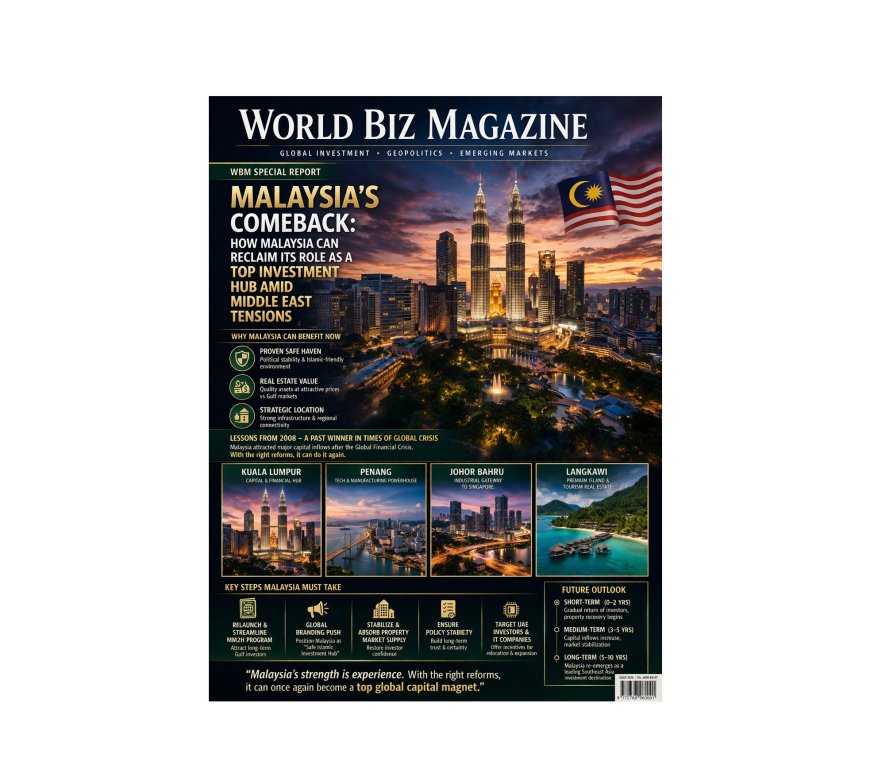
Malaysia: The Quiet Contender - Can It Reclaim Its Role as a Capital Magnet in a New Middle East Crisis?
Lessons from Past Crises, Strategic Repositioning & the Path to a Second Investment Boom
World Biz Magazine | Global Investment, Real Estate & Emerging Markets Intelligence
As geopolitical tensions escalate across the Middle East particularly involving Iran and major Gulf economies like United Arab Emirates and Saudi Arabia global capital is once again entering a phase of relocation and diversification.
In this evolving landscape, Malaysia is uniquely positioned not as a new entrant, but as a proven beneficiary of past crises.
The key question now: Can Malaysia repeat its previous success and re-emerge as a major destination for Middle Eastern capital?
Historical Context: Malaysia’s Rise After the 2008 Financial Crisis
The Global Shock - 2008 Financial Crisis
When the global financial system collapsed following the fall of Lehman Brothers:
- Western markets weakened
- Gulf real estate markets slowed
- Investors sought new, stable, and affordable destinations
Malaysia’s Opportunity Moment
Malaysia capitalized on this shift by offering:
- Political stability
- Islamic-friendly environment (important for Gulf investors)
- Affordable luxury real estate
- Residency programs like Malaysia My Second Home (MM2H)
Result:
- Surge in Middle Eastern investors
- Property boom in Kuala Lumpur, Langkawi, and coastal regions
- Strong inflow into tourism and hospitality
Post-Boom Decline (COVID Era Impact)
However, after years of growth:
- Oversupply in real estate
- Policy tightening (MM2H restrictions)
- COVID-19 slowdown
Result:
- Property market stagnation
- Reduced foreign investor interest
Malaysia lost momentum as a top-tier investment destination
Why Malaysia Can Benefit Again Today
Distance from Conflict, Close to Opportunity
Malaysia is:
- Far from Middle East conflict zones
- Politically neutral
- Economically stable
In a war scenario:
- Investors seek distance + safety
- Malaysia offers both
Proven Safe Haven for Muslim Investors
Malaysia has a unique advantage:
- Islamic finance leadership
- Cultural alignment with Gulf investors
This creates:
- Trust
- Familiarity
A major psychological advantage over Western markets
Real Estate Value Opportunity
Compared to Dubai or Istanbul:
- Lower property prices
- High-quality developments
- Strong rental potential
This makes Malaysia: A value-driven re-entry market
Strong Infrastructure & Connectivity
Malaysia offers:
- World-class airports
- Modern cities
- Digital infrastructure
Particularly strong in:
- Kuala Lumpur
- Penang
- Johor
Investment Environment & Policies
Business Climate
Malaysia provides:
- Investor-friendly policies
- Foreign ownership in many sectors
- Developed banking system
Known for:
- Ease of setting up businesses
- Stable regulatory environment
Incentives & Programs
Key programs:
- MM2H (residency program)
- Tax incentives for foreign investors
- Special economic zones
These can be restructured to attract Gulf capital again
Ease of Doing Business
Malaysia consistently ranks as:
- One of Southeast Asia’s easiest countries for business
Strengths:
- Transparent regulations
- Strong legal framework
Why Investors Should Return to Malaysia
1. Proven Track Record
Malaysia is not a new market it has already:
- Successfully attracted global capital
- Delivered strong returns
2. Lifestyle + Investment Combo
- Safe living environment
- High-quality healthcare and education
Ideal for:
- Families
- Long-term residency
3. Diversification Strategy
Investors leaving the Gulf can:
- Add Malaysia to their portfolio
- Reduce regional risk exposure
4. Currency Advantage
- Weak currency can benefit foreign investors
- Lower entry cost
Challenges & Risks
1. Property Oversupply
- Excess inventory in some areas
2. Policy Inconsistency
- Changes in MM2H program reduced trust
3. Slow Economic Momentum
- Growth slower compared to emerging competitors
4. Competition from Other Markets
- Turkey
- Indonesia
- Thailand
War-Related Risks
Even as a beneficiary:
Limited Immediate Proximity Advantage
- Not a “first relocation destination”
Dependency on Global Trends
- Relies on international investor flows
Strategic Steps Malaysia Must Take (CRITICAL)
1. Relaunch MM2H Aggressively - Or Introduce a Next-Generation Investor Residency Program
Malaysia must immediately reposition its flagship residency offering to compete with global leaders like United Arab Emirates, Turkey, and Portugal.
Core Actions:
- Simplify financial and eligibility requirements
- Reduce minimum income and deposit thresholds
- Introduce fast-track approvals (30-60 days)
- Create tiered categories:
- Entry-level investors (SMEs, freelancers)
- Mid-tier investors (property + business)
- High-net-worth individuals (premium residency)
Strategic Upgrade:
Malaysia should either:
- Relaunch MM2H with competitive reforms
OR - Launch a new global investor visa program with:
- Flexible stay requirements (like UAE Golden Visa)
- Family inclusion
- Long-term residency (10-15 years)
- Optional pathway to permanent residency
The goal is to transform Malaysia from a residency option into a global investor platform
2. Market Malaysia as a “Safe Islamic Investment Hub”
Malaysia holds a unique global position in Islamic finance and cultural alignment, especially for Middle Eastern investors.
Key Positioning Strategy:
- Promote Malaysia as:
- Politically stable
- Neutral and safe
- Culturally aligned with Gulf investors
Focus Areas:
- Islamic banking leadership
- Halal economy ecosystem
- Lifestyle compatibility for Muslim investors
This gives Malaysia a distinct competitive edge over Western markets
3. Fix Property Market Imbalance & Unlock Foreign Demand
Malaysia’s real estate sector has strong fundamentals but faces oversupply in certain segments.
Strategic Actions:
- Incentivize foreign buyers through:
- Lower minimum property thresholds
- Taxation & Stamp duty reductions
- Foreign ownership incentives
- Align property investment with residency:
- Property-linked visas (similar to UAE and Turkey models)
This will:
- Absorb excess inventory
- Restart the property growth cycle
4. Strengthen Investor Confidence Through Policy Stability
One of Malaysia’s biggest challenges has been policy inconsistency, particularly around MM2H.
Critical Measures:
- Ensure long-term policy continuity
- Avoid sudden regulatory changes
- Establish transparent investor frameworks
Investor confidence is built on:
Predictability
Trust
Stability
Without this, capital will shift to more reliable jurisdictions.
5. Target UAE-Based Investors & IT Companies (High-Impact Opportunity)
As companies reassess risk in Gulf markets especially in United Arab Emirates Malaysia can position itself as a cost-efficient and scalable alternative.
Strategic Actions:
Offer relocation incentives:
- Tax breaks
- Office setup support, including free zone style facilities, plug-and-play business environments, and flexible office solutions (co-working, serviced offices, and virtual offices)
- Dedicated business zones with:
- 100% foreign ownership
- Simplified licensing and fast-track approvals
- Customs and duty exemptions for import/export businesses
- Integrated digital infrastructure for IT and tech companies
- Promote Malaysia as:
- Lower-cost alternative to Dubai
- Tech-friendly environment
- Gateway to Southeast Asia
Particularly attractive for:
- IT firms
- Startups
- Digital service companies
Integrated Strategic Vision
Malaysia must combine all five pillars into a single unified strategy:
The Winning Formula:
- Immigration Reform (MM2H 2.0)
- Global Branding (Islamic + Safe Haven)
- Real Estate Activation
- Policy Stability
- Corporate Relocation Strategy
This creates a complete investment ecosystem, not just isolated reforms.
Future Outlook
Short-Term (0-2 Years)
- Gradual return of investor interest
- Moderate real estate recovery
Medium-Term (3-5 Years)
- Stronger capital inflows
- Property market stabilization
Long-Term (5-10 Years)
- Potential to re-emerge as:
- Top Southeast Asian investment hub
- Preferred destination for Middle Eastern capital
Strategic Insight
Malaysia’s biggest strength is:
Experience
It has already:
- Benefited from global crisis
- Built investor trust
The challenge now is: Reactivating that positioning
World Biz Magazine Insight
“In the race for global capital, success no longer depends on location alone but on how intelligently a country aligns policy, perception, and opportunity into a single investment narrative. Malaysia does not need to reinvent itself; it needs to remind the world what it once was a stable, strategic, and investor-friendly gateway between Asia and the Middle East.”
Final Conclusion
Malaysia’s Role:
- A secondary but high-potential beneficiary
Strengths:
- Stability
- Past success
- Islamic finance leadership
Risks:
- Policy inconsistency
- Market oversupply
Bottom Line:
If Malaysia executes the right policies, it can recreate its post-2008 success and attract a new wave of global capital, especially from the Middle East.
Disclaimer:
This publication by World Biz Magazine is intended for informational, analytical, and educational purposes only. The content reflects current geopolitical and economic conditions, which are subject to rapid change and uncertainty. The analysis presented does not constitute financial, investment, legal, or professional advice.
Readers are strongly advised to conduct independent research and consult with licensed financial advisors, legal professionals, or investment consultants before making any investment decisions. While every effort has been made to ensure accuracy and reliability, World Biz Magazine does not guarantee the completeness, accuracy, or future performance of any data, projections, or opinions expressed.
World Biz Magazine shall not be held liable for any direct or indirect losses arising from the use of this information. Investments in emerging and geopolitically sensitive regions involve inherent risks, including political instability, currency fluctuations, regulatory changes, and market volatility.
What's Your Reaction?
 Like
0
Like
0
 Dislike
0
Dislike
0
 Love
0
Love
0
 Funny
0
Funny
0
 Angry
0
Angry
0
 Sad
0
Sad
0
 Wow
0
Wow
0