
















































































































































































































How Fake and Low-Quality Job Posts Impact Freelancers and Platform Economics
A detailed World Biz Magazine analysis explaining fake job concerns, low-quality listings, proposal monetization, and freelance marketplace economics.

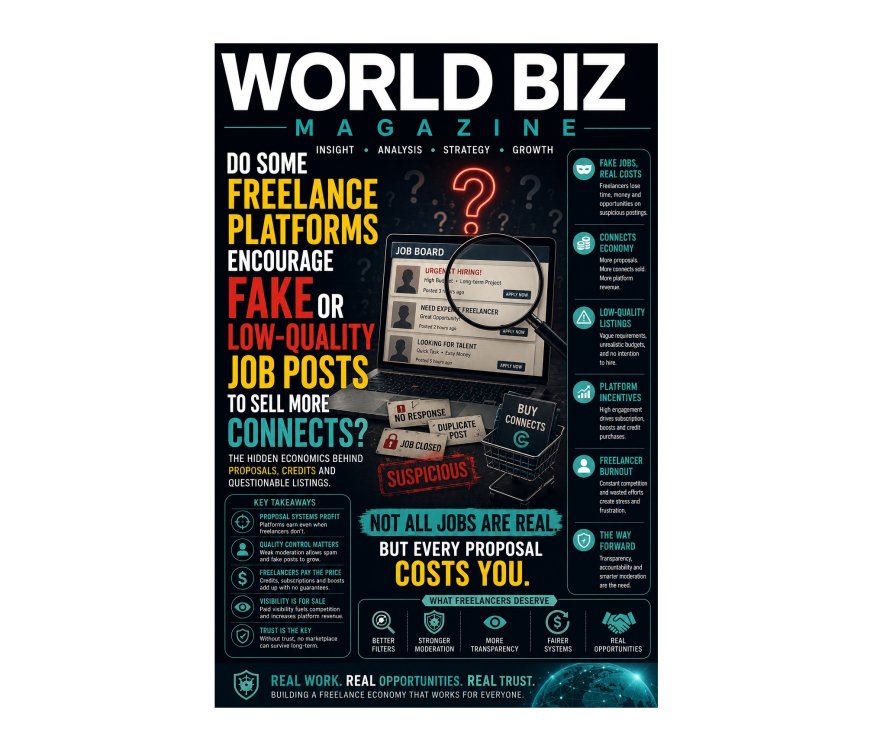
Do Some Freelance Platforms Encourage Fake or Low-Quality Job Posts to Sell More Connects?
Investigating the Economics, Incentives, and Controversies Behind Proposal-Driven Freelance Marketplaces
World Biz Magazine | Global Freelance & Digital Economy Intelligence | Platform Economics
The Growing Suspicion Inside the Freelance Economy
The global freelance economy has become one of the most important workforce transformations of the digital age. Millions of independent professionals now rely on online labor platforms to secure projects, build careers, connect with international clients, and generate income through remote work. Designers, developers, writers, marketers, video editors, consultants, AI specialists, and digital creators increasingly participate in highly competitive online ecosystems that promise flexibility, entrepreneurial freedom, and global access to opportunity.
However, as freelance platforms evolved into multi-billion-dollar technology businesses powered by venture capital, algorithmic systems, artificial intelligence, and platform monetization strategies, many freelancers began questioning whether the incentives within these ecosystems truly align with worker success.
One of the most controversial and emotionally charged concerns emerging within the digital labor economy involves the possibility that some freelance marketplaces may indirectly benefit from fake, inactive, abandoned, duplicate, or low-quality job posts because these listings generate proposal activity, worker engagement, subscription purchases, and application-credit consumption.
In many proposal-driven freelance ecosystems, workers spend digital credits, bidding tokens, subscriptions, or paid visibility resources simply to apply for projects. Yet freelancers increasingly report experiences involving:
- Job posts that never hire anyone
- Repeatedly recycled listings
- Extremely vague project descriptions
- Unrealistic budgets
- Suspiciously inactive clients
- Duplicate projects
- AI-generated job descriptions
- Posts designed only to collect ideas or market research
For freelancers operating inside highly competitive labor markets, each proposal represents more than time investment. It may also involve direct financial cost through proposal systems and application credits. As a result, concerns have grown regarding whether low-quality or suspicious listings contribute to platform profitability by increasing proposal volume and freelancer engagement, regardless of whether genuine hiring occurs.
At the same time, freelance platforms generally argue that low-quality postings are an unavoidable challenge within large-scale global marketplaces involving millions of users and continuous project submissions. Platforms often invest heavily in fraud prevention systems, moderation tools, AI-driven detection systems, verification processes, and trust infrastructure designed to protect marketplace integrity.
The issue is therefore highly complex. There is often no publicly available evidence proving intentional encouragement of fake job posts by major platforms. However, the economic structure of proposal-driven ecosystems has created growing debate about whether platform incentives may unintentionally reward marketplace conditions where high proposal activity itself becomes financially valuable.
Understanding this controversy requires examining the intersection of platform economics, proposal monetization, behavioral incentives, algorithmic engagement systems, labor competition, and the financial structure of the modern freelance economy.
The Rise of the Proposal Economy
Modern freelance marketplaces increasingly rely on proposal-driven systems where freelancers may need:
- Application credits
- Proposal tokens
- Visibility boosts
- Premium memberships
- Paid profile exposure
to compete for projects.
This transforms job applications into monetized activity.
Instead of generating revenue only from completed work transactions, platforms may also profit from:
- Proposal submissions
- Marketplace engagement
- Subscription systems
- Visibility purchases
This creates economic tension because worker participation itself becomes part of the revenue model.
Why Freelancers Suspect Fake or Low-Quality Job Posts
Freelancers across digital labor ecosystems often report concerns regarding suspicious listings.
Common complaints include:
- Jobs with no hiring activity
- Clients repeatedly posting identical projects
- Extremely vague project requirements
- Unrealistic pricing expectations
- Projects disappearing without responses
- Clients interviewing workers but never hiring
- Listings requesting free sample work
- AI-generated spam-style job descriptions
These experiences create frustration because freelancers may spend:
- Time
- Emotional energy
- Proposal credits
- Visibility resources
without receiving meaningful opportunities.
The Economics Behind Proposal Systems
To understand the controversy, it is important to examine platform incentives.
In proposal-based ecosystems:
- More job posts create more freelancer applications
- More applications consume more proposal credits
- More competition increases engagement activity
If proposal systems generate revenue, then proposal volume itself becomes economically valuable.
This creates concern among freelancers that marketplace saturation and high application activity may indirectly benefit platform business models even when project quality declines.
Fake Job Posts vs Low-Quality Job Posts
These two issues are related but different.
Fake Job Posts
Fake posts may involve:
- Fraud attempts
- Identity scams
- Data collection schemes
- Fake hiring activity
- Spam operations
These listings may never intend to hire anyone at all.
Most platforms actively attempt to remove such activity because fraud damages marketplace trust.
Low-Quality Job Posts
Low-quality posts may involve:
- Unrealistic budgets
- Poorly written requirements
- Inactive clients
- Non-serious buyers
- Market research behavior
- Idea harvesting
- AI-generated content spam
These listings may technically be real, but still waste freelancer time and resources.
This category creates more ambiguity and controversy.
The Incentive Problem
One major concern is the possibility of misaligned incentives.
Critics argue:
- Platforms benefit from proposal activity
- More competition increases proposal purchases
- More visibility anxiety drives subscriptions and boosts
This creates fear that marketplaces may not be strongly incentivized to aggressively reduce low-quality listings if those listings still generate engagement and revenue.
Supporters argue platforms ultimately depend on:
- Trust
- Successful hiring outcomes
- Long-term marketplace reputation
and therefore have incentives to improve quality over time.
Both perspectives may contain elements of truth.
Why Fake Job Posts Hurt Freelancers
Suspicious or low-quality listings create several major problems for freelancers.
Financial Loss
Freelancers may spend:
- Proposal credits
- Paid visibility
- Subscription resources
on projects that never hire anyone.
This creates direct financial cost.
Time Waste
Freelancers often spend significant time:
- Writing proposals
- Researching projects
- Preparing portfolios
- Conducting interviews
only to discover the opportunity was inactive or non-serious.
Emotional Burnout
Repeated exposure to suspicious or low-quality projects can create:
- Frustration
- Cynicism
- Anxiety
- Burnout
- Distrust toward platforms
Freelancers may begin feeling trapped inside systems where effort does not reliably produce opportunity.
The Role of AI in Low-Quality Listings
Artificial intelligence is beginning to affect freelance marketplaces significantly.
AI tools now allow rapid generation of:
- Job descriptions
- Client messages
- Proposal spam
- Automated listings
This may increase:
- Low-effort postings
- Generic project listings
- Marketplace clutter
AI-generated job spam may become a growing challenge across digital labor ecosystems.
Marketplace Saturation and Proposal Competition
Freelance marketplaces have become extremely competitive globally.
Some projects receive:
- Hundreds of proposals
- Aggressive bidding behavior
- Extremely rapid application volume
In saturated marketplaces, even legitimate projects may feel inaccessible.
This creates conditions where freelancers become increasingly sensitive to suspicious or low-quality listings because:
- Competition is already intense
- Proposal systems carry financial cost
- Visibility is limited
Proposal Credits and Behavioral Economics
Proposal systems create strong behavioral incentives.
Freelancers may feel pressure to:
- Apply quickly
- Submit more bids
- Remain constantly active
- Purchase additional credits
The uncertainty of outcomes creates engagement loops where workers continue participating despite repeated rejection.
Critics argue these systems resemble attention-economy structures where engagement itself becomes monetized.
Do Platforms Intentionally Encourage Fake Posts?
There is generally no verified public evidence that major freelance platforms intentionally create fake job posts themselves.
However, critics often focus less on intentional fraud and more on:
- Weak moderation incentives
- Marketplace overcrowding
- Poor quality control
- Proposal monetization structures
The debate centers around whether platforms are sufficiently incentivized to aggressively eliminate low-quality engagement-generating activity.
This distinction is important.
Why Platforms Still Need Marketplace Trust
Despite criticism, platforms also face strong incentives to maintain trust.
If freelancers and clients lose confidence:
- Marketplace reputation declines
- User retention weakens
- Revenue growth slows
- Brand damage increases
Long-term platform sustainability depends heavily on:
- Successful transactions
- Reliable hiring outcomes
- Marketplace credibility
Therefore, platforms often invest heavily in:
- Fraud detection systems
- Verification tools
- AI moderation
- Trust and safety teams
The challenge lies in balancing scalability with quality control across massive global ecosystems.
The Psychological Impact on Freelancers
Suspicious job activity contributes heavily to freelancer anxiety.
Workers may begin questioning:
- Whether projects are genuine
- Whether proposals are worth the cost
- Whether visibility systems are fair
- Whether platforms prioritize worker success
This creates emotional fatigue within already competitive labor environments.
Venture Capital and Monetization Pressure
Investor-driven growth pressure may intensify these concerns.
Platforms backed by venture capital or public market expectations often face pressure to increase:
- Revenue
- Engagement
- Marketplace activity
- User retention
- Monetization efficiency
Critics argue this may encourage ecosystems where:
- Proposal volume
- Continuous bidding
- Engagement behavior
become economically valuable regardless of hiring quality.
The Future of Freelance Marketplace Quality
The future of freelance ecosystems may increasingly depend on:
- Better AI moderation
- Improved verification systems
- Transparent hiring metrics
- Reduced proposal spam
- Higher-quality matching algorithms
Freelancers increasingly demand:
- Greater transparency
- Better filtering systems
- Fairer proposal economics
- More trustworthy marketplaces
Platforms capable of balancing profitability with marketplace trust may gain long-term competitive advantage.
Ethical Questions Surrounding Proposal Economies
The controversy raises important ethical questions:
- Should workers pay heavily to seek opportunity?
- Should platforms refund credits for inactive jobs?
- How transparent should hiring data become?
- Should low-quality listings face stronger moderation?
These debates reflect broader concerns surrounding:
- Platform capitalism
- Digital labor rights
- Algorithmic economies
- Workforce sustainability
The answers may shape the future structure of remote work itself.
World Biz Magazine Insights
At World Biz Magazine, we view the controversy surrounding fake and low-quality freelance job posts as one of the most important trust issues facing the modern digital labor economy. Freelancers increasingly operate inside highly monetized ecosystems where proposal activity, visibility systems, and engagement behavior have become central components of platform business models.
While there is generally no verified public evidence that major platforms intentionally create fake job posts, the economic structure of proposal-driven marketplaces has created understandable concern regarding incentive alignment, worker sustainability, and marketplace quality control.
As AI-generated content, algorithmic management, proposal monetization, and platform competition continue expanding globally, the long-term success of freelance ecosystems may depend heavily on transparency, trust infrastructure, ethical marketplace governance, and sustainable labor economics.
The future of digital work may ultimately be shaped not only by technology, but by how platforms choose to value worker trust itself.
Conclusion
The growing debate surrounding fake and low-quality job posts highlights deeper structural tensions within the modern freelance economy. Proposal-based monetization systems, algorithm-driven visibility, and intense global labor competition have created environments where freelancer engagement itself increasingly carries economic value.
While platforms continue investing in moderation and trust systems, freelancers remain concerned about marketplace quality, proposal costs, and incentive structures that may financially benefit from high engagement activity even when hiring outcomes remain uncertain.
As remote work ecosystems continue evolving through AI, automation, venture capital pressure, and platform economics, trust and transparency may become some of the most important competitive advantages within the future freelance economy.
Disclaimer
This article is published for informational, educational, and editorial purposes only and does not constitute legal, financial, labor policy, employment, or professional business advice. The article discusses general industry concerns, marketplace dynamics, and economic theories within digital labor ecosystems and does not make factual allegations against any specific company, platform, or organization. Readers should consult qualified legal professionals, labor experts, financial advisors, or business consultants regarding specific freelance, contractual, or platform-related matters. World Biz Magazine and its affiliates are not responsible for financial outcomes, employment disputes, or professional decisions based on the information presented in this publication.
What's Your Reaction?
 Like
1
Like
1
 Dislike
0
Dislike
0
 Love
0
Love
0
 Funny
0
Funny
0
 Angry
0
Angry
0
 Sad
0
Sad
0
 Wow
1
Wow
1