


























































































































































































Gig Economy Regulation: How Governments Are Responding Worldwide
A complete analysis of gig work policies, worker classification, and global regulatory trends.

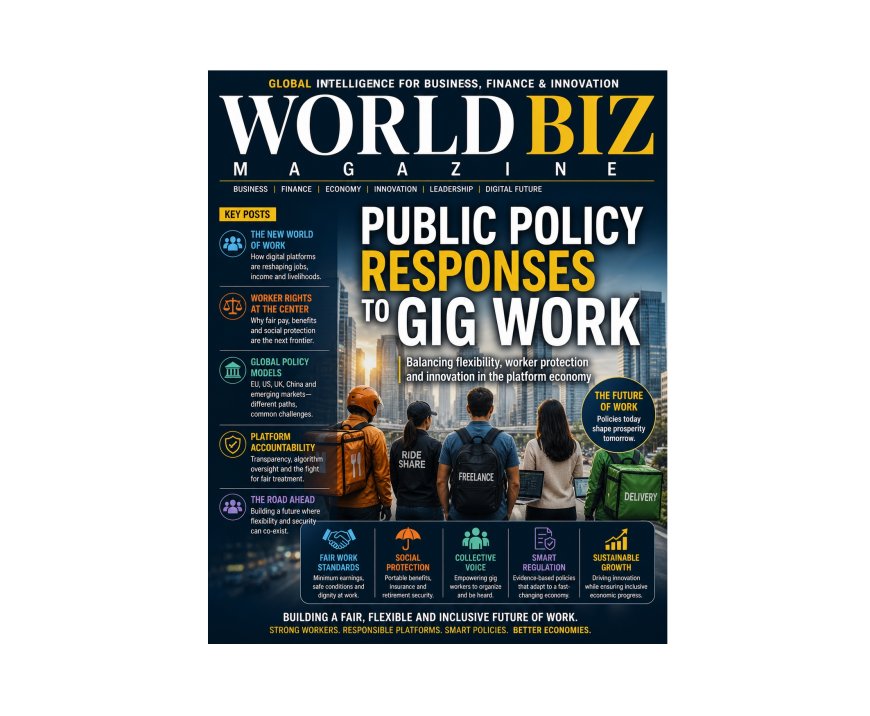
Public Policy Responses to Gig Work: Redefining Labor in the Platform Economy
How governments are balancing flexibility, worker protection, and innovation in the rapidly expanding gig economy
World Biz Magazine | Global Intelligence for Business, Finance & Innovation
The Rise of Gig Work
The global labor market is undergoing a structural transformation. Digital platforms have enabled millions to earn income through short-term, flexible work commonly known as the gig economy.
Companies like Uber, DoorDash, Fiverr, and Upwork have created new opportunities but also new challenges.
At the center of the debate: Are gig workers entrepreneurs or employees without protections? Governments worldwide are now stepping in to define the rules.
Understanding the Gig Economy
Gig work refers to:
- Short-term, task-based employment
- Independent contractor arrangements
- Platform-mediated work
Key Characteristics:
- Flexibility and autonomy
- Income variability
- Lack of traditional benefits
- Algorithm-driven management
The Policy Dilemma
Policymakers face a complex balancing act:
Protect Workers
Ensure fair wages, benefits, and job security
Preserve Flexibility
Avoid destroying the core value proposition of gig work
Support Innovation
Maintain growth of digital platforms and startups
Ensure Fair Competition
Prevent regulatory arbitrage and labor exploitation
Global Policy Approaches
European Union: Worker Protection First
The European Union is leading a rights-based approach.
Key Developments:
- Proposed platform worker directive
- Presumption of employment status
- Algorithm transparency requirements
Policy Focus:
- Classifying gig workers as employees
- Ensuring minimum wage and benefits
- Regulating algorithmic management
Impact:
Stronger protections but increased costs for platforms.
United States: Hybrid & State-Level Models
The United States follows a fragmented approach.
Key Example:
- California Proposition 22
Key Features:
- Workers classified as independent contractors
- Limited benefits (health subsidies, insurance)
- State-driven policy experimentation
Impact:
Maintains flexibility but creates legal complexity and inconsistency.
United Kingdom: Middle-Ground Classification
The United Kingdom has introduced a third category:
“Worker” Status:
- Between employee and contractor
- Entitled to:
- Minimum wage
- Paid leave
- Limited protections
Landmark Case:
- Uber BV v Aslam
Impact:
A compromise model balancing rights and flexibility.
China: State-Directed Protections
The China has moved toward stronger state intervention.
Policies Include:
- Minimum income guarantees
- Insurance requirements
- Platform accountability mandates
Impact:
Improves worker conditions while maintaining centralized control.
Emerging Markets: Rapid Growth, Limited Regulation
Countries across South Asia, Africa, and Southeast Asia are still evolving policy frameworks.
Characteristics:
- High dependence on gig work for income
- Limited formal protections
- Growing regulatory interest
Impact:
Massive opportunity but rising risks of labor exploitation.
Key Policy Tools Being Used
Worker Classification Reform
Defining whether gig workers are:
- Employees
- Contractors
- Hybrid workers
Minimum Earnings Standards
Setting wage floors or guaranteed earnings
Social Protection Mechanisms
Including:
- Health insurance
- Pension contributions
- Accident coverage
Algorithmic Accountability
Requiring transparency in:
- Job allocation
- Ratings systems
- Deactivations
Collective Representation
Allowing gig workers to:
- Unionize
- Negotiate with platforms
Economic Impact of Regulation
For Platforms:
- Increased operating costs
- Reduced margins
- Potential restructuring of business models
For Workers:
- Greater security
- Potential reduction in flexibility
- More predictable income
For Governments:
- Increased tax compliance
- Formalization of informal labor
- Policy enforcement challenges
The Future of Gig Work Policy
The next phase of policy evolution will likely include:
- Portable benefits systems
- Global labor standards for platforms
- AI-driven labor regulation
- Cross-border gig taxation
- Integration with digital identity systems
We are moving toward a world where:
Work is flexible but protections are portable.
World Biz Magazine Insights
WBJ Insight 01 - The Classification Battle Defines Everything
The employee vs contractor debate is the single most important policy issue shaping the gig economy.
WBJ Insight 02 - Flexibility vs Security Trade-Off
No model fully satisfies both policy outcomes always involve compromise.
WBJ Insight 03 - Platforms Are Becoming Employers in Practice
Even when legally classified as contractors, gig workers often operate under employer-like control.
WBJ Insight 04 - Emerging Markets Face the Highest Stakes
Gig work is not supplemental income it is a primary livelihood for millions.
WBJ Insight 05 - Regulation Will Reshape Business Models
Future platforms may adopt hybrid employment structures or subscription-based labor systems.
Conclusion
Public policy responses to gig work reflect a broader transformation in how societies define employment.
There is no universal solution only evolving frameworks shaped by economic priorities, political values, and technological realities.
For platforms, the challenge is adaptation.
For governments, the challenge is balance.
For workers, the outcome will define the future of labor itself.
Disclaimer
This article is for informational purposes only and does not constitute legal, labor, or policy advice. Regulatory frameworks vary by jurisdiction and are subject to change. Readers should consult legal or policy professionals for specific guidance.
What's Your Reaction?
 Like
1
Like
1
 Dislike
0
Dislike
0
 Love
0
Love
0
 Funny
1
Funny
1
 Angry
0
Angry
0
 Sad
0
Sad
0
 Wow
1
Wow
1