






















































































































































































International Trade Law: The Legal Framework Driving Global Commerce | World Biz Magazine
Understand International Trade Law, trade agreements, import-export regulations, dispute resolution, and the future of global commerce and business.

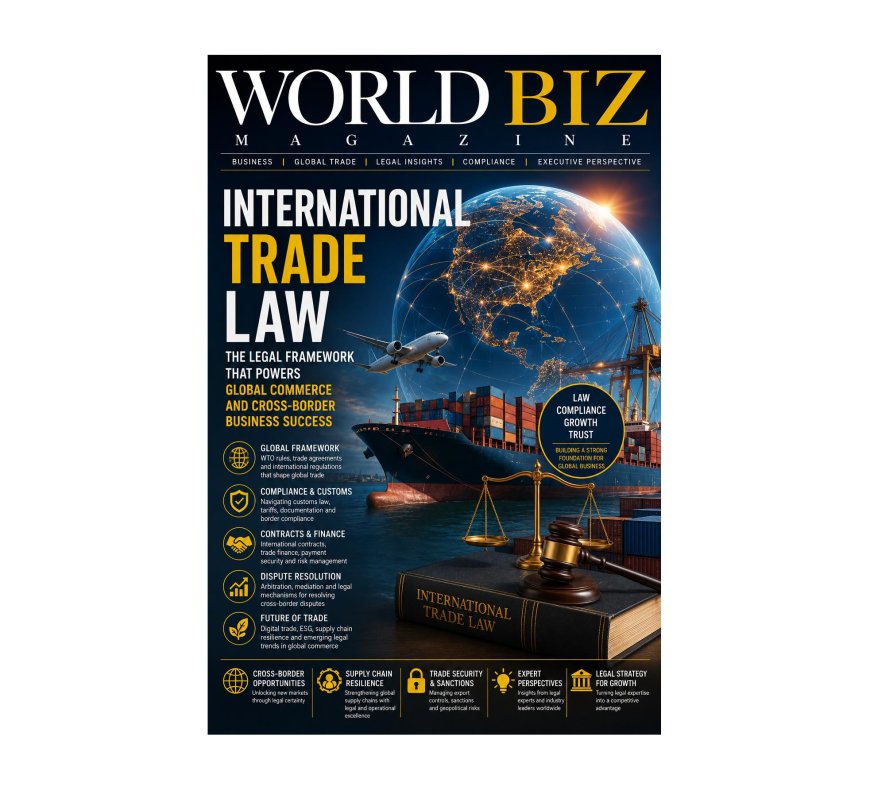
International Trade Law
The Legal Framework Powering Global Commerce, Supply Chains, and Cross-Border Business in an Era of Geopolitical Change
World Biz Magazine | International Trade | Global Commerce | International Business | Trade Compliance
The Legal Backbone of Global Trade
International trade has become one of the defining forces of the modern global economy. Every day, trillions of dollars' worth of goods, services, technology, intellectual property, and digital products move across borders, connecting manufacturers, suppliers, logistics providers, governments, financial institutions, and consumers in an increasingly interconnected marketplace.
Behind every international shipment lies a complex legal framework that governs how businesses buy, sell, transport, finance, insure, and protect commercial transactions. This framework is known collectively as International Trade Law.
International Trade Law provides the rules that facilitate fair competition, reduce trade barriers, protect investments, resolve disputes, regulate customs procedures, safeguard intellectual property, and establish standards for international commercial relationships. Without these legal foundations, global commerce would be characterized by uncertainty, inconsistent regulations, and heightened commercial risk.
As businesses expand internationally, compliance with trade laws has become more than a legal obligation—it has become a strategic business necessity. Companies that understand international trade regulations are better equipped to manage risks, optimize global supply chains, build trusted partnerships, and compete successfully in international markets.
Understanding International Trade Law
International Trade Law is a collection of international treaties, national legislation, trade agreements, customs regulations, commercial practices, and legal principles that govern cross-border commercial activities.
Unlike domestic commercial law, international trade law must accommodate differing legal systems, languages, currencies, tax structures, political environments, and regulatory requirements.
Its primary objectives include:
- Promoting free and fair trade
- Reducing unnecessary trade barriers
- Encouraging economic cooperation
- Protecting investors and consumers
- Standardizing commercial practices
- Resolving international trade disputes
- Supporting sustainable economic development
International Trade Law evolves continuously to address technological innovation, geopolitical developments, environmental priorities, and changing patterns of global commerce.
The Foundation of Global Trade Governance
The international trading system is supported by a network of multilateral organizations, regional agreements, and national regulatory authorities.
At the center of this framework is the World Trade Organization (WTO), which establishes global rules governing trade between member economies. WTO agreements address tariffs, subsidies, customs valuation, technical standards, intellectual property, services, agriculture, and dispute settlement.
Complementing the WTO are regional and bilateral trade agreements that reduce tariffs, simplify customs procedures, encourage investment, and deepen economic cooperation between participating countries.
Examples include free trade agreements, customs unions, comprehensive economic partnerships, and regional economic communities that facilitate smoother movement of goods and services across borders.
Together, these legal frameworks create predictability and confidence for businesses engaged in international trade.
International Sales Contracts
Every international business transaction begins with a commercial agreement.
International sales contracts define the legal rights and obligations of buyers and sellers operating under different legal jurisdictions.
Well-structured contracts typically address:
- Product specifications
- Pricing
- Currency
- Delivery schedules
- Payment methods
- Shipping responsibilities
- Risk allocation
- Insurance requirements
- Inspection procedures
- Warranty obligations
- Force majeure provisions
- Governing law
- Dispute resolution mechanisms
Clearly drafted contracts reduce misunderstandings and provide legal certainty should disagreements arise during international transactions.
Customs Law and Border Compliance
Customs authorities play a vital role in regulating international trade.
Every shipment entering or leaving a country must comply with customs legislation governing documentation, product classification, valuation, duties, taxes, origin requirements, and inspection procedures.
Businesses must accurately declare:
- Harmonized System (HS) Codes
- Country of origin
- Customs value
- Product descriptions
- Import permits
- Export licenses
- Safety certifications
Failure to comply can result in shipment delays, financial penalties, cargo seizures, increased inspections, or criminal liability.
Effective customs compliance has become a major competitive advantage for global businesses operating high-volume international supply chains.
Tariffs, Trade Barriers, and Market Access
Tariffs remain one of the oldest instruments of trade policy.
Governments impose import duties to generate revenue, protect domestic industries, encourage local manufacturing, or respond to unfair trade practices.
Beyond tariffs, businesses increasingly encounter non-tariff barriers such as:
- Product standards
- Health regulations
- Environmental requirements
- Technical certifications
- Licensing procedures
- Import quotas
- Labeling requirements
- Security inspections
Companies entering foreign markets must understand both tariff obligations and regulatory compliance requirements to ensure successful market access.
Rules of Origin and Free Trade Agreements
Many countries participate in preferential trade agreements that reduce or eliminate customs duties.
To benefit from these agreements, exporters must satisfy specific Rules of Origin, which determine where products are legally considered to have been manufactured or substantially transformed.
Accurate origin certification can significantly reduce import costs and improve price competitiveness in international markets.
However, misuse of origin documentation can lead to substantial penalties and loss of preferential trade benefits.
International Trade Finance
Cross-border trade often involves substantial financial risk due to differences in geography, legal systems, and payment timing.
Trade finance instruments reduce these risks while supporting international commerce.
Common financial mechanisms include:
- Letters of Credit
- Documentary Collections
- Bank Guarantees
- Export Credit Insurance
- Supply Chain Finance
- Factoring
- Trade Credit Insurance
- Open Account Arrangements
Financial institutions play a crucial role in facilitating secure international transactions while minimizing payment uncertainty for buyers and sellers.
Logistics, Shipping, and International Transportation Law
Global supply chains depend upon sophisticated logistics networks spanning ports, airports, rail systems, highways, and digital transportation platforms.
International transportation law governs:
- Ocean freight
- Air cargo
- Rail transportation
- Multimodal logistics
- Marine insurance
- Cargo liability
- Bills of lading
- Freight forwarding
- Warehousing
- Delivery obligations
International Commercial Terms (Incoterms®), developed by the International Chamber of Commerce (ICC), define responsibilities relating to transportation costs, insurance, customs clearance, and risk transfer between buyers and sellers.
Selecting the appropriate Incoterm reduces disputes and clarifies commercial responsibilities.
Intellectual Property in International Trade
Knowledge-based assets have become central to international commerce.
Businesses increasingly trade:
- Software
- Digital products
- Trademarks
- Patents
- Industrial designs
- Copyrights
- Trade secrets
- Proprietary technologies
International intellectual property protection enables innovators to commercialize inventions while discouraging unauthorized copying.
Strong IP protection has become particularly important in sectors such as pharmaceuticals, technology, manufacturing, entertainment, biotechnology, and artificial intelligence.
Trade Sanctions and Export Controls
Governments frequently use trade restrictions to pursue foreign policy, national security, or economic objectives.
Export controls may regulate:
- Military technology
- Dual-use products
- Sensitive software
- Advanced semiconductors
- Telecommunications equipment
- Encryption technologies
Trade sanctions may restrict business with specific countries, industries, organizations, or individuals.
Businesses operating internationally must conduct rigorous compliance screening to avoid violating sanctions regimes, which can result in severe legal and financial consequences.
Digital Trade and E-Commerce
Digital commerce has dramatically expanded the scope of international trade.
Companies now sell:
- Software-as-a-Service (SaaS)
- Cloud computing
- Streaming platforms
- Digital media
- AI services
- Online education
- Professional consulting
- Digital advertising
Digital trade introduces new legal questions concerning:
- Data privacy
- Cross-border data transfers
- Consumer protection
- Electronic contracts
- Digital taxation
- Cybersecurity
- Platform regulation
As the digital economy grows, international legal frameworks continue evolving to address these emerging issues.
Sustainability and ESG in Global Trade
Environmental, Social, and Governance (ESG) considerations are becoming increasingly important in international trade.
Global businesses are expected to demonstrate:
- Responsible sourcing
- Ethical labor practices
- Carbon emissions reporting
- Supply chain transparency
- Environmental compliance
- Human rights due diligence
- Circular economy initiatives
Many multinational corporations now evaluate suppliers based not only on price and quality but also on sustainability performance and regulatory compliance.
ESG has become a commercial differentiator as well as a legal consideration.
Trade Dispute Resolution
Despite careful planning, international commercial disputes occasionally arise.
Disagreements may involve:
- Payment defaults
- Product quality
- Contract interpretation
- Delivery delays
- Customs classification
- Intellectual property infringement
- Breach of warranty
- Regulatory compliance
International dispute resolution mechanisms include:
- Commercial negotiation
- Mediation
- Arbitration
- Domestic courts
- International tribunals
International arbitration has become particularly popular due to its neutrality, confidentiality, enforceability, and efficiency across multiple jurisdictions.
Emerging Challenges in International Trade Law
The global trading environment is becoming increasingly complex.
Businesses now face challenges such as:
- Geopolitical tensions
- Trade wars
- Economic sanctions
- Supply chain disruptions
- Cybersecurity threats
- Artificial Intelligence regulation
- Climate-related trade policies
- Digital taxation
- Data localization laws
- Economic nationalism
Legal teams must continuously monitor regulatory developments across multiple jurisdictions to ensure ongoing compliance.
The Future of International Trade Law
Technology is reshaping nearly every aspect of global commerce.
Future legal developments are expected in areas including:
- AI-assisted customs processing
- Blockchain-enabled trade documentation
- Smart contracts
- Electronic bills of lading
- Digital trade agreements
- Carbon border adjustment mechanisms
- Automated compliance systems
- Supply chain traceability
- Cross-border digital identity
- International AI governance
The legal profession itself is increasingly adopting technology to improve compliance, contract management, dispute resolution, and regulatory reporting.
Businesses that embrace digital legal transformation are likely to gain operational efficiencies while reducing compliance risks.
Executive Perspective
International Trade Law has evolved far beyond customs duties and shipping documentation. It now forms the legal architecture supporting global investment, digital commerce, technology transfer, intellectual property protection, environmental responsibility, and international economic cooperation.
As geopolitical uncertainty, technological innovation, and regulatory complexity continue to reshape global markets, businesses must integrate legal strategy into every stage of international operations.
Organizations that proactively invest in trade compliance, contractual certainty, supply chain resilience, digital governance, and sustainable business practices will be better positioned to compete in an increasingly interconnected global economy.
In the coming decade, success in international trade will depend not only on producing exceptional products or services but also on understanding the legal systems that enable those products and services to move confidently across borders.
International Trade Law is therefore no longer merely a legal discipline—it has become a strategic driver of global business growth, operational resilience, and long-term competitive advantage.
World Biz Magazine Insights
International Trade Law has evolved from a regulatory framework focused primarily on tariffs and customs into a strategic foundation of the global economy. In today's interconnected marketplace, legal compliance is no longer confined to legal departments it influences corporate strategy, supply chain resilience, investment decisions, digital commerce, sustainability, and geopolitical risk management.
World Biz Magazine believes that the future of international trade will be shaped by five transformational forces:
1. Digital Trade Will Become the New Growth Engine
Cross-border commerce is rapidly shifting toward digital goods, cloud services, software platforms, artificial intelligence, financial technology, and e-commerce. Future trade agreements will increasingly address data governance, cybersecurity, digital taxation, and cross-border data flows alongside traditional goods and services.
2. Compliance Will Become a Competitive Advantage
Businesses that proactively invest in customs compliance, export controls, sanctions screening, ESG reporting, and supply chain transparency will reduce operational risk, strengthen stakeholder confidence, and gain easier access to international markets. Regulatory readiness is becoming a business differentiator rather than merely a legal requirement.
3. Supply Chain Diversification Will Redefine Global Trade
Recent geopolitical tensions, pandemics, regional conflicts, and climate-related disruptions have demonstrated the risks of overreliance on single-country sourcing. Organizations are increasingly adopting multi-country manufacturing, regional production hubs, and resilient logistics networks to improve business continuity.
4. Sustainability Will Influence Trade Policy
Environmental regulations, carbon reporting, ethical sourcing, and responsible manufacturing are becoming central elements of international trade policy. Businesses that embed Environmental, Social, and Governance (ESG) principles into their operations will be better positioned to meet evolving customer expectations and regulatory requirements.
5. Technology Will Transform Trade Administration
Artificial Intelligence, blockchain, smart contracts, digital customs platforms, predictive analytics, and automated compliance systems are modernizing international trade. Companies that embrace these technologies can improve efficiency, enhance transparency, and reduce administrative costs while strengthening risk management.
World Biz Magazine believes that International Trade Law should no longer be viewed solely as a legal discipline. It has become a strategic business capability that enables organizations to compete confidently in an increasingly complex and interconnected global economy. As trade rules continue to evolve, organizations that combine legal expertise with digital innovation and resilient operational strategies will be best positioned for sustainable international growth. The World Trade Organization (WTO) continues to provide the core multilateral framework for global trade rules, while regional agreements and national regulations increasingly shape day-to-day commercial operations.
Conclusion
International Trade Law remains one of the most important pillars of the global economic system, providing the legal certainty that allows businesses, investors, and governments to conduct cross-border commerce with confidence. From international sales contracts and customs compliance to intellectual property protection, trade finance, digital commerce, and dispute resolution, these legal frameworks support the movement of goods, services, capital, and innovation across international markets.
As globalization enters a new phase defined by technological advancement, geopolitical uncertainty, sustainability priorities, and digital transformation, international trade regulations will continue to evolve. Businesses must therefore move beyond reactive compliance and adopt proactive legal and risk-management strategies that align with long-term commercial objectives.
Organizations that invest in legal expertise, regulatory compliance, resilient supply chains, ethical business practices, and digital trade capabilities will be better equipped to navigate an increasingly dynamic global marketplace. In the years ahead, success in international business will depend not only on competitive products and services but also on a comprehensive understanding of the legal frameworks that govern global commerce.
International Trade Law is no longer simply about crossing borders—it is about building trust, reducing uncertainty, enabling innovation, and supporting sustainable economic growth in an increasingly interconnected world.
Disclaimer
This article is published by World Biz Magazine for editorial, educational, and informational purposes only. The content reflects independent editorial analysis based on internationally recognized legal principles, publicly available information, industry developments, and evolving trends in global commerce.
International trade laws, customs regulations, sanctions, tariffs, export controls, tax policies, and trade agreements differ by jurisdiction and are subject to frequent legislative and regulatory changes. Readers should not interpret this publication as legal, regulatory, tax, financial, investment, or professional advice. Organizations engaged in international trade should obtain guidance from qualified legal counsel, customs specialists, trade compliance professionals, and other relevant advisors before making commercial, contractual, investment, or operational decisions.
References to international organizations, treaties, governments, trade agreements, regulatory bodies, companies, products, or commercial practices are provided solely for informational and educational purposes and do not constitute endorsement, legal interpretation, or official representation by World Biz Magazine.
What's Your Reaction?
 Like
1
Like
1
 Dislike
0
Dislike
0
 Love
0
Love
0
 Funny
0
Funny
0
 Angry
0
Angry
0
 Sad
0
Sad
0
 Wow
0
Wow
0