








































































































































































Global Consumer Trends Outlook: How Consumer Behavior Is Changing | World Biz Magazine
Understand the key consumer trends shaping purchasing decisions, business innovation, and the global economy in today's rapidly evolving marketplace.

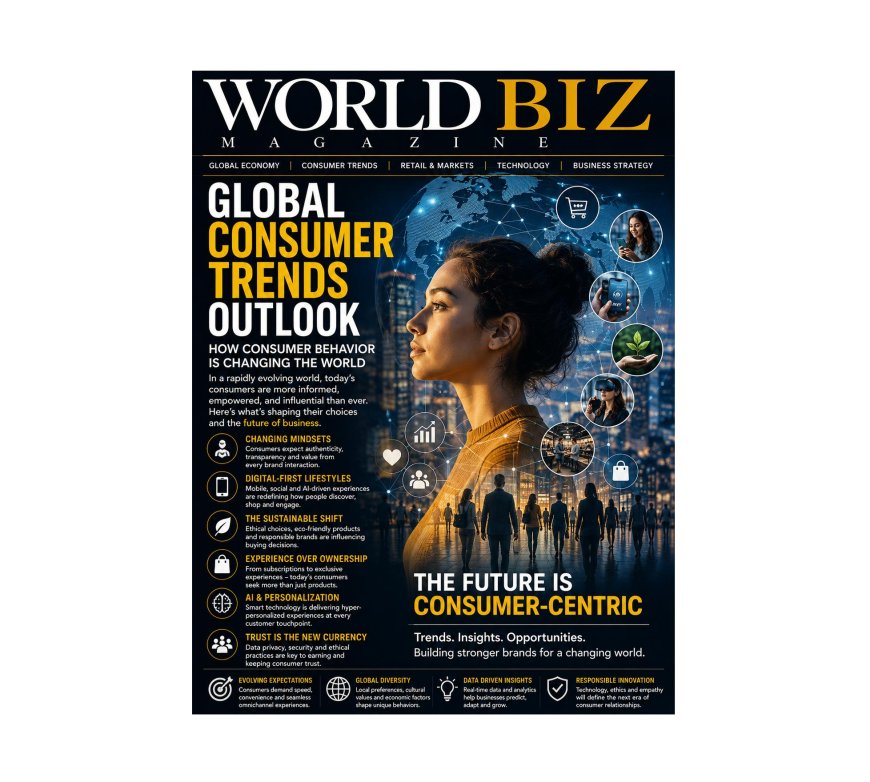
Global Consumer Trends Outlook
How Consumer Behavior Is Changing and What It Means for the Future of Business, Retail, Technology, and the Global Economy
World Biz Magazine | Consumer Trends | Global Economy | Retail | Marketing |
The Consumer Has Become the Center of the Global Economy
Consumer behavior has always influenced business success, but never before has it changed as rapidly or as profoundly as it is today. Digital transformation, artificial intelligence, economic uncertainty, demographic shifts, environmental awareness, technological innovation, and evolving lifestyles are collectively redefining how people discover, evaluate, purchase, and engage with products and services.
Today's consumers are more informed, connected, and empowered than any previous generation. A single purchasing decision is no longer influenced solely by price or product quality. Instead, customers increasingly evaluate brand reputation, sustainability, digital experiences, personalization, convenience, privacy, ethical business practices, and overall customer value before making purchasing decisions.
Businesses operating in every industry from retail and healthcare to finance, manufacturing, travel, entertainment, education, and technology must therefore understand not only what consumers buy but also why they buy, how they interact with brands, and what motivates long-term loyalty.
As global markets become increasingly interconnected, consumer expectations continue to evolve across both developed and emerging economies. Organizations capable of anticipating these changes are better positioned to innovate, strengthen customer relationships, and achieve sustainable growth.
Understanding Modern Consumer Behavior
Consumer behavior refers to the processes through which individuals identify needs, evaluate alternatives, make purchasing decisions, use products or services, and form long-term relationships with brands.
Historically, purchasing decisions were influenced primarily by availability, affordability, and product functionality.
Today, buying decisions involve a much broader range of considerations, including:
· Digital experiences
· Brand reputation
· Customer reviews
· Social influence
· Convenience
· Sustainability
· Data privacy
· Ethical business practices
· Personalization
· Emotional connection
This transformation has fundamentally shifted business strategy from product-centered thinking toward customer-centered innovation.
Digital Consumers Are Reshaping Global Markets
The widespread adoption of smartphones, high-speed internet, cloud computing, and digital platforms has created a generation of digitally connected consumers.
Modern buyers expect businesses to provide:
· Instant information
· Mobile-first experiences
· Fast delivery
· Digital payments
· Personalized recommendations
· Omnichannel shopping
· Real-time customer support
· Seamless checkout
Consumers increasingly move between websites, mobile applications, physical stores, and social media before completing purchases.
This interconnected journey requires businesses to deliver consistent experiences across every customer touchpoint.
Personalization Has Become a Competitive Advantage
Mass marketing is gradually giving way to individualized customer experiences.
Businesses increasingly leverage data analytics and Artificial Intelligence to deliver:
· Personalized product recommendations
· Customized promotions
· Individual pricing strategies
· Tailored marketing campaigns
· Personalized content
· Dynamic shopping experiences
Consumers increasingly expect brands to understand their preferences while respecting privacy and maintaining transparency regarding data usage.
Organizations that balance personalization with responsible data governance strengthen customer trust and loyalty.
Convenience Continues to Drive Purchasing Decisions
Convenience remains one of the strongest influences on modern consumer behavior.
Customers increasingly prioritize:
· One-click purchasing
· Same-day delivery
· Flexible payment options
· Mobile ordering
· Subscription services
· Self-service technology
· Contactless payments
· Easy returns
Businesses reducing friction throughout the customer journey often achieve higher conversion rates and stronger customer satisfaction.
Trust Has Become a Purchasing Currency
Corporate reputation increasingly influences buying decisions.
Consumers now evaluate:
· Product quality
· Brand credibility
· Online reviews
· Customer service
· Data security
· Ethical sourcing
· Transparency
· Corporate values
Trust has become a long-term strategic asset that differentiates businesses in highly competitive markets.
Organizations demonstrating consistent integrity often build stronger customer loyalty than those competing solely on price.
Sustainability Is Influencing Consumer Choices
Environmental awareness continues expanding across global markets.
Consumers increasingly consider:
· Sustainable packaging
· Carbon emissions
· Ethical sourcing
· Circular economy initiatives
· Renewable energy
· Waste reduction
· Responsible manufacturing
· Social responsibility
While purchasing priorities vary across regions and income levels, sustainability has become an important competitive factor for many global brands.
Organizations integrating Environmental, Social, and Governance (ESG) principles into their operations increasingly strengthen both brand reputation and customer engagement.
Social Commerce Continues to Expand
Social media platforms have evolved beyond communication channels into commercial ecosystems.
Consumers increasingly discover products through:
· Influencers
· Creator communities
· Short-form videos
· Live commerce
· User-generated content
· Social advertising
· Interactive shopping experiences
Businesses are increasingly integrating commerce directly into digital communities where purchasing decisions naturally occur.
Artificial Intelligence Is Transforming Consumer Experiences
Artificial Intelligence has become a powerful driver of customer engagement.
Businesses increasingly use AI for:
· Virtual shopping assistants
· Personalized recommendations
· Customer support chatbots
· Demand forecasting
· Dynamic pricing
· Inventory optimization
· Visual product search
· Voice commerce
AI enables businesses to deliver faster, more personalized, and highly efficient customer experiences while improving operational performance.
Consumers Expect Seamless Omnichannel Experiences
Modern consumers rarely distinguish between physical and digital retail environments.
Instead, they expect integrated experiences across:
· Physical stores
· E-commerce websites
· Mobile applications
· Social platforms
· Customer service channels
· Call centers
· Digital marketplaces
Successful businesses maintain consistent branding, pricing, inventory visibility, and customer service regardless of where customers engage.
Financial Pressures Continue to Shape Purchasing Decisions
Inflation, economic uncertainty, and changing household budgets continue influencing consumer priorities.
Many consumers increasingly seek:
· Better value
· Flexible financing
· Subscription optimization
· Loyalty rewards
· Product durability
· Price transparency
Rather than simply purchasing the lowest-priced products, consumers increasingly evaluate overall value relative to quality and long-term benefits.
The Growing Importance of Data Privacy
As personalization increases, consumers have become more concerned about how organizations collect, store, and utilize personal information.
Businesses must demonstrate:
· Transparent privacy policies
· Responsible data collection
· Secure payment systems
· Cybersecurity investment
· Regulatory compliance
Trustworthy data practices increasingly influence customer retention and brand perception.
Generational Differences Continue to Shape Markets
Different generations often demonstrate distinct purchasing behaviors.
Younger consumers frequently prioritize:
· Digital convenience
· Social influence
· Sustainability
· Brand authenticity
· Mobile commerce
Older consumers may place greater emphasis on:
· Reliability
· Customer service
· Product quality
· Brand familiarity
· Value
Understanding generational diversity enables businesses to develop more targeted marketing strategies.
Globalization and Local Preferences
Although digital commerce enables global expansion, consumer preferences remain influenced by local culture, regulations, language, payment methods, and purchasing habits.
Successful international businesses combine global operational efficiency with localized customer experiences.
Localization increasingly includes:
· Language adaptation
· Local currencies
· Regional payment methods
· Cultural marketing
· Local customer support
· Country-specific product offerings
This balance between global scale and local relevance strengthens international competitiveness.
Emerging Consumer Technologies
Several technologies are expected to reshape future consumer behavior.
These include:
· Artificial Intelligence
· Augmented Reality
· Virtual Reality
· Spatial Computing
· Voice Commerce
· Smart Homes
· Internet of Things
· Wearable Devices
· Digital Identity
· Autonomous Commerce
These innovations will continue redefining how consumers discover, evaluate, and purchase products.
Challenges Facing Businesses
Despite technological progress, organizations face several consumer-related challenges.
These include:
· Rising customer expectations
· Increasing competition
· Privacy regulations
· Cybersecurity risks
· Market saturation
· Supply chain disruption
· Economic uncertainty
· Brand differentiation
Businesses must continuously innovate while maintaining operational efficiency and customer trust.
The Future Consumer
The next generation of consumers will likely become even more digitally connected, environmentally conscious, financially informed, and technologically sophisticated.
Future purchasing decisions are expected to prioritize:
· Personalized experiences
· Ethical brands
· Transparent businesses
· Instant service
· Digital ecosystems
· AI-enabled convenience
· Sustainable products
· Trusted relationships
Businesses capable of adapting to these evolving expectations will be better positioned to compete in the future economy.
Executive Perspective
Consumer behavior is no longer changing incrementally it is undergoing structural transformation driven by technology, demographics, economic shifts, sustainability, and Artificial Intelligence.
Organizations that continue relying solely on traditional marketing, standardized customer experiences, and product-focused strategies risk falling behind increasingly agile competitors.
Future business success will depend upon understanding consumers as long-term partners rather than isolated transactions. Customer experience, trust, personalization, digital innovation, ethical governance, and operational excellence will collectively define competitive advantage.
As global markets become increasingly interconnected, organizations must continuously monitor consumer expectations while remaining flexible enough to respond to rapid technological and societal change.
In the coming decade, the businesses that thrive will not necessarily be those offering the largest product portfolios or lowest prices. Instead, they will be those that best understand evolving consumer behavior, anticipate emerging needs, and build trusted relationships that extend far beyond individual purchases.
The future of commerce belongs to organizations that place the consumer not the product at the center of every strategic decision.
Industry Outlook: How Consumer Trends Will Reshape Every Sector
The evolution of consumer behavior will influence virtually every industry over the next decade. Organizations will increasingly compete on their ability to understand customer expectations, deliver personalized experiences, and build long-term relationships rather than simply offering products or services. As consumer preferences become more dynamic, businesses will need to adopt flexible strategies supported by real-time data, advanced analytics, and continuous innovation.
Retailers will continue investing in omnichannel commerce, artificial intelligence, automated fulfillment, and experiential shopping to meet growing customer expectations. Financial institutions will develop more personalized digital banking services, while healthcare providers will focus on patient-centric digital experiences. The travel and hospitality industry will emphasize seamless booking, personalized itineraries, sustainability, and contactless services. Manufacturers will increasingly align product development with changing lifestyle preferences, environmental concerns, and demand for greater transparency throughout supply chains.
The Rise of the Experience Economy
Consumers are increasingly prioritizing experiences over ownership. Rather than simply purchasing products, customers seek memorable interactions that create emotional value and strengthen relationships with brands.
Businesses are responding by investing in:
- Personalized customer journeys
- Immersive retail experiences
- Interactive digital platforms
- Loyalty ecosystems
- Community engagement
- Exclusive memberships
- Live events
- Experiential marketing
The experience economy demonstrates that emotional connections often create stronger customer loyalty than price-based competition alone.
Hyper-Personalization Through Data Intelligence
The next phase of customer engagement will extend beyond basic personalization toward hyper-personalization powered by Artificial Intelligence, machine learning, and predictive analytics.
Businesses will increasingly analyze customer behavior to anticipate future needs before purchasing decisions are made.
This may include:
- Predictive product recommendations
- Personalized pricing strategies
- AI-generated shopping assistants
- Customized subscription plans
- Intelligent customer support
- Context-aware promotions
Organizations capable of delivering relevant experiences while respecting customer privacy will likely strengthen long-term engagement and competitive differentiation.
Consumer Expectations Around Speed Continue to Increase
The digital economy has fundamentally changed perceptions of time.
Consumers increasingly expect:
- Instant customer support
- Immediate payment confirmation
- Same-day delivery
- Real-time shipment tracking
- Fast refunds
- Rapid issue resolution
- Continuous service availability
Businesses that reduce waiting times throughout the customer journey often experience higher customer satisfaction, stronger retention, and increased repeat purchases.
Operational efficiency therefore becomes an important component of customer experience.
Digital Communities Influence Purchasing Decisions
Consumers increasingly rely on online communities when researching products and services.
Recommendations from:
- Friends
- Professional networks
- Industry experts
- Online communities
- Customer reviews
- Video creators
- Influencers
- Independent analysts
often influence purchasing decisions more than traditional advertising.
Businesses should therefore focus on building authentic communities that encourage dialogue, customer participation, and long-term brand advocacy.
Brand Authenticity Is Becoming More Valuable
Modern consumers increasingly evaluate whether businesses genuinely reflect their publicly communicated values.
Organizations that consistently demonstrate:
- Honest communication
- Ethical leadership
- Responsible sourcing
- Employee well-being
- Customer transparency
- Community engagement
- Environmental responsibility
often strengthen customer trust and long-term brand loyalty.
Authenticity has become an important differentiator in increasingly competitive markets.
Data-Driven Decision Making Will Define Future Marketing
Marketing strategies are becoming increasingly dependent upon measurable customer intelligence.
Organizations now analyze:
- Purchase behavior
- Customer lifetime value
- Shopping frequency
- Customer retention
- Digital engagement
- Search behavior
- Product preferences
- Geographic trends
These insights enable businesses to allocate resources more efficiently while improving marketing effectiveness and return on investment.
Subscription-Based Consumer Relationships
Subscription business models continue expanding beyond media and software.
Consumers increasingly subscribe to:
- Food delivery services
- Beauty products
- Healthcare services
- Fitness programs
- Education platforms
- Automotive services
- Household essentials
- Professional software
Subscription models strengthen recurring revenue while creating continuous engagement between businesses and customers.
Ethical Artificial Intelligence Will Influence Consumer Trust
Artificial Intelligence offers significant opportunities for improving customer experiences. However, consumers increasingly expect AI systems to operate responsibly.
Businesses deploying AI should prioritize:
- Transparency
- Fairness
- Privacy protection
- Human oversight
- Responsible automation
- Data security
Organizations that demonstrate ethical AI governance are more likely to earn customer confidence while supporting responsible innovation.
Consumer Education Is Becoming a Competitive Advantage
Today's customers actively research products before making purchasing decisions.
Businesses increasingly provide:
- Educational content
- Product demonstrations
- Buying guides
- Expert insights
- Customer tutorials
- Interactive experiences
- Knowledge centers
Educated consumers often become more confident buyers while developing stronger trust in brands that provide valuable information rather than purely promotional messaging.
Preparing for the Next Generation of Consumers
Future consumers will grow up in environments shaped by Artificial Intelligence, connected devices, immersive digital experiences, autonomous technologies, and increasingly personalized services.
Businesses preparing for the next decade should invest in:
- Digital transformation
- Customer intelligence
- Flexible technology platforms
- Sustainable business practices
- Innovation ecosystems
- Responsible AI
- Workforce development
- Continuous customer research
Organizations that anticipate future expectations rather than simply reacting to market changes will be better positioned to achieve sustainable competitive advantage.
Final Executive Reflection
Consumer behavior has become one of the most dynamic forces shaping the global economy. Every advancement in technology, every shift in demographics, every economic cycle, and every societal transformation influences how people discover brands, evaluate products, make purchasing decisions, and build long-term relationships with organizations.
The businesses that will define the next decade are unlikely to succeed solely through operational scale or product innovation. Their competitive advantage will increasingly come from understanding people their motivations, expectations, values, concerns, and evolving lifestyles.
Organizations that combine advanced technology with empathy, responsible leadership, trusted brands, and exceptional customer experiences will be best positioned to thrive in an increasingly intelligent, connected, and customer-driven global marketplace. In the future, consumer-centricity will not simply be a marketing philosophy—it will become the foundation of sustainable business success.
World Biz Magazine Insights
Consumer behavior is entering one of the most transformative periods in modern economic history. Advances in Artificial Intelligence, digital commerce, financial technology, sustainability initiatives, demographic shifts, and evolving consumer expectations are fundamentally reshaping how businesses create value and compete in global markets.
World Biz Magazine believes that the future of business will be defined not by the companies that simply produce the best products, but by those that build the strongest customer relationships through trust, innovation, personalization, and responsible business practices.
Our editorial analysis identifies six major trends that will shape the next generation of global consumer markets.
1. Consumer-Centric Business Models Will Become the Global Standard
The era of product-first strategies is gradually giving way to customer-first business models. Organizations are increasingly designing products, services, pricing, marketing, and customer experiences around evolving consumer needs rather than internal operational priorities.
Businesses that continuously collect customer insights and adapt quickly to changing preferences will strengthen long-term competitiveness and customer loyalty.
2. Artificial Intelligence Will Personalize Every Customer Journey
Artificial Intelligence is transforming every stage of the customer lifecycle from product discovery and recommendation engines to customer support, pricing optimization, inventory forecasting, and after-sales engagement.
Rather than replacing human interaction, AI will increasingly enhance customer experiences by delivering faster, more relevant, and highly personalized services. Companies that use AI responsibly while protecting consumer privacy will be best positioned to earn long-term trust.
3. Digital Trust Will Become a Critical Competitive Advantage
As consumers share more personal information across digital platforms, trust will become one of the most valuable assets a business can build.
Organizations that demonstrate strong cybersecurity, transparent data practices, ethical Artificial Intelligence, responsible marketing, and regulatory compliance will differentiate themselves in increasingly competitive markets.
Trust will influence not only purchasing decisions but also customer retention, brand advocacy, investor confidence, and enterprise value.
4. Sustainability Will Move from Preference to Expectation
Consumers increasingly expect organizations to operate responsibly by reducing environmental impact, supporting ethical supply chains, promoting responsible sourcing, and demonstrating meaningful Environmental, Social, and Governance (ESG) commitments.
While affordability and quality remain essential purchasing considerations, sustainability is becoming an increasingly important factor influencing long-term brand preference and consumer loyalty.
Businesses integrating sustainability into core strategy rather than treating it solely as a marketing initiative are likely to strengthen both reputation and long-term resilience.
5. Omnichannel Experiences Will Define Customer Expectations
Consumers no longer distinguish between online and offline shopping. They expect a consistent experience whether interacting through websites, mobile applications, physical stores, social media, marketplaces, or customer service channels.
Future business leaders will focus on creating seamless ecosystems where customers can discover, purchase, receive support, and engage with brands without friction across every touchpoint.
6. Consumer Intelligence Will Become a Strategic Business Asset
Data-driven decision-making will increasingly shape product innovation, marketing investment, inventory management, customer service, and long-term corporate strategy.
Organizations capable of transforming customer insights into actionable business intelligence will respond more effectively to changing market conditions while identifying emerging opportunities ahead of competitors.
World Biz Magazine believes that understanding consumers has become one of the most valuable strategic capabilities in modern business. The organizations that continuously monitor changing behaviors, embrace innovation, and build authentic customer relationships will define the future of global commerce.
Conclusion
Consumer behavior is evolving at an unprecedented pace, driven by technological innovation, digital connectivity, economic uncertainty, demographic change, and increasing expectations for personalized, transparent, and responsible business practices. These transformations are influencing every industry, from retail and financial services to healthcare, manufacturing, travel, education, and entertainment.
For businesses, understanding consumer behavior is no longer limited to marketing departments. It has become a strategic priority that shapes product development, operational planning, customer experience, investment decisions, digital transformation, and long-term growth strategies.
Organizations that actively monitor emerging trends, invest in customer intelligence, embrace Artificial Intelligence responsibly, strengthen digital trust, and deliver seamless omnichannel experiences will be better equipped to adapt to future market conditions and maintain lasting competitive advantage.
Ultimately, the future belongs to businesses that recognize consumers not simply as customers, but as long-term partners whose expectations, values, and experiences drive innovation and sustainable economic growth. In an increasingly connected world, consumer insight will become one of the most powerful assets any organization can possess.
Disclaimer
This article is published by World Biz Magazine for editorial, educational, and informational purposes only. The analysis, observations, and opinions presented are based on publicly available market information, global consumer trends, independent editorial research, and widely recognized industry developments.
The content should not be interpreted as financial, investment, legal, marketing, business consulting, or professional advice. Consumer behavior varies across countries, industries, cultures, demographic groups, and economic conditions, and future market developments may differ based on technological advancements, regulatory changes, geopolitical events, and evolving consumer preferences.
References to technologies, business models, industries, organizations, products, brands, market practices, or consumer trends are provided solely for informational and educational purposes and do not constitute endorsement, certification, commercial affiliation, or recommendation by World Biz Magazine. The magazine supports responsible innovation, ethical business practices, consumer protection, transparency, sustainability, and data-driven decision-making as essential foundations for long-term business success and inclusive global economic development.
What's Your Reaction?
 Like
0
Like
0
 Dislike
0
Dislike
0
 Love
0
Love
0
 Funny
0
Funny
0
 Angry
0
Angry
0
 Sad
0
Sad
0
 Wow
0
Wow
0