
























































































































































































Partial Divestment and Value Unlocking: Strategies for Business Growth | World Biz Magazine
Understand how businesses use partial divestment to unlock value, improve operational focus, strengthen brands, and achieve sustainable growth.

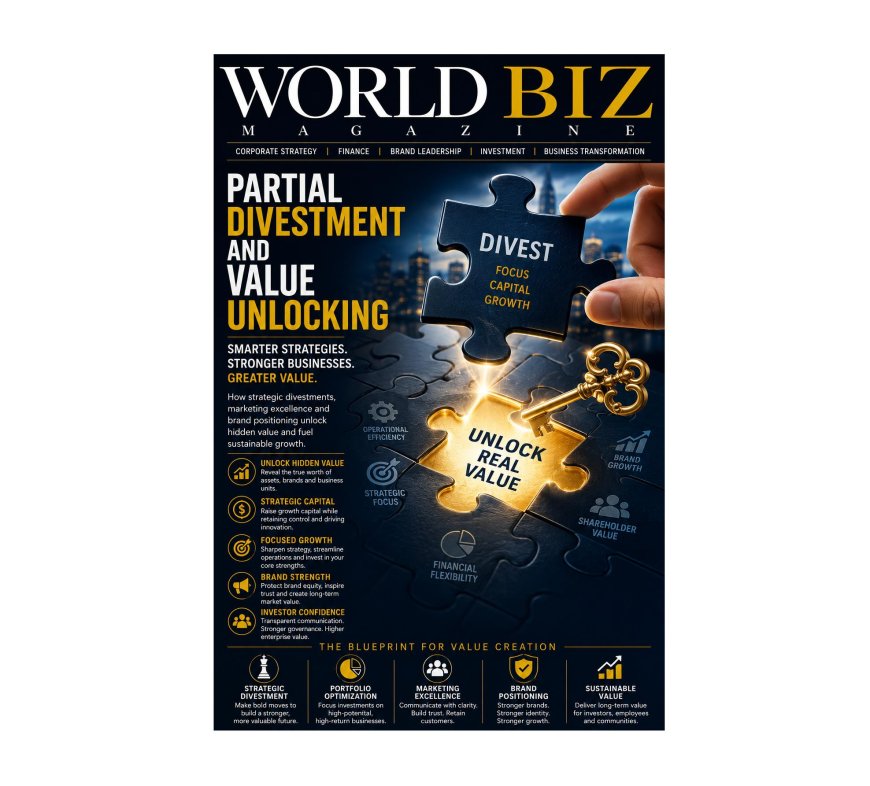
Partial Divestment and Value Unlocking
How Strategic Divestitures, Marketing Excellence, and Brand Positioning Can Maximise Enterprise Value and Drive Sustainable Growth
World Biz Magazine | Corporate Strategy | Marketing Strategy | Brand Management | M&A
Redefining Growth Through Strategic Divestment
For decades, corporate growth was primarily associated with acquisitions, mergers, market expansion, and diversification. Companies pursued larger portfolios, broader geographic footprints, and increasingly complex organizational structures in pursuit of scale and market dominance. While these strategies remain relevant, today's dynamic business environment has introduced another powerful strategic lever partial divestment.
Rather than selling an entire business, organizations are increasingly divesting selected business units, minority ownership stakes, product lines, brands, or non-core assets while retaining strategic control over the remaining enterprise. This approach enables businesses to unlock hidden value, strengthen financial flexibility, attract strategic investors, and sharpen their focus on core competencies.
Partial divestment is no longer viewed as a sign of corporate weakness or financial distress. Instead, it has become a sophisticated strategy employed by multinational corporations, family-owned businesses, technology firms, consumer brands, private equity investors, and high-growth startups seeking to optimize enterprise value while accelerating innovation.
When supported by a well-defined marketing and branding strategy, partial divestment can transform both the divested business and the parent organization, creating new opportunities for investors, customers, employees, and shareholders alike.
Understanding Partial Divestment
Partial divestment refers to the strategic sale or transfer of a portion of a company's ownership, assets, subsidiaries, product divisions, intellectual property, or business operations while maintaining ownership or influence over the remaining business.
Unlike a complete acquisition or full disposal, partial divestment allows organizations to retain strategic participation while generating capital and improving operational focus.
Common forms of partial divestment include:
· Selling minority equity stakes
· Carving out business divisions
· Spin-offs
· Joint ventures
· Strategic partnerships
· Franchise expansion
· Brand licensing
· Asset monetization
· Initial Public Offerings (IPOs) of subsidiaries
Each structure serves different strategic objectives depending on market conditions and long-term corporate goals.
Why Companies Choose Partial Divestment
Organizations pursue partial divestments for numerous strategic reasons beyond raising capital.
Common objectives include:
· Unlocking shareholder value
· Improving operational efficiency
· Focusing on core business activities
· Reducing debt
· Funding innovation
· Accelerating digital transformation
· Expanding internationally
· Attracting strategic investors
· Enhancing corporate valuation
· Simplifying organizational structures
In many cases, individual business units may possess significant market value that is not fully reflected within a larger diversified corporation. By separating or partially divesting these assets, companies can allow investors to value each business independently, often resulting in higher combined valuations.
Understanding Value Unlocking
Value unlocking refers to strategies that reveal the intrinsic worth of assets, brands, technologies, customer relationships, or business divisions that may be undervalued within an existing corporate structure.
Hidden value often exists because:
· Conglomerate structures obscure business performance.
· High-growth divisions are overshadowed by mature businesses.
· Brand assets remain under-commercialized.
· Intellectual property lacks dedicated investment.
· Capital allocation is inefficient.
· Investors struggle to evaluate complex portfolios.
Strategic divestment creates greater transparency, allowing markets to assign more accurate valuations to individual businesses.
Marketing Strategy During Partial Divestment
Marketing plays a critical role in ensuring that partial divestment strengthens rather than weakens market confidence.
Customers often have concerns regarding:
· Product continuity
· Service quality
· Customer support
· Brand ownership
· Future innovation
· Long-term stability
A proactive marketing strategy should reassure stakeholders that the transition enhances rather than disrupts customer value.
Effective marketing objectives include:
· Maintaining customer trust
· Communicating strategic vision
· Reinforcing product quality
· Highlighting investment opportunities
· Demonstrating long-term commitment
· Managing public perception
Transparent communication minimizes uncertainty and protects brand reputation during organizational change.
Branding Strategy for Value Creation
Brand equity frequently represents one of a company's most valuable intangible assets.
During partial divestment, organizations must carefully determine how brands will be positioned.
Potential branding approaches include:
Parent Brand Retention
The divested business continues operating under the parent company's established brand, benefiting from existing customer recognition and trust.
Independent Brand Creation
The divested entity develops its own distinct identity, positioning itself for independent growth and strategic differentiation.
Endorsed Brand Strategy
The new business maintains its own identity while retaining an endorsement from the parent company, balancing independence with credibility.
Selecting the appropriate branding model depends upon customer expectations, competitive positioning, long-term strategy, and investor objectives.
Investor Communications
Investors evaluate divestments differently than customers.
Their primary concerns include:
· Future revenue growth
· Profitability
· Return on investment
· Capital allocation
· Strategic rationale
· Governance
· Risk management
· Market positioning
Companies should clearly explain:
· Why the divestment is occurring.
· How proceeds will be utilized.
· Expected financial impact.
· Growth opportunities.
· Long-term corporate strategy.
Strong investor communication reduces uncertainty while increasing market confidence.
Digital Marketing During Corporate Transformation
Digital communication has become central to corporate restructuring initiatives.
Organizations should leverage:
· Corporate websites
· Investor relations portals
· LinkedIn
· Executive interviews
· Webinars
· Press releases
· Email communications
· Industry publications
· Financial media
· Thought leadership articles
Consistent messaging across all channels reinforces strategic clarity while minimizing misinformation.
Brand Equity as a Financial Asset
Modern corporate valuations increasingly recognize intangible assets.
These include:
· Brand reputation
· Customer loyalty
· Intellectual property
· Digital communities
· Software platforms
· Data assets
· Technology ecosystems
Strong brands often command premium valuations because they reduce customer acquisition costs, increase pricing power, and generate recurring revenue.
Partial divestment frequently allows these assets to receive independent market recognition.
Customer Experience During Divestment
Customers judge organizational change primarily through experience rather than corporate announcements.
Businesses should prioritize:
· Uninterrupted service delivery
· Product availability
· Customer support
· Consistent pricing
· Quality assurance
· Transparent communication
Protecting customer relationships remains essential throughout restructuring.
Positive customer experiences preserve long-term brand equity while reducing revenue disruption.
Internal Branding and Employee Engagement
Employees represent important ambassadors during periods of organizational transformation.
Internal communication should address:
· Strategic objectives
· Career opportunities
· Organizational structure
· Leadership vision
· Business continuity
· Cultural alignment
Confident employees strengthen customer relationships while supporting successful implementation.
Technology and Data in Value Unlocking
Digital transformation has expanded the sources of enterprise value.
Organizations increasingly unlock value through:
· Artificial Intelligence
· Customer analytics
· Cloud infrastructure
· Proprietary software
· Digital platforms
· Data monetization
· Subscription ecosystems
· Automation technologies
These assets often become more valuable when managed independently with dedicated investment.
Risks Associated with Partial Divestment
Despite its advantages, partial divestment introduces several strategic challenges.
Organizations must manage:
· Brand confusion
· Customer uncertainty
· Employee turnover
· Operational disruption
· Regulatory approvals
· Integration complexity
· Competitive responses
· Investor expectations
Comprehensive planning and disciplined execution are essential for mitigating these risks.
Global Trends Driving Partial Divestment
Several macroeconomic forces are accelerating divestment activity worldwide.
These include:
· Digital transformation
· Artificial Intelligence adoption
· ESG priorities
· Supply chain restructuring
· Rising interest in focused business models
· Activist investors
· Capital efficiency
· Geopolitical uncertainty
· Private equity investment
· Corporate portfolio optimization
Businesses increasingly recognize that focused organizations often outperform highly diversified structures.
The Future of Value Unlocking
Future corporate value creation will extend beyond physical assets.
Increasing emphasis will be placed on:
· Digital ecosystems
· Platform businesses
· Intellectual property
· Brand communities
· Customer data
· Artificial Intelligence capabilities
· Sustainable business models
· Innovation ecosystems
Organizations capable of identifying, separating, and maximizing these assets will likely generate superior long-term shareholder returns.
Executive Perspective
Partial divestment represents a strategic evolution in corporate growth rather than a retreat from expansion. By selectively monetizing assets while retaining strategic influence, organizations can unlock hidden enterprise value, improve financial flexibility, and sharpen their competitive focus.
However, financial engineering alone does not guarantee success. Sustainable value creation depends upon transparent communication, disciplined execution, strong governance, effective marketing, and thoughtful brand management.
Companies that integrate corporate strategy with marketing excellence and brand positioning are better equipped to maintain stakeholder confidence while maximizing long-term enterprise value.
In an increasingly competitive global economy, partial divestment is becoming more than a restructuring tool it is emerging as a powerful strategy for innovation, investment attraction, and sustainable business transformation. For forward-looking organizations, unlocking value is no longer simply about selling assets; it is about revealing the full potential of brands, technologies, people, and business ecosystems.
Best Uses of Partial Divestment and Value Unlocking
Partial divestment is not a one-size-fits-all strategy. When aligned with clear business objectives, market conditions, and long-term corporate vision, it can become one of the most effective tools for accelerating growth, improving financial performance, and enhancing enterprise value. The following are among the most impactful applications of partial divestment across industries.
Raising Growth Capital Without Losing Control
One of the most common uses of partial divestment is raising capital while allowing existing owners to retain strategic control of the business. Rather than selling the entire company, organizations can monetize a minority ownership stake and use the proceeds to fund expansion, research and development, acquisitions, technology upgrades, or international market entry.
This approach enables businesses to strengthen their financial position without sacrificing long-term ownership or decision-making authority.
Unlocking Hidden Enterprise Value
Large organizations often own business units, brands, technologies, or intellectual property that receive limited recognition within a diversified corporate structure. Partial divestment allows these assets to operate independently, making their financial performance more transparent and enabling investors to assign a more accurate market valuation.
This strategy frequently results in higher combined enterprise value than maintaining all assets within a single corporate entity.
Attracting Strategic Investors
Beyond financial investment, partial divestment can bring experienced strategic partners into the business. Investors may contribute industry expertise, global distribution networks, advanced technologies, operational knowledge, or access to new markets.
The right strategic partnership can significantly accelerate innovation, market expansion, and competitive positioning.
Accelerating Digital Transformation
Organizations undergoing digital transformation often require significant investment in artificial intelligence, cloud infrastructure, automation, cybersecurity, analytics, and software development.
Partial divestment provides access to capital that can finance these initiatives while allowing management to remain focused on executing long-term digital strategies.
Supporting International Expansion
Entering new international markets requires investment in local operations, regulatory compliance, marketing, logistics, and partnerships. Partial divestment provides funding while enabling organizations to retain ownership of core operations and benefit from future growth.
This approach is particularly valuable for companies expanding into emerging markets or establishing regional operations.
Strengthening Brand Portfolios
Companies managing multiple brands may choose to separate premium, luxury, consumer, or regional brands into independent business units with dedicated leadership and investment strategies.
This enables each brand to develop a more focused market position, clearer customer identity, and stronger long-term growth potential.
Preparing for Future Public Listings
Many organizations use partial divestment as an intermediate step before an Initial Public Offering (IPO). By separating a business unit, improving governance, and establishing independent financial reporting, companies can enhance transparency and investor confidence ahead of a future stock market listing.
Improving Operational Focus
Corporate complexity can reduce organizational agility. Divesting non-core operations allows leadership teams to concentrate resources on their highest-performing products, services, and strategic priorities while improving decision-making and operational efficiency.
Enhancing Shareholder Returns
Value unlocking strategies often improve shareholder value by optimizing capital allocation, increasing profitability, strengthening balance sheets, and allowing markets to better recognize the value of individual business segments.
This can contribute to stronger long-term returns for investors while improving corporate financial flexibility.
Building Long-Term Corporate Resilience
Economic uncertainty, geopolitical tensions, technological disruption, and evolving customer expectations require organizations to remain agile. Partial divestment provides financial flexibility, simplifies corporate structures, and creates stronger, more focused businesses that are better equipped to adapt to changing market conditions.
World Biz Magazine Insights
Corporate value creation has entered a new era. In today's economy, the most valuable companies are not necessarily those with the largest asset bases but those that allocate capital efficiently, maintain strategic focus, and continuously optimize their business portfolios.
World Biz Magazine believes that partial divestment is increasingly becoming a strategic growth initiative rather than a defensive restructuring measure. It reflects a broader shift toward portfolio optimization, capital efficiency, and long-term enterprise transformation.
Our editorial analysis identifies five defining trends shaping the future of value unlocking:
Portfolio Optimization Will Replace Conglomerate Expansion
Many corporations are moving away from highly diversified structures toward focused portfolios where each business unit has a clear strategic purpose, stronger operational accountability, and greater investment visibility.
Brand Equity Will Be Recognized as a Core Financial Asset
Brands are no longer viewed solely as marketing tools. Strong brand equity contributes directly to enterprise valuation by driving customer loyalty, pricing power, market differentiation, and investor confidence. Organizations that actively invest in brand management are likely to create more sustainable long-term value.
Data, Technology, and Intellectual Property Will Drive Enterprise Valuation
Traditional valuation models focused primarily on physical assets and revenue. Modern enterprise value increasingly depends on digital platforms, proprietary technology, customer data, artificial intelligence capabilities, software ecosystems, and intellectual property. These intangible assets are becoming central to corporate competitiveness.
Strategic Partnerships Will Accelerate Growth
Future value creation will rely more heavily on collaboration than ownership alone. Joint ventures, minority investments, technology alliances, licensing agreements, and strategic partnerships will enable businesses to expand more rapidly while sharing investment requirements and operational risks.
Marketing Will Become a Strategic Value Driver
Successful divestments depend not only on financial execution but also on stakeholder confidence. Marketing, investor relations, corporate communications, and brand strategy play critical roles in preserving trust among customers, employees, regulators, partners, and shareholders throughout periods of organizational change.
World Biz Magazine believes that the most successful organizations of the next decade will be those that continuously evaluate their business portfolios, identify underutilized assets, invest in innovation, and communicate transformation with transparency and purpose. Value unlocking should not be viewed as an isolated transaction but as an ongoing strategic discipline that strengthens resilience, improves competitiveness, and supports sustainable growth.
Conclusion
Partial divestment and value unlocking have become essential components of modern corporate strategy. Rather than representing a reduction in business ambition, they provide organizations with the flexibility to reallocate capital, sharpen strategic focus, strengthen governance, and unlock the full potential of both tangible and intangible assets.
When supported by disciplined financial planning, effective marketing, strong brand management, and transparent stakeholder communication, partial divestment can create significant value for shareholders, investors, customers, employees, and strategic partners alike.
As industries continue to evolve through digital transformation, artificial intelligence, sustainability initiatives, and changing investor expectations, organizations must continually reassess how capital and resources are deployed. Businesses that actively optimize their portfolios while preserving customer trust and brand equity will be better positioned to achieve sustainable long-term growth.
Ultimately, value unlocking is not simply about selling assets it is about recognizing opportunity, maximizing strategic potential, and building stronger, more agile enterprises capable of thriving in an increasingly competitive global marketplace.
Disclaimer
This article is published by World Biz Magazine for editorial, educational, and informational purposes only. The opinions, analysis, and observations presented are based on publicly available market information, corporate finance principles, industry practices, and emerging business trends.
The content should not be interpreted as legal, financial, investment, accounting, tax, valuation, merger and acquisition (M&A), or strategic advisory services. Every organization operates within unique commercial, regulatory, financial, and operational circumstances. Readers should seek independent advice from qualified legal counsel, investment bankers, financial advisors, accountants, valuation experts, and corporate strategy professionals before making decisions relating to divestments, mergers, acquisitions, restructuring, capital raising, investments, or portfolio optimization.
References to business models, corporate strategies, financial instruments, organizations, brands, or market practices are provided solely for educational and informational purposes and do not constitute endorsement, investment recommendations, or commercial affiliation by World Biz Magazine. Market conditions, regulations, valuation methodologies, and corporate governance standards vary across jurisdictions and may change over time.
What's Your Reaction?
 Like
0
Like
0
 Dislike
0
Dislike
0
 Love
0
Love
0
 Funny
0
Funny
0
 Angry
0
Angry
0
 Sad
0
Sad
0
 Wow
0
Wow
0