














































































































































































































Platform Risk Management: Strategies to Secure Digital Ecosystems
Learn how platform businesses manage risks, from cybersecurity to compliance, and build resilient, scalable digital ecosystems.

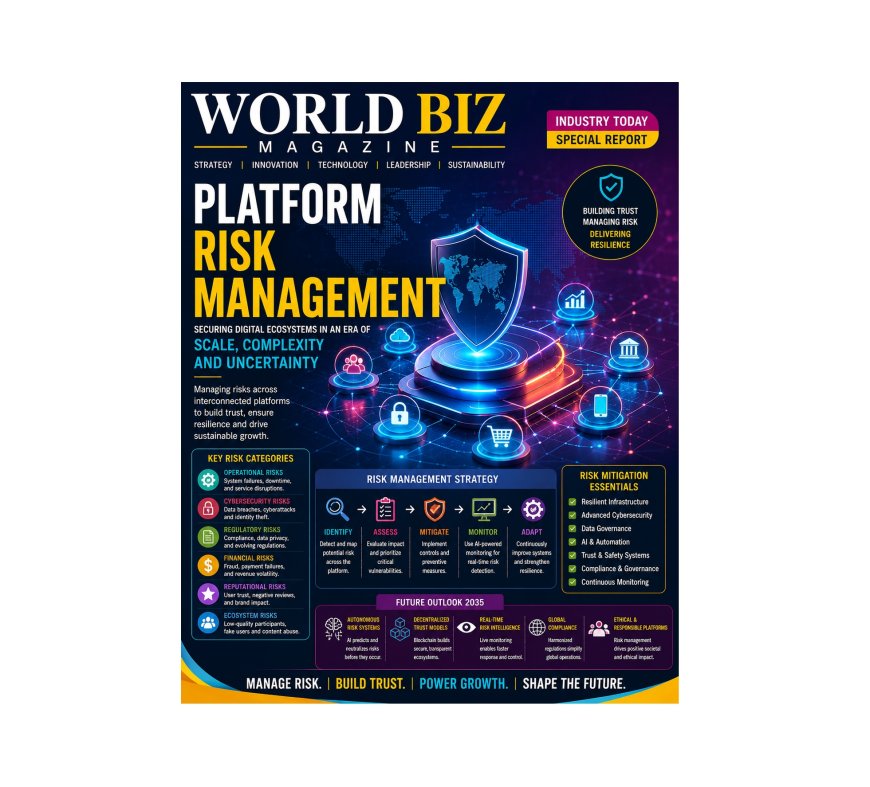
Platform Risk Management
Securing Digital Ecosystems in an Era of Scale, Complexity, and Uncertainty
World Biz Magazine | Industry Today Special Report
Delivering global insights on the trends shaping tomorrow’s economy.
The Fragile Strength of Digital Platforms
In the modern platform economy, scale is both a strength and a vulnerability. The same interconnected networks that enable exponential growth also expose platforms to systemic risks, operational disruptions, and reputational crises.
From global marketplaces and fintech ecosystems to mobility platforms and social networks, today’s digital platforms operate in environments defined by high velocity, massive data flows, and multi-sided user interactions. This complexity makes risk management not just a compliance function but a strategic necessity for survival and long-term dominance.
In an ecosystem where a single failure can cascade across millions of users, platform risk management has become the backbone of sustainable growth.
Understanding Platform Risk Management
Platform risk management refers to the identification, assessment, and mitigation of risks that arise from operating digital ecosystems connecting multiple stakeholders.
Unlike traditional businesses, platform risks are:
- Multi-dimensional (technical, financial, reputational, regulatory)
- Interconnected (one issue can impact the entire ecosystem)
- Scalable (risks grow with user base and data volume)
This makes platform risk management both complex and mission-critical.
Core Types of Risks in Platform Businesses
Operational Risks
Failures in platform functionality, infrastructure, or service delivery.
- System outages
- Poor user experience
- Supply-demand imbalances
Cybersecurity Risks
Digital platforms are prime targets for cyberattacks.
- Data breaches
- Identity theft
- Ransomware attacks
Regulatory & Compliance Risks
Governments are increasingly regulating platform activities.
- Data privacy laws (GDPR, etc.)
- Antitrust regulations
- Cross-border compliance challenges
Financial Risks
Risks tied to revenue models and transaction flows.
- Fraudulent transactions
- Payment failures
- Revenue volatility
Reputational Risks
Trust is everything in platform businesses.
- Negative reviews
- Misinformation
- User misconduct
Ecosystem Risks
Risks arising from participants within the platform.
- Low-quality suppliers
- Fake users or bots
- Content abuse
The Risk Amplification Effect
One of the defining characteristics of platform businesses is the risk amplification effect:
- A single vulnerability → affects millions of users
- One fraudulent actor → damages trust across the platform
- A minor outage → leads to global disruption
This interconnected nature means that risk is not isolated it is systemic.
Step-by-Step Platform Risk Management Strategy
Step 1: Risk Identification
- Map all potential risk areas across the platform
- Analyze user journeys and data flows
- Identify weak points in infrastructure and operations
Step 2: Risk Assessment
- Evaluate probability and impact of each risk
- Prioritize high-impact vulnerabilities
- Use risk scoring models
Step 3: Risk Mitigation Planning
- Develop preventive and corrective measures
- Implement security protocols
- Design fail-safe mechanisms
Step 4: Technology Integration
- Use AI for fraud detection
- Deploy real-time monitoring systems
- Implement automated alerts
Step 5: Governance & Compliance
- Establish clear policies and guidelines
- Ensure regulatory compliance across regions
- Conduct regular audits
Step 6: User Trust & Safety Mechanisms
- Ratings and review systems
- Identity verification
- Transparent dispute resolution
Step 7: Continuous Monitoring & Adaptation
- Track emerging risks
- Update systems regularly
- Learn from past incidents
Risk Mitigation Strategies
Build Resilient Infrastructure
Use cloud redundancy, load balancing, and backup systems to prevent downtime.
Strengthen Cybersecurity
Implement encryption, multi-factor authentication, and continuous threat detection.
Enhance Data Governance
Ensure secure storage, access control, and compliance with global data regulations.
Leverage AI & Automation
AI can detect anomalies, prevent fraud, and improve response time.
Foster a Trust-First Ecosystem
Encourage transparency, accountability, and ethical practices.
Diversify Revenue Streams
Reduce dependency on a single income source to manage financial risk.
Key Metrics for Risk Management
- Incident Response Time
- Fraud Detection Rate
- System Uptime (%)
- User Trust Score
- Compliance Score
- Data Breach Frequency
These metrics provide a measurable framework for risk performance and resilience.
Challenges in Platform Risk Management
- Rapid scaling outpacing risk controls
- Evolving cyber threats
- Complex global regulations
- Balancing growth with governance
- Maintaining user trust at scale
The Role of Technology in Risk Management
Advanced technologies are transforming how platforms manage risk:
- Artificial Intelligence → predictive risk detection
- Blockchain → transparent and secure transactions
- Cloud Computing → scalable and resilient infrastructure
- Big Data Analytics → real-time risk insights
Technology is shifting risk management from reactive to proactive.
Future Outlook: Platform Risk Management in 2035
The future of risk management will be defined by intelligence, automation, and decentralization:
1. Autonomous Risk Systems
AI will predict and neutralize risks before they occur.
2. Decentralized Trust Models
Blockchain-based systems will reduce reliance on centralized control.
3. Global Regulatory Harmonization
Standardized frameworks will simplify cross-border compliance.
4. Real-Time Risk Intelligence
Platforms will operate with continuous, live risk monitoring systems.
5. Ethical & Responsible Platforms
Risk management will extend to ethical AI, data usage, and societal impact.
Conclusion: Managing Risk Is Managing Growth
In platform businesses, risk is not a side concern it is a core strategic function.
The most successful platforms are not those that avoid risk, but those that:
- Anticipate it
- Manage it effectively
- Turn it into a competitive advantage
Because in a world driven by digital ecosystems,
trust is the ultimate currency and risk management is how it is protected.
World Biz Magazine Insights
- Platform risk management is critical for long-term scalability and sustainability
- Trust, security, and compliance are non-negotiable pillars
- AI and automation will define the future of risk control
- Platforms that manage risk effectively will dominate global markets
Disclaimer
This article is for informational purposes only and does not constitute legal, financial, or risk advisory services. Organizations should consult professionals for tailored risk management strategies.
What's Your Reaction?
 Like
1
Like
1
 Dislike
0
Dislike
0
 Love
0
Love
0
 Funny
0
Funny
0
 Angry
0
Angry
0
 Sad
0
Sad
0
 Wow
1
Wow
1