














































































































































































































The Business Models Powering Modern Digital Platforms
An in-depth analysis of platform monetization, attention economies, AI-powered revenue models, and digital ecosystem strategy.

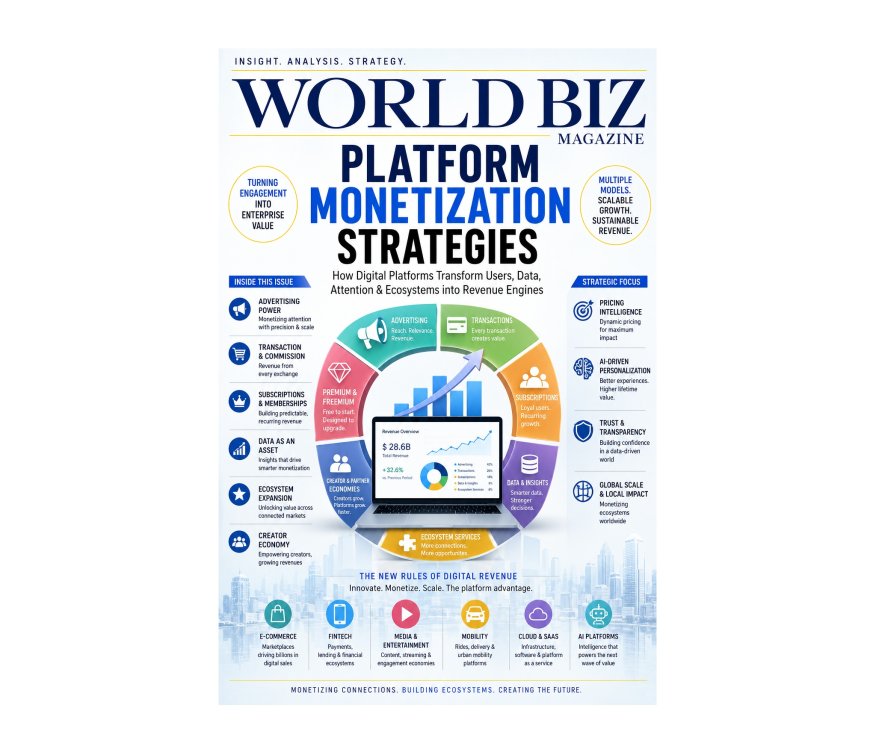
Platform Monetization Strategies
How Digital Platforms Transform Users, Data, Attention, and Ecosystems into Revenue Engines
World Biz Magazine | Business Strategy, Platform Economy & Digital Innovation
In the modern digital economy, some of the world’s most valuable companies provide services that appear free to consumers while generating billions in annual revenue. Behind this paradox lies one of the most sophisticated business transformations of the 21st century: platform monetization.
From social media networks and streaming services to e-commerce marketplaces, fintech applications, gaming ecosystems, mobility platforms, and AI-driven services, digital businesses are redefining how value is created, distributed, and monetized at global scale.
Unlike traditional companies that rely primarily on direct product sales, modern platforms monetize ecosystems converting engagement, transactions, network participation, data flows, subscriptions, and digital interactions into diversified revenue streams.
As digital ecosystems continue expanding across industries, platform monetization strategies are becoming central to modern business growth, competitive advantage, and long-term scalability.
The Evolution of Platform Monetization
Traditional business models were largely linear:
- Companies produced products
- Consumers purchased them
- Revenue came directly from sales
Platform businesses operate differently.
Modern platforms often:
- Connect multiple participant groups
- Facilitate interactions
- Generate network effects
- Capture behavioral data
- Monetize engagement ecosystems
In many cases, the platform itself does not own the inventory, content, vehicles, or products being exchanged.
Instead, the platform monetizes the infrastructure enabling transactions and interactions.
This shift has transformed monetization from simple sales generation into ecosystem orchestration.
Understanding Platform Economics
At the core of platform monetization lies a simple principle:The larger and more engaged the ecosystem becomes, the more monetization opportunities emerge.
Platforms create value by attracting:
- Users
- Businesses
- Advertisers
- Developers
- Merchants
- Content creators
- Financial partners
- Data ecosystems
As participation increases, network effects strengthen platform influence and revenue potential.
This creates scalable digital economies capable of generating multiple parallel income streams simultaneously.
Major Platform Monetization Models
Modern digital platforms rarely rely on a single revenue source.
The most successful ecosystems combine multiple monetization strategies.
Advertising-Based Monetization
Advertising remains one of the most dominant platform revenue models globally.
Platforms monetize user attention through:
- Display advertising
- Search advertising
- Sponsored listings
- Video advertising
- Influencer integrations
- AI-driven targeting
- Behavioral advertising
The effectiveness of platform advertising depends heavily on:
- User scale
- Engagement levels
- Data quality
- Algorithmic targeting
- Behavioral prediction
Platforms with stronger data ecosystems can offer more precise audience segmentation and advertising efficiency.
This has transformed attention into a highly valuable economic asset.
Transaction & Commission Fees
Many platforms monetize transactions occurring within their ecosystems.
Examples include:
- E-commerce marketplaces
- Food delivery platforms
- Ride-hailing services
- Booking platforms
- Payment gateways
- Freelance marketplaces
- App stores
Revenue is generated through:
- Transaction commissions
- Listing fees
- Payment processing charges
- Service fees
- Dynamic pricing models
This model scales efficiently because revenue grows alongside platform activity.
Subscription-Based Monetization
Subscription models provide recurring and predictable revenue streams.
Popular examples include:
- Streaming platforms
- SaaS ecosystems
- Cloud infrastructure
- Premium memberships
- Productivity tools
- AI platforms
- Gaming subscriptions
Subscriptions are attractive because they:
- Improve revenue stability
- Increase customer retention
- Enhance lifetime value
- Reduce advertising dependency
Many modern platforms now combine subscriptions with additional monetization layers.
Freemium Models
Freemium strategies offer core services free while charging for advanced features.
This approach is common across:
- Productivity applications
- AI tools
- Cloud storage
- Gaming ecosystems
- Communication platforms
The goal is to maximize user adoption before converting a portion of users into paying customers.
Freemium models are especially effective in network-driven environments where scale increases ecosystem value.
Data Monetization
Data has become one of the most valuable assets in platform economies.
Platforms monetize data through:
- Advertising optimization
- Market analytics
- Consumer insights
- AI training systems
- Enterprise intelligence
- Recommendation engines
Although many platforms do not directly “sell” user data, they monetize insights generated from data ecosystems.
This raises growing concerns regarding:
- Privacy
- Transparency
- Consumer consent
- Data governance
- Algorithmic accountability
Ecosystem Monetization
Large platforms increasingly monetize entire ecosystems rather than individual services.
Examples include:
- Cloud infrastructure
- Developer ecosystems
- Payment systems
- Digital identity services
- AI APIs
- Enterprise integrations
- Logistics infrastructure
This creates diversified revenue channels while strengthening ecosystem dependency.
The more integrated users become, the higher the switching costs.
Marketplace Visibility Monetization
Many platforms monetize visibility itself.
Businesses increasingly pay for:
- Sponsored placement
- Search ranking priority
- Discovery optimization
- Algorithmic visibility
- Premium listings
As digital competition intensifies, visibility becomes a strategic monetizable asset.
This model is especially dominant in:
- E-commerce
- App stores
- Search engines
- Travel platforms
- Social commerce ecosystems
Artificial Intelligence and the Future of Monetization
Artificial intelligence is rapidly transforming platform economics.
AI enables platforms to:
- Personalize recommendations
- Predict consumer behavior
- Optimize advertising
- Automate pricing
- Generate synthetic content
- Improve customer support
- Enhance search relevance
- Increase engagement duration
AI-powered monetization models may increasingly rely on:
- Conversational commerce
- AI subscriptions
- Enterprise AI services
- Usage-based AI billing
- API monetization
- AI-generated advertising systems
The integration of generative AI may fundamentally reshape how digital ecosystems capture value.
The Attention Economy
One of the most influential monetization trends is the rise of the attention economy.
In digital ecosystems:
- User attention becomes inventory
- Engagement becomes monetizable
- Time spent becomes measurable value
Platforms compete aggressively for:
- Screen time
- User retention
- Interaction frequency
- Behavioral predictability
Algorithms are designed to maximize engagement because engagement directly influences monetization potential.
This has reshaped industries including:
- Social media
- Streaming
- Gaming
- News publishing
- Creator economies
Creator Economies and Platform Revenue Sharing
Modern platforms increasingly depend on creator ecosystems to sustain engagement.
This has led to new monetization structures including:
- Revenue sharing
- Subscription creators
- Virtual tipping
- Affiliate commerce
- Live-stream monetization
- Sponsored content
- Digital collectibles
Creators are becoming critical participants in platform growth strategies.
Platforms that successfully balance creator incentives with monetization often achieve stronger ecosystem loyalty.
Risks and Challenges
Despite their profitability, platform monetization models face growing scrutiny.
Major concerns include:
- Over-commercialization
- Consumer fatigue
- Data privacy issues
- Regulatory intervention
- Algorithmic manipulation
- Market concentration
- Platform dependency
- Ad saturation
Excessive monetization can damage user trust and long-term ecosystem sustainability.
Balancing profitability with user experience is becoming increasingly important.
Regulation and Global Oversight
Governments worldwide are intensifying oversight of platform monetization practices.
Areas of focus include:
- Digital taxation
- Data privacy
- Antitrust regulation
- App store commissions
- Advertising transparency
- AI accountability
- Consumer protection
- Competitive fairness
Future regulations may significantly reshape platform revenue structures.
The Future of Platform Monetization
Several major trends are expected to shape the next phase of platform economics.
AI-Driven Revenue Models
AI subscriptions, AI assistants, and enterprise AI ecosystems may become dominant revenue categories.
Integrated Super Apps
Platforms may continue consolidating payments, commerce, entertainment, logistics, and communication into unified ecosystems.
Decentralized Monetization
Blockchain-based ecosystems may introduce alternative monetization structures through tokenized participation models.
Personalized Commerce
AI-driven personalization may dramatically improve conversion efficiency and monetization precision.
Usage-Based Digital Economies
Consumption-based pricing may expand across cloud, AI, and enterprise software ecosystems.
Conclusion
Platform monetization strategies have become some of the most powerful business mechanisms in the modern economy. By transforming attention, transactions, data, engagement, and digital ecosystems into scalable revenue engines, platforms have redefined how companies create value at global scale.
The future of monetization will increasingly depend on artificial intelligence, ecosystem integration, data infrastructure, and the ability to orchestrate multi-sided digital environments.
However, as platform influence expands, so too will debates surrounding competition, privacy, regulation, transparency, and economic concentration.
The next generation of market leaders may ultimately be defined not only by what they sell, but by how effectively they monetize the ecosystems surrounding modern digital life.
World Biz Magazine Insights
The most successful digital platforms of the future will likely be those capable of balancing monetization efficiency with ecosystem trust. As AI, commerce, cloud infrastructure, fintech, and creator economies converge, platform monetization is evolving from a business function into a strategic architecture shaping the future of global digital markets.
Disclaimer
This article is intended for informational and editorial purposes only and does not constitute financial, investment, legal, regulatory, or business advisory guidance. Market observations and strategic analysis are based on evolving digital economy trends and publicly available industry information.
What's Your Reaction?
 Like
0
Like
0
 Dislike
0
Dislike
0
 Love
0
Love
0
 Funny
0
Funny
0
 Angry
0
Angry
0
 Sad
0
Sad
0
 Wow
0
Wow
0