


































































































































































































Will AI Replace Entry-Level Freelancers? The Future of Writing, Design & Coding | World Biz Magazine
Artificial Intelligence is changing the freelance economy. Learn who is most at risk, who will thrive, and how businesses can prepare for the AI-powered future.

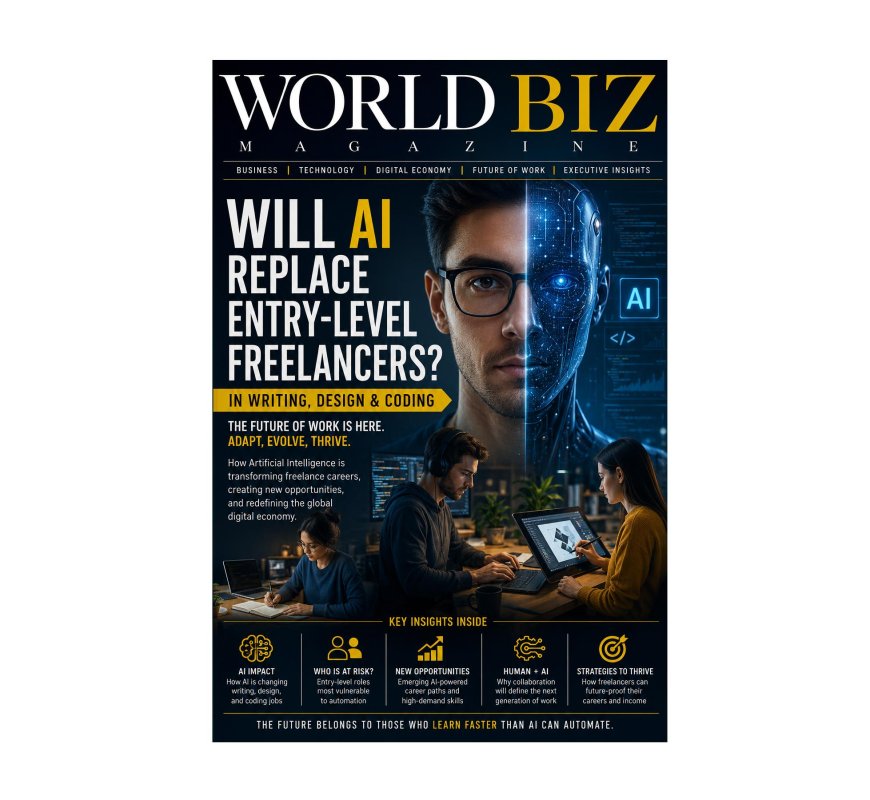
Will AI Replace Entry-Level Freelancers in Writing, Design & Coding?
How Artificial Intelligence Is Transforming the Global Freelance Economy While Creating New Opportunities for Skilled Professionals
World Biz Magazine | Artificial Intelligence | Future of Work | Freelance Economy | Digital Business
A Turning Point for the Global Freelance Workforce
Artificial Intelligence is no longer a futuristic concept it has become an everyday productivity tool that is fundamentally reshaping the global workforce. From content creation and graphic design to software development and customer support, AI-powered platforms are performing tasks that once required hours of human effort in just a matter of seconds.
This rapid transformation has sparked one of the biggest debates in the modern digital economy: Will AI replace entry-level freelancers?
Millions of freelancers worldwide rely on platforms such as Upwork, Fiverr, Freelancer, PeoplePerHour, Toptal, Contra, and numerous regional marketplaces to earn income through writing, design, programming, digital marketing, and administrative services. Many of these professionals began their careers by offering basic services at competitive prices while gradually building experience and expertise.
Today, however, businesses can generate marketing copy, create logos, write software, translate documents, edit videos, produce illustrations, and even develop websites using AI tools—often at a fraction of traditional costs.
While some predict widespread job displacement, others believe AI will simply redefine freelance work rather than eliminate it. The reality lies somewhere between these perspectives.
The freelance economy is not disappearing. It is evolving into an AI-powered ecosystem where human creativity, judgment, strategic thinking, and business understanding become more valuable than repetitive execution.
The Rise of AI as a Digital Workforce
Over the past few years, AI capabilities have advanced at an extraordinary pace. Large language models, image-generation systems, code assistants, speech synthesis, video generation, and intelligent automation platforms have significantly expanded what machines can accomplish.
Modern AI systems can now:
- Write blog articles
- Generate marketing campaigns
- Design presentations
- Produce social media graphics
- Create logos
- Develop websites
- Generate mobile application code
- Write documentation
- Debug software
- Analyze data
- Translate content
- Produce voiceovers
- Generate videos
- Build chatbots
- Perform customer support
Tasks that once required teams of junior professionals can increasingly be completed by a single experienced worker using AI-assisted workflows.
Rather than simply automating one profession, AI is becoming a universal productivity engine across nearly every digital industry.
Why Entry-Level Freelancers Face the Greatest Risk
Freelance marketplaces have historically rewarded affordable, repetitive, and standardized services.
Many beginner freelancers earn income by offering:
- Basic blog writing
- Product descriptions
- Social media captions
- Data entry
- Logo creation
- Business cards
- Banner ads
- WordPress setup
- Landing pages
- Simple coding fixes
- Translation
- Image editing
These services share one common characteristic—they follow predictable patterns.
Predictable work is precisely what AI performs exceptionally well.
Businesses that once hired junior freelancers for routine tasks can now use AI tools to complete similar work within minutes. As AI quality improves, demand for purely execution-based freelance services continues to decline in many categories.
This does not mean all entry-level opportunities will disappear, but competition for basic work is becoming significantly more intense.
Writing: From Content Creation to Content Strategy
The writing industry has experienced one of AI's most significant disruptions.
Modern AI can generate:
- Blog articles
- Product descriptions
- Email campaigns
- SEO outlines
- Technical documentation
- Marketing copy
- Press releases
- Social media posts
- News summaries
For businesses requiring high volumes of standardized content, AI dramatically reduces production costs.
However, professional publishing still depends heavily on human expertise.
High-value writing increasingly requires:
- Original research
- Interviews
- Fact verification
- Industry knowledge
- Editorial judgment
- Storytelling
- Brand voice consistency
- Regulatory understanding
- Ethical oversight
- Investigative reporting
Readers value credibility, expertise, and authentic perspectives qualities that cannot be fully automated.
Consequently, freelance writers who transition from simply producing words to delivering strategic communication and subject-matter expertise are likely to remain in strong demand.
Graphic Design: Automation of Execution, Not Creativity
AI image generators now create illustrations, marketing visuals, product mockups, advertising concepts, icons, and branding ideas in seconds.
This has reduced demand for certain routine design services such as:
- Simple social media graphics
- Basic advertisements
- Stock illustrations
- Presentation visuals
- Thumbnail design
- Background removal
- Image enhancement
Yet branding extends far beyond visual generation.
Successful companies require designers who understand:
- Consumer psychology
- Brand positioning
- User experience
- Accessibility
- Visual hierarchy
- Marketing strategy
- Customer engagement
- Product storytelling
The future designer is less likely to spend hours manually creating assets and more likely to direct AI systems while making strategic creative decisions.
AI accelerates production, but humans continue shaping identity, messaging, and emotional connection.
Software Development: AI Writes Code, Engineers Build Systems
Coding assistants have transformed software development.
AI now generates:
- Functions
- APIs
- Database queries
- Documentation
- Unit tests
- Website layouts
- Mobile interfaces
- Debugging suggestions
- Code optimization
These capabilities reduce time spent on repetitive programming tasks.
However, building enterprise software requires considerably more than writing code.
Professional developers remain responsible for:
- System architecture
- Security
- Scalability
- Infrastructure
- Performance optimization
- Business logic
- Compliance
- Testing
- Integration
- Long-term maintenance
Experienced software engineers increasingly use AI as a collaborative assistant rather than viewing it as competition.
The role shifts from typing code manually to supervising intelligent development systems.
Clients Are Buying Outcomes, Not Hours
One of the most important shifts occurring in freelancing is the transition from hourly work to outcome-based services.
Businesses care less about:
- Hours worked
- Number of revisions
- Manual effort
Instead, they prioritize:
- Faster delivery
- Better quality
- Business impact
- Revenue growth
- Customer engagement
- Operational efficiency
AI enables freelancers to complete projects faster.
Clients generally do not object to AI assistance if the final outcome delivers measurable value.
This changes how freelancers compete.
Instead of selling time, successful professionals increasingly sell expertise, strategic thinking, and business results.
AI Is Creating a New Type of Freelancer
The future freelancer combines human intelligence with AI capabilities.
Rather than competing against automation, they integrate AI into every stage of their workflow.
Emerging freelance specialties include:
- AI workflow consulting
- Prompt engineering
- AI content editing
- AI quality assurance
- AI brand management
- AI implementation consulting
- AI automation design
- Knowledge-base creation
- Retrieval-Augmented Generation (RAG) implementation
- AI governance consulting
These new professions did not exist just a few years ago.
As AI adoption accelerates across industries, demand for professionals capable of integrating these technologies into business operations continues to grow.
The Freelancers Most Likely to Thrive
Several characteristics distinguish resilient freelancers in the AI era.
They:
- Solve business problems instead of completing isolated tasks.
- Build long-term client relationships.
- Develop expertise within specific industries.
- Understand customer objectives.
- Continuously learn emerging technologies.
- Combine multiple complementary skills.
- Use AI responsibly while maintaining quality control.
Clients increasingly value specialists who understand healthcare, finance, manufacturing, logistics, education, media, legal services, or engineering over generalists offering undifferentiated services.
Domain expertise becomes a major competitive advantage.
Soft Skills Become Premium Skills
As AI automates technical execution, uniquely human capabilities become increasingly valuable.
These include:
- Communication
- Leadership
- Negotiation
- Emotional intelligence
- Critical thinking
- Strategic planning
- Creativity
- Ethics
- Decision-making
- Client management
These qualities influence project success far more than technical execution alone.
Organizations continue seeking professionals who can navigate ambiguity, understand stakeholders, and make sound business decisions.
The Future of Freelance Marketplaces
Freelance platforms themselves are rapidly evolving.
Future marketplaces are likely to feature:
- AI-assisted proposal writing
- Automated skill verification
- AI portfolio generation
- Performance analytics
- Intelligent client matching
- Real-time collaboration
- AI-powered project management
- Automated pricing recommendations
- Integrated productivity assistants
Freelancers who embrace these tools can improve efficiency while serving more clients with higher-quality deliverables.
Challenges That Businesses Must Address
The widespread adoption of AI also introduces significant challenges.
Organizations must carefully manage:
- Intellectual property ownership
- Data privacy
- Confidential information
- Copyright compliance
- Hallucinated information
- Bias in AI outputs
- Regulatory compliance
- Brand consistency
- Security risks
These concerns reinforce the importance of human review and professional oversight.
Businesses that rely entirely on automated systems without governance risk damaging their reputation, violating regulations, or making costly strategic errors.
Education Must Adapt
Traditional education often emphasizes technical execution.
However, AI increasingly performs technical execution independently.
Educational institutions must therefore place greater emphasis on:
- Problem-solving
- Systems thinking
- AI literacy
- Business communication
- Innovation
- Entrepreneurship
- Cross-disciplinary collaboration
- Digital ethics
Tomorrow's professionals will be evaluated less on memorization and more on their ability to leverage intelligent technologies effectively.
Opportunities for Emerging Economies
Countries with rapidly growing freelance communities including Philippines, Pakistan, India, Bangladesh, Nigeria, the Vietnam, Indonesia, and many others face both opportunities and challenges.
Lower-cost labor alone will no longer provide a sustainable competitive advantage.
Instead, economic growth will increasingly depend upon:
- Digital infrastructure
- AI education
- High-value specialization
- Innovation ecosystems
- Startup development
- Global collaboration
- Advanced technical skills
Governments, universities, and private organizations all have important roles in preparing future freelancers for AI-enhanced careers.
The Next Decade of Freelancing
The freelance economy is unlikely to shrink.
Instead, it is expected to become significantly more sophisticated.
Routine work will continue moving toward automation.
Human professionals will increasingly focus on:
- Strategy
- Innovation
- Customer experience
- Business consulting
- Creative leadership
- Product development
- AI supervision
- Cross-functional collaboration
Freelancers who successfully combine AI capabilities with deep expertise are likely to enjoy greater productivity, higher earnings, and stronger global competitiveness.
Executive Perspective
Artificial Intelligence is not simply replacing jobs it is redefining the nature of work itself.
Entry-level freelance services centered on repetitive execution face growing pressure from increasingly capable AI systems. Yet the demand for human expertise, strategic insight, creativity, ethical judgment, and industry knowledge continues to expand.
The winners in tomorrow's freelance economy will not be those who resist AI, nor those who rely on it blindly. Success will belong to professionals who understand how to combine intelligent automation with distinctly human capabilities to deliver measurable business value.
Rather than asking whether AI will replace freelancers, business leaders should ask a more strategic question:
Which freelancers will learn to work alongside AI and which businesses will recognize the competitive advantage of hiring them?
The future of freelancing belongs not to humans or machines alone, but to professionals who master the powerful collaboration between both.
Solutions for Freelancers, Businesses & Policymakers
The rapid adoption of Artificial Intelligence should not be viewed solely as a disruption but as an opportunity to redesign how digital work is created, delivered, and valued. Governments, businesses, educational institutions, freelance platforms, and professionals all have important roles to play in ensuring that AI drives inclusive economic growth rather than widening workforce inequality.
Solutions for Freelancers
Freelancers should view AI as a productivity partner rather than a competitor. The most successful professionals will be those who integrate AI into their workflows while strengthening uniquely human capabilities that machines cannot easily replicate.
Practical strategies include:
- Develop expertise in a specific industry such as healthcare, finance, legal services, manufacturing, logistics, education, or media.
- Learn to use multiple AI platforms efficiently for writing, design, coding, research, analytics, and automation.
- Shift from selling individual tasks to offering complete business solutions and consulting services.
- Build long-term client relationships instead of relying solely on one-time marketplace projects.
- Invest in communication, negotiation, project management, and leadership skills.
- Continuously update technical knowledge as AI technologies evolve.
- Create a strong personal brand through thought leadership, case studies, professional portfolios, and industry networking.
Freelancers who combine AI proficiency with domain expertise will be better positioned to command premium rates and establish long-term competitive advantages. Recent industry data also suggests that AI-focused freelance work commands higher compensation than traditional freelance projects, reflecting growing demand for strategic AI expertise.
Solutions for Businesses
Organizations should avoid viewing AI solely as a cost-cutting initiative. Sustainable competitive advantage comes from combining AI automation with experienced human talent.
Business leaders should focus on:
- Upskilling existing employees instead of replacing them wherever practical.
- Implementing human review processes for AI-generated content and code.
- Establishing governance policies for AI ethics, privacy, copyright, and regulatory compliance.
- Investing in AI literacy across all departments rather than limiting knowledge to IT teams.
- Measuring AI success through business outcomes, innovation, customer satisfaction, and productivity not only labor cost reductions.
Many small and medium-sized businesses are already using AI to improve productivity while retaining and empowering their workforce rather than reducing headcount, demonstrating that augmentation can often be more sustainable than replacement.
Solutions for Governments and Educational Institutions
The future workforce will require education systems that evolve alongside technological innovation.
Key priorities include:
- Integrating AI literacy into school and university curricula.
- Expanding digital skills and lifelong learning programs.
- Supporting entrepreneurship and startup ecosystems.
- Encouraging public-private partnerships for workforce reskilling.
- Promoting ethical AI standards and responsible innovation.
- Expanding affordable access to digital infrastructure and advanced computing resources.
Countries that invest early in AI education and innovation ecosystems are likely to develop stronger digital economies and a more resilient workforce.
World Biz Magazine Insights
Artificial Intelligence represents one of the most significant economic transformations since the emergence of the internet. However, history consistently demonstrates that major technological shifts rarely eliminate work altogether they redefine where value is created.
World Biz Magazine believes the discussion should move beyond the simplistic question of whether AI will replace freelancers. The more important question is how businesses, governments, educational institutions, and professionals will adapt to an AI-driven economy.
Our analysis indicates five major trends that will shape the next decade:
Human-AI Collaboration Will Become the New Standard
The highest-performing organizations will combine intelligent automation with experienced professionals rather than relying exclusively on either.
Specialization Will Outperform Generalization
Generic services are increasingly becoming automated, while deep industry expertise continues to command premium value.
Business Consulting Will Grow Faster Than Task Execution
Clients increasingly seek professionals who solve business problems, improve operational efficiency, and deliver measurable outcomes rather than simply completing isolated tasks.
AI Governance Will Become a Strategic Priority
As AI adoption accelerates, organizations will require governance frameworks addressing transparency, intellectual property, cybersecurity, compliance, accountability, and ethical deployment.
Continuous Learning Will Define Career Longevity
Professional success will increasingly depend on adaptability. Individuals and organizations that invest consistently in learning, experimentation, and innovation will be better positioned to thrive in rapidly evolving markets.
From the perspective of World Biz Magazine, AI should be viewed not merely as a software tool but as foundational business infrastructure that is reshaping productivity, competitiveness, and the global digital economy.
Conclusion
Artificial Intelligence is fundamentally transforming freelancing, but transformation should not be mistaken for extinction.
Entry-level freelance services built around repetitive and highly standardized tasks will continue to experience increasing automation. At the same time, demand for strategic thinking, industry expertise, creative problem-solving, business consulting, ethical oversight, and client relationship management is expected to expand.
The next generation of successful freelancers will be distinguished not by how much manual work they perform, but by how effectively they combine AI with human intelligence, creativity, and business insight.
For organizations, AI adoption should focus on enhancing human capability rather than replacing it wherever possible. Businesses that invest in people alongside technology are more likely to achieve sustainable productivity gains, stronger innovation, and long-term resilience.
The future belongs neither to AI alone nor to human expertise in isolation. It belongs to those who successfully integrate both into a new model of intelligent work.
Disclaimer
This article is published by World Biz Magazine for editorial, educational, and informational purposes. The analysis, opinions, and market observations presented are based on publicly available research, industry developments, emerging technology trends, and the editorial assessment of World Biz Magazine.
Artificial Intelligence technologies, regulations, labor markets, and business practices continue to evolve rapidly. Readers should not interpret this publication as legal, financial, investment, employment, or professional advice. Organizations and individuals are encouraged to conduct independent due diligence and consult qualified advisors before making strategic, operational, hiring, or investment decisions related to AI adoption.
References to companies, platforms, technologies, or products are provided for informational purposes only and do not constitute endorsement, recommendation, or commercial affiliation by World Biz Magazine unless explicitly stated.
What's Your Reaction?
 Like
0
Like
0
 Dislike
0
Dislike
0
 Love
0
Love
0
 Funny
0
Funny
0
 Angry
0
Angry
0
 Sad
0
Sad
0
 Wow
0
Wow
0