









































































































































































































Banking Regulation Frameworks Worldwide: Building Stability in Global Financial Systems
Understand the role of banking regulation in managing risk, promoting resilience, and overseeing modern financial institutions.

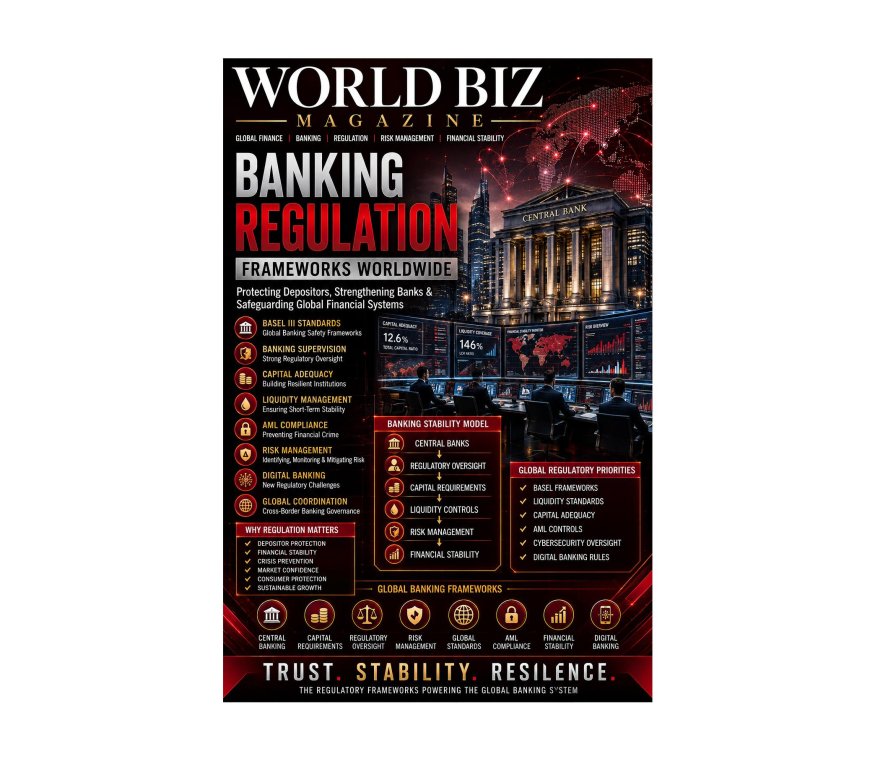
Banking Regulation Frameworks Worldwide
How Global Regulatory Systems Protect Financial Stability, Strengthen Banks, and Safeguard Economic Growth
World Biz Magazine | Banking, Finance & Global Regulation
Banking systems are among the most critical components of modern economies. They facilitate the flow of capital, support business growth, enable consumer lending, safeguard deposits, process payments, and help governments implement monetary policy. Every day, banks manage trillions of dollars in transactions that connect businesses, investors, governments, and consumers across domestic and international markets. Given the central role banks play within the financial system, ensuring their safety, stability, and resilience has become a priority for governments and regulators worldwide. This responsibility is fulfilled through banking regulation.
Banking regulation refers to the framework of laws, supervisory standards, prudential requirements, and enforcement mechanisms that govern the operations of banks and other deposit-taking institutions. These regulations are designed to reduce financial risks, protect depositors, maintain confidence in banking systems, and prevent systemic failures capable of destabilizing entire economies. While banking regulations vary significantly between jurisdictions, their fundamental objectives remain remarkably consistent across countries.
The importance of banking regulation has grown substantially over the past several decades. Financial crises, banking collapses, liquidity shortages, economic recessions, and rapid financial innovation have repeatedly demonstrated the consequences of inadequate oversight. Events such as the Global Financial Crisis of 2008 highlighted vulnerabilities within banking systems and accelerated regulatory reforms worldwide. Since then, regulators have introduced stricter capital requirements, enhanced risk management standards, stronger governance expectations, and more comprehensive supervisory frameworks.
As technology transforms financial services through digital banking, fintech innovation, artificial intelligence, open banking, and digital assets, regulatory frameworks continue evolving to address emerging risks and opportunities. Understanding how banking regulation operates worldwide provides valuable insight into the systems that support financial stability and economic confidence in an increasingly interconnected global economy.
Understanding Banking Regulation
Banking regulation encompasses the legal and supervisory structures that govern the activities of banks and financial institutions.
These frameworks establish rules regarding:
- Capital adequacy
- Liquidity management
- Risk controls
- Consumer protection
- Corporate governance
- Financial reporting
- Operational resilience
Regulators use these requirements to monitor and influence banking behavior.
The primary objective is to ensure that banks remain financially sound while serving the needs of businesses, consumers, and the broader economy.
Without effective regulation, banking systems would be significantly more vulnerable to instability and financial crises.
Why Banking Regulation Matters
The failure of a major bank can create consequences far beyond the institution itself.
Banking systems are highly interconnected.
Problems affecting one institution can quickly spread to others through financial markets, lending relationships, payment systems, and depositor confidence.
Banking regulation seeks to minimize these risks.
The core objectives include:
- Protecting depositors
- Preserving financial stability
- Promoting market confidence
- Reducing systemic risk
- Supporting economic growth
Strong regulatory frameworks contribute to public trust and financial resilience.
The Evolution of Banking Regulation
Banking regulation has evolved significantly over time.
Early regulations focused primarily on protecting depositors and preventing bank failures.
Over time, regulators expanded their focus to include:
- Risk management
- Consumer protection
- Market conduct
- Financial crime prevention
- Systemic stability
Major financial crises frequently serve as catalysts for regulatory reform.
The Great Depression, Asian Financial Crisis, Global Financial Crisis, and more recent banking disruptions have all influenced regulatory development.
Today's frameworks are substantially more sophisticated than those of previous generations.
Prudential Regulation: The Foundation of Banking Oversight
Prudential regulation forms the core of modern banking supervision.
It focuses on ensuring that banks maintain sufficient financial strength to withstand adverse conditions.
Prudential requirements generally address:
- Capital adequacy
- Liquidity levels
- Risk concentrations
- Asset quality
- Stress testing
The goal is to ensure institutions remain solvent and operational during economic downturns.
Prudential supervision remains one of the most important tools available to regulators.
Capital Adequacy Requirements
Capital serves as a financial buffer protecting banks against losses.
Regulators require banks to maintain minimum capital levels based on the risks they undertake.
Capital requirements help:
- Absorb unexpected losses
- Protect depositors
- Improve resilience
- Reduce insolvency risks
Following the Global Financial Crisis, regulators strengthened capital standards significantly.
Banks worldwide are now generally required to hold higher-quality capital than in previous decades.
Capital adequacy remains a central pillar of global banking regulation.
Liquidity Regulation and Funding Stability
Even profitable banks can fail if they cannot meet short-term obligations.
Liquidity regulation addresses this risk.
Regulators require banks to maintain sufficient liquid assets capable of meeting withdrawal demands and operational needs.
Key objectives include:
- Supporting operational continuity
- Reducing funding risks
- Strengthening market confidence
- Improving crisis resilience
Liquidity oversight has become increasingly important in modern regulatory frameworks.
Funding stability is now viewed as equally important as capital strength.
Basel Standards and Global Coordination
One of the most influential forces in banking regulation is the Basel framework.
Developed by the Basel Committee on Banking Supervision, these standards promote consistency across global banking systems.
Major frameworks include:
Basel I
Focused on minimum capital requirements.
Basel II
Introduced risk-sensitive approaches to capital regulation.
Basel III
Strengthened capital, liquidity, and risk management standards following the 2008 financial crisis.
Although implementation varies between jurisdictions, Basel standards have become the foundation of modern banking regulation worldwide.
Banking Supervision and Regulatory Authorities
Most countries maintain specialized supervisory agencies responsible for overseeing banks.
These authorities may include:
- Central banks
- Financial supervisory agencies
- Prudential regulators
- Financial conduct authorities
Regulators typically conduct:
- On-site examinations
- Risk assessments
- Compliance reviews
- Enforcement actions
Supervisory oversight helps identify emerging risks before they become systemic threats.
Effective supervision remains essential for maintaining financial stability.
Consumer Protection Regulations
Modern banking regulation extends beyond institutional safety.
Consumer protection has become a major regulatory priority.
Requirements often address:
- Fair lending practices
- Product transparency
- Fee disclosures
- Data privacy
- Complaint resolution
Consumers rely on banks for essential financial services.
Regulators therefore seek to ensure that institutions treat customers fairly and responsibly.
Strong consumer protection frameworks enhance confidence in banking systems.
Anti-Money Laundering (AML) and Financial Crime Prevention
Banks play a critical role in preventing financial crime.
AML regulations require institutions to implement controls designed to detect and prevent illicit activities.
Key requirements often include:
- Customer due diligence
- Know Your Customer (KYC) procedures
- Transaction monitoring
- Sanctions screening
- Suspicious activity reporting
These frameworks help combat:
- Money laundering
- Terrorism financing
- Fraud
- Corruption
AML compliance has become one of the most resource-intensive aspects of modern banking regulation.
Corporate Governance in Banking
Strong governance is essential for effective risk management.
Banking regulators increasingly emphasize governance standards.
Areas of focus include:
- Board oversight
- Executive accountability
- Internal controls
- Compliance functions
- Risk management systems
Governance failures have contributed to numerous banking crises and scandals.
As a result, governance expectations continue strengthening worldwide.
Stress Testing and Risk Management
Stress testing has become a central regulatory tool.
Banks are required to evaluate how they would perform under adverse economic scenarios.
Stress tests may examine:
- Economic recessions
- Market shocks
- Liquidity disruptions
- Credit losses
These exercises help identify vulnerabilities and support contingency planning.
Risk management capabilities are increasingly viewed as critical indicators of institutional resilience.
Deposit Insurance Systems
Many countries operate deposit insurance schemes designed to protect consumers if banks fail.
These systems help:
- Prevent bank runs
- Maintain public confidence
- Protect small depositors
- Support financial stability
Deposit protection limits vary by jurisdiction.
Nevertheless, deposit insurance has become a standard feature of modern banking systems.
It serves as an important safeguard during periods of financial stress.
Digital Banking and Regulatory Innovation
Technology is reshaping banking at an unprecedented pace.
Digital banks, fintech platforms, mobile banking solutions, and embedded finance models are transforming financial services.
Regulators face the challenge of supporting innovation while managing risks.
Key regulatory concerns include:
- Cybersecurity
- Operational resilience
- Data protection
- Consumer protection
- Third-party risk management
Regulatory frameworks are increasingly adapting to accommodate digital transformation.
Open Banking and Data Regulation
Open banking initiatives are changing how financial data is shared.
These frameworks allow consumers to authorize third-party providers to access banking information securely.
Potential benefits include:
- Increased competition
- Innovation
- Improved customer experiences
However, regulators must address:
- Data security
- Privacy protection
- Operational risks
Open banking regulation remains an evolving area globally.
Banking Regulation Across Major Regions
Although core principles are similar, regulatory frameworks vary worldwide.
United States
Characterized by multiple regulatory agencies and extensive supervisory oversight.
European Union
Emphasizes harmonized banking regulation through regional frameworks and centralized supervision.
United Kingdom
Maintains a risk-based supervisory model focused on prudential and conduct regulation.
Asia-Pacific
Features diverse regulatory systems reflecting varying levels of market development and economic priorities.
Despite differences, international coordination continues increasing.
Emerging Challenges for Banking Regulators
Several challenges are reshaping the regulatory landscape.
These include:
- Cybersecurity threats
- Digital asset integration
- Climate-related financial risks
- Artificial intelligence
- Geopolitical uncertainty
- Cross-border supervision
Regulators must balance innovation with financial stability.
This balancing act will likely remain a defining challenge for the coming decade.
The Future of Banking Regulation
Future regulatory developments are expected to focus on:
- Real-time supervision
- AI-powered oversight
- Climate risk management
- Operational resilience
- Cybersecurity standards
- Digital asset regulation
- Cross-border regulatory cooperation
Technology will likely play an increasingly important role in supervisory processes.
Regulation is becoming more data-driven and forward-looking.
Institutions capable of adapting quickly will be better positioned to thrive.
World Biz Magazine Insights
Banking regulation is often perceived as a constraint on financial institutions, yet its broader purpose is to create stability, trust, and resilience within financial systems. Effective regulatory frameworks enable banks to support economic growth while managing risks responsibly. In an era defined by digital transformation, fintech disruption, cybersecurity concerns, and global interconnectedness, regulatory frameworks will continue evolving to address emerging challenges. The strongest banking systems are not necessarily those with the fewest regulations, but those that successfully balance innovation, competition, consumer protection, and financial stability.
Conclusion
Banking regulation frameworks worldwide serve as critical pillars supporting modern financial systems. Through prudential supervision, capital requirements, liquidity standards, governance expectations, consumer protections, and financial crime controls, regulators help maintain confidence in banking institutions and reduce systemic risks.
While regulatory approaches vary across jurisdictions, their shared objective remains clear: ensuring that banking systems remain stable, resilient, and capable of supporting economic activity. As technology, globalization, and emerging risks reshape the financial landscape, banking regulation will continue adapting to preserve trust and strengthen the foundations of global finance.
Ultimately, effective banking regulation is not merely about preventing failures—it is about creating the conditions necessary for sustainable growth, responsible innovation, and long-term financial stability.
Disclaimer
This article is published for informational, educational, and industry analysis purposes only and does not constitute legal, financial, regulatory, compliance, investment, tax, or professional advice. Banking regulations vary significantly across jurisdictions and may change over time. Readers should consult qualified legal, regulatory, compliance, and financial professionals regarding specific banking regulations and supervisory requirements.
What's Your Reaction?
 Like
1
Like
1
 Dislike
0
Dislike
0
 Love
0
Love
0
 Funny
0
Funny
0
 Angry
0
Angry
0
 Sad
0
Sad
0
 Wow
0
Wow
0