










































































































































































































Credit Risk Regulation in Banking: Managing Lending Risk and Strengthening Financial Stability
Understand the role of credit risk regulation in preventing banking crises, improving resilience, and supporting sustainable lending practices.

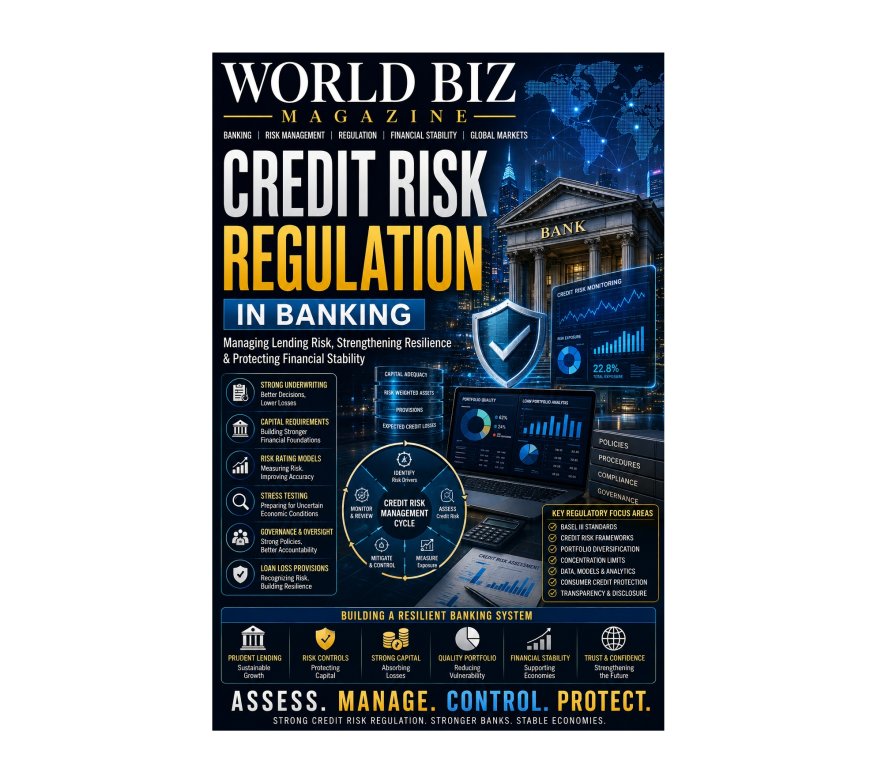
Credit Risk Regulation in Banking
How Global Regulatory Frameworks Manage Lending Risk, Protect Financial Stability, and Strengthen Banking Resilience
World Biz Magazine | Banking, Risk Management & Financial Regulation
Credit risk remains one of the most significant risks faced by banks and financial institutions worldwide. At its core, credit risk refers to the possibility that a borrower will fail to meet contractual obligations, resulting in financial losses for lenders. Since lending activities form the foundation of most banking business models, effective credit risk management has become a critical component of financial stability, regulatory oversight, and sustainable economic growth. From consumer mortgages and business loans to corporate financing and sovereign debt exposures, virtually every banking institution must manage the risks associated with extending credit.
The importance of credit risk regulation has grown substantially over the past several decades. Financial crises, banking failures, economic recessions, and periods of market volatility have repeatedly demonstrated the potentially devastating consequences of inadequate credit risk controls. Poor underwriting practices, excessive risk-taking, inadequate capital reserves, and weak governance structures have historically contributed to significant banking sector disruptions. As a result, regulators worldwide have developed increasingly sophisticated frameworks designed to strengthen lending standards, improve risk assessment processes, enhance capital adequacy, and reduce systemic vulnerabilities.
Today, credit risk regulation extends far beyond traditional loan approval processes. Modern frameworks incorporate advanced analytics, stress testing, capital requirements, portfolio monitoring, governance standards, provisioning requirements, and supervisory oversight mechanisms. Regulatory authorities expect banks to identify, measure, monitor, and control credit risk throughout the entire lending lifecycle. These requirements have become even more important as financial institutions navigate evolving economic conditions, digital lending platforms, artificial intelligence applications, and increasingly interconnected global markets.
Understanding credit risk regulation is essential for bankers, investors, regulators, policymakers, and business leaders seeking to comprehend how modern banking systems manage lending risks while supporting economic development and financial stability.
Understanding Credit Risk
Credit risk arises whenever a lender provides funds or extends financial obligations to a borrower.
The risk materializes if the borrower fails to repay principal, interest, or other contractual obligations.
Credit risk can affect:
- Commercial loans
- Corporate lending
- Consumer credit
- Mortgages
- Credit cards
- Trade finance
- Sovereign debt
- Project financing
Because lending generates a significant portion of bank revenues, credit risk management is central to banking operations.
Effective management protects both individual institutions and broader financial systems.
Why Credit Risk Regulation Matters
Bank failures often originate from poor lending decisions.
When borrowers default in large numbers, banks may experience substantial losses that erode profitability and capital reserves.
Unchecked credit risk can create:
- Institutional instability
- Liquidity pressures
- Reduced lending capacity
- Investor concerns
- Broader financial crises
Regulatory frameworks seek to reduce these risks by establishing minimum standards for risk management and capital adequacy.
Strong credit risk regulation supports confidence in banking systems and financial markets.
The Evolution of Credit Risk Regulation
Historically, credit risk assessment relied heavily on manual analysis and relationship banking.
Loan officers evaluated borrowers based on financial statements, collateral, industry conditions, and personal judgment.
Over time, financial markets became more complex.
The expansion of global banking, securitization, derivatives markets, and digital lending platforms increased regulatory concerns.
Major financial crises accelerated regulatory reform efforts.
The Global Financial Crisis of 2008 particularly highlighted weaknesses in credit risk assessment, underwriting standards, and risk governance.
Subsequent reforms significantly strengthened regulatory expectations worldwide.
Regulatory Objectives in Credit Risk Management
Credit risk regulations are designed to achieve several key objectives.
These include:
- Protecting depositors
- Maintaining financial stability
- Strengthening bank resilience
- Promoting prudent lending
- Enhancing transparency
- Reducing systemic risk
Regulators seek to ensure that banks maintain sufficient resources to absorb potential losses while continuing to support economic activity.
The goal is not to eliminate lending risk but to manage it responsibly.
Basel Framework and Credit Risk Regulation
Global credit risk regulation is heavily influenced by standards developed by the Basel Committee on Banking Supervision.
The Basel framework establishes international principles governing capital adequacy and risk management.
Major regulatory milestones include:
Basel I
Introduced risk-weighted capital requirements.
Basel II
Enhanced credit risk measurement and introduced advanced risk assessment methodologies.
Basel III
Strengthened capital standards, stress testing requirements, and risk management expectations following the Global Financial Crisis.
These frameworks have become foundational elements of modern banking supervision.
Credit Risk Assessment and Underwriting Standards
Regulators expect banks to maintain robust underwriting practices.
Effective credit assessment involves evaluating:
- Borrower creditworthiness
- Repayment capacity
- Financial performance
- Industry risks
- Collateral quality
- Economic conditions
Lending decisions should be supported by objective analysis and documented processes.
Weak underwriting standards can lead to excessive risk accumulation.
Regulatory guidance emphasizes disciplined lending practices and consistent risk evaluation.
Risk Rating Systems
Modern banks typically utilize internal risk rating systems to classify borrowers according to credit quality.
These systems support:
- Pricing decisions
- Capital allocation
- Portfolio monitoring
- Regulatory reporting
Risk ratings help institutions identify higher-risk exposures and implement appropriate controls.
Regulators often review rating methodologies as part of supervisory examinations.
Effective rating systems improve risk transparency and decision-making.
Capital Requirements and Credit Risk
One of the primary tools used by regulators is capital regulation.
Banks must maintain capital reserves sufficient to absorb losses arising from credit exposures.
Capital requirements are generally linked to the risk profile of assets.
Higher-risk loans typically require higher capital allocations.
This framework encourages prudent lending and discourages excessive risk-taking.
Capital adequacy remains a central pillar of credit risk regulation worldwide.
Loan Loss Provisions and Expected Credit Losses
Banks must recognize potential losses before actual defaults occur.
Provisioning frameworks require institutions to establish reserves for anticipated credit losses.
Modern accounting standards increasingly emphasize expected credit loss models.
These approaches require forward-looking assessments based on:
- Economic forecasts
- Portfolio characteristics
- Borrower conditions
- Historical loss data
Provisioning enhances transparency and improves financial resilience.
Regulators closely monitor reserve adequacy.
Credit Concentration Risk
Excessive exposure to specific borrowers, industries, sectors, or geographic regions can create concentration risk.
Regulators encourage diversification to reduce vulnerability.
Examples of concentration risk include:
- Heavy exposure to real estate markets
- Industry-specific lending concentrations
- Large corporate borrower dependencies
Concentration limits help prevent localized problems from causing significant institutional losses.
Diversification remains a key risk management principle.
Stress Testing and Scenario Analysis
Stress testing has become a critical regulatory tool.
Banks are required to evaluate how portfolios would perform under adverse scenarios.
Examples include:
- Economic recessions
- Rising interest rates
- Property market declines
- Industry downturns
- Geopolitical disruptions
Stress testing helps identify vulnerabilities before losses occur.
Regulators increasingly incorporate stress testing into supervisory frameworks.
These exercises support capital planning and risk management.
Corporate Governance and Credit Risk Oversight
Effective governance is essential for managing credit risk.
Regulators expect boards of directors and senior management to maintain oversight of lending activities.
Governance responsibilities include:
- Risk appetite setting
- Policy approval
- Portfolio monitoring
- Internal controls
- Compliance oversight
Strong governance promotes accountability and supports sound decision-making.
Governance failures have often contributed to significant credit losses.
Technology and Credit Risk Management
Technology is transforming credit risk assessment.
Banks increasingly utilize:
- Artificial intelligence
- Machine learning
- Predictive analytics
- Alternative data sources
- Automated underwriting systems
These tools can improve efficiency and enhance risk identification.
However, regulators also monitor technology-related risks including:
- Model risk
- Data quality concerns
- Algorithmic bias
- Transparency issues
Technology governance is becoming an important component of regulatory oversight.
Consumer Credit Regulation
Consumer lending remains a major focus of credit risk regulation.
Authorities seek to ensure responsible lending practices and consumer protection.
Key regulatory concerns include:
- Affordability assessments
- Disclosure requirements
- Fair lending standards
- Debt management practices
Consumer protection frameworks help reduce excessive household indebtedness and support financial stability.
Responsible lending benefits both consumers and institutions.
Credit Risk and Economic Cycles
· Credit risk is closely linked to economic conditions.
· During periods of economic growth, default rates often decline.
· During recessions, credit losses may increase significantly.
· Regulators encourage banks to adopt countercyclical approaches that strengthen resilience during favorable conditions.
· This helps institutions withstand future downturns.
· Economic cycle management remains an important aspect of modern supervision.
Emerging Risks in Credit Regulation
Several emerging trends are influencing credit risk frameworks.
These include:
- Climate-related financial risks
- Digital lending platforms
- Artificial intelligence models
- Cross-border credit exposures
- Geopolitical uncertainty
- Alternative credit providers
Regulators continue adapting frameworks to address evolving risks.
Future credit risk management will likely become increasingly data-driven and predictive.
Global Regulatory Approaches
Although regulatory systems vary across jurisdictions, common themes exist worldwide.
Major banking markets generally emphasize:
- Risk-sensitive capital requirements
- Prudential supervision
- Stress testing
- Governance standards
- Portfolio monitoring
International coordination continues expanding through global regulatory organizations.
Cross-border consistency supports financial stability and market confidence.
The Future of Credit Risk Regulation
Future regulatory developments are expected to focus on:
- AI-enhanced risk supervision
- Climate stress testing
- Real-time portfolio monitoring
- Advanced analytics
- Digital lending oversight
- Enhanced capital planning
Technology will increasingly support both banks and regulators in managing credit risk.
The future regulatory landscape is expected to become more proactive and predictive.
World Biz Magazine Insights
Credit risk regulation sits at the heart of modern banking supervision because lending activities remain the primary source of both profitability and vulnerability within financial institutions. Effective regulatory frameworks help ensure that banks maintain strong underwriting standards, adequate capital reserves, diversified portfolios, and robust governance systems. As financial markets become increasingly digital and interconnected, credit risk management is evolving from a traditional banking function into a sophisticated discipline driven by data, technology, and predictive analytics. Institutions that successfully integrate regulatory compliance with advanced risk management capabilities will be best positioned to navigate future economic uncertainties while supporting sustainable growth.
Conclusion
Credit risk regulation plays a fundamental role in maintaining banking sector resilience and protecting financial stability. Through capital requirements, underwriting standards, stress testing, governance expectations, provisioning frameworks, and supervisory oversight, regulators help ensure that banks manage lending risks responsibly.
While credit risk can never be eliminated entirely, effective regulation provides the safeguards necessary to reduce vulnerabilities and strengthen confidence in financial institutions. As economic conditions, technology, and financial markets continue evolving, credit risk regulation will remain one of the most important pillars of global banking supervision.
Ultimately, strong credit risk frameworks not only protect individual institutions but also support broader economic stability by ensuring that lending continues in a prudent, sustainable, and resilient manner.
Disclaimer
This article is published for informational, educational, and industry analysis purposes only and does not constitute legal, regulatory, financial, investment, banking, compliance, tax, or professional advice. Credit risk regulations, capital requirements, supervisory expectations, and banking standards vary across jurisdictions and may change over time. Readers should consult qualified legal, regulatory, banking, and financial professionals regarding specific credit risk management and compliance obligations.
What's Your Reaction?
 Like
0
Like
0
 Dislike
0
Dislike
0
 Love
0
Love
0
 Funny
0
Funny
0
 Angry
0
Angry
0
 Sad
0
Sad
0
 Wow
0
Wow
0