










































































































































































































Financial Regulation Explained: Purpose, Scope, and Impact on Global Markets
Understand the role of financial regulation in maintaining trust, transparency, and resilience across global financial markets.

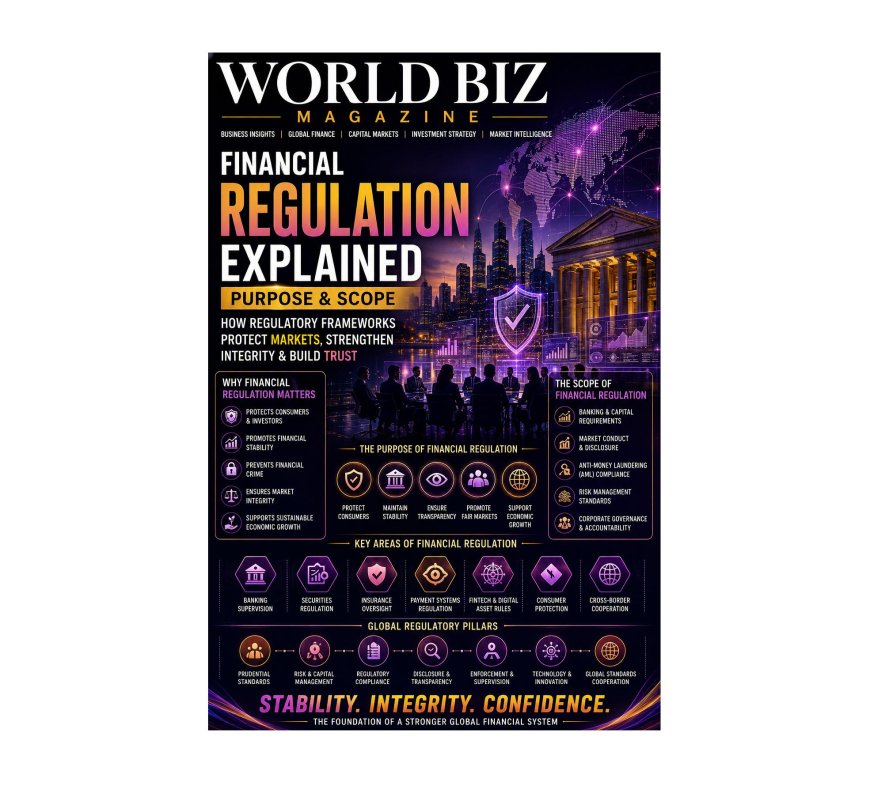
Financial Regulation Explained: Purpose and Scope
Understanding the Rules That Protect Markets, Preserve Stability, and Shape the Global Financial System
World Biz Magazine | Finance, Regulation & Global Markets
The global financial system serves as the backbone of modern economies, enabling businesses to raise capital, governments to fund public services, consumers to access credit, and investors to participate in wealth creation. Every day, trillions of dollars move through banks, stock exchanges, insurance companies, investment funds, payment networks, and financial institutions across international markets. While these activities are essential for economic growth and development, they also create risks that can threaten financial stability if left unchecked. This is where financial regulation plays a critical role.
Financial regulation encompasses the laws, rules, standards, and supervisory frameworks designed to govern financial institutions, markets, and activities. Its primary purpose is to maintain confidence in financial systems, protect consumers and investors, reduce systemic risk, promote market integrity, and support sustainable economic growth. Although regulations are often viewed as constraints on business activity, they are fundamentally intended to create trust and stability two essential ingredients for efficient financial markets.
The importance of financial regulation became particularly evident during major financial crises, including the Global Financial Crisis of 2008, which exposed weaknesses in risk management, regulatory oversight, and market transparency. Since then, governments and regulators around the world have introduced extensive reforms aimed at strengthening financial institutions, improving governance standards, increasing transparency, and reducing vulnerabilities within the financial system.
As financial markets continue evolving through technological innovation, digital assets, fintech platforms, artificial intelligence, and cross-border transactions, financial regulation remains one of the most influential forces shaping the future of global commerce and investment.
What Is Financial Regulation?
Financial regulation refers to the legal and supervisory framework governing financial institutions, financial products, and market activities.
These regulations are established by governments, central banks, regulatory agencies, and international organizations to ensure that financial systems operate fairly, transparently, and efficiently.
Financial regulation affects:
- Commercial banks
- Investment banks
- Insurance companies
- Securities markets
- Asset managers
- Pension funds
- Credit institutions
- Fintech companies
- Payment service providers
- Cryptocurrency platforms
The overall objective is to balance innovation and economic growth with stability and risk management.
Without regulation, financial systems would be more vulnerable to fraud, misconduct, excessive risk-taking, and systemic instability.
Why Financial Regulation Exists
Financial regulation serves multiple objectives that support economic and social stability.
The most important purpose is maintaining confidence in financial systems.
Banks, markets, and financial institutions depend on trust.
Depositors trust banks to safeguard their money.
Investors trust markets to operate fairly.
Businesses trust lenders to provide capital.
Consumers trust financial products and services to function as promised.
When trust breaks down, financial instability can spread rapidly.
Regulation helps establish safeguards that reinforce confidence and reduce uncertainty.
Protecting Consumers and Investors
One of the central goals of financial regulation is protecting consumers and investors from unfair practices, fraud, and financial harm.
Consumers often lack the expertise needed to evaluate complex financial products.
Similarly, investors rely on accurate information when making investment decisions.
Regulatory frameworks therefore establish rules governing:
- Product disclosures
- Advertising standards
- Fiduciary obligations
- Fair treatment requirements
- Market conduct standards
These protections help create a more transparent financial environment.
Investor confidence plays a crucial role in supporting capital formation and economic growth.
Promoting Financial Stability
Financial stability refers to the ability of the financial system to function effectively even during periods of economic stress.
Regulators seek to reduce systemic risks that could threaten entire markets or economies.
Systemic risk may arise from:
- Excessive leverage
- Liquidity shortages
- Asset bubbles
- Bank failures
- Market disruptions
Financial regulation helps limit these risks by imposing prudential requirements and supervisory oversight.
The objective is not to eliminate risk entirely but to prevent localized problems from becoming widespread crises.
Prudential Regulation and Capital Requirements
Prudential regulation focuses on the safety and soundness of financial institutions.
Banks and financial firms are typically required to maintain adequate capital reserves capable of absorbing losses during adverse conditions.
Capital requirements serve several purposes:
- Protect depositors
- Improve institutional resilience
- Reduce insolvency risks
- Strengthen market confidence
International standards such as the Basel framework establish minimum capital and liquidity requirements for banks.
These standards help create greater consistency across global financial systems.
Market Integrity and Fair Competition
Financial markets function efficiently when participants have confidence that transactions are conducted fairly.
Regulators therefore establish rules designed to prevent:
- Market manipulation
- Insider trading
- Fraudulent activities
- Misleading disclosures
Market integrity contributes to price transparency and efficient capital allocation.
Fair competition also encourages innovation while reducing opportunities for abusive practices.
Strong market oversight remains a key component of financial regulation worldwide.
The Role of Central Banks
Central banks play an important role within financial regulatory frameworks.
Although responsibilities vary by jurisdiction, central banks commonly oversee:
- Monetary policy
- Banking supervision
- Financial stability monitoring
- Payment systems
- Emergency liquidity support
Central banks frequently coordinate with other regulatory agencies to address systemic risks and emerging financial challenges.
Their role becomes particularly important during periods of market stress.
Financial Regulatory Authorities
Most countries maintain specialized regulatory agencies responsible for supervising financial markets and institutions.
Common responsibilities include:
- Licensing financial firms
- Conducting examinations
- Enforcing regulations
- Monitoring market activity
- Investigating misconduct
Different agencies may oversee different sectors of the financial system.
Examples include banking regulators, securities commissions, insurance supervisors, and consumer protection authorities.
Together, these agencies form the broader regulatory ecosystem.
Anti-Money Laundering (AML) Regulations
AML regulations are designed to prevent financial systems from being used for illicit purposes.
Financial institutions must implement procedures to identify suspicious activities and verify customer identities.
Key AML requirements often include:
- Customer due diligence
- Know Your Customer (KYC) procedures
- Transaction monitoring
- Suspicious activity reporting
- Recordkeeping obligations
AML regulations support broader efforts to combat financial crime, corruption, terrorism financing, and sanctions evasion.
Corporate Governance and Financial Regulation
Financial regulation increasingly emphasizes governance standards.
Regulators expect financial institutions to maintain effective governance structures that support responsible decision-making and risk management.
Key governance areas include:
- Board oversight
- Executive accountability
- Internal controls
- Compliance frameworks
- Risk management systems
Strong governance helps reduce operational failures and improves organizational resilience.
Governance failures have often been significant contributors to financial crises and corporate scandals.
Financial Reporting and Disclosure Requirements
Transparency is a fundamental principle of modern financial regulation.
Investors, regulators, and stakeholders rely on accurate information when evaluating financial institutions and investment opportunities.
Disclosure requirements commonly involve:
- Financial statements
- Risk disclosures
- Governance reporting
- Material event notifications
- Regulatory filings
Transparency supports informed decision-making while improving market efficiency.
Accurate reporting also strengthens accountability.
The Impact of Technology on Financial Regulation
Technology is transforming both financial services and regulatory oversight.
Fintech innovations have introduced:
- Digital banking
- Mobile payments
- Online lending
- Robo-advisory platforms
- Digital assets
These developments create opportunities as well as regulatory challenges.
Regulators must balance innovation with consumer protection and financial stability.
Technology is also improving regulatory supervision through data analytics, automation, and real-time monitoring tools.
Cryptocurrency and Digital Asset Regulation
The rise of digital assets has introduced new regulatory considerations.
Cryptocurrencies, stablecoins, tokenized assets, and decentralized finance platforms often operate outside traditional financial structures.
Regulators are developing frameworks addressing:
- Investor protection
- Market integrity
- AML compliance
- Custody requirements
- Systemic risk concerns
Digital asset regulation remains one of the fastest-evolving areas of financial policy.
Governments worldwide continue exploring appropriate regulatory approaches.
International Coordination in Financial Regulation
Financial markets increasingly operate across borders.
As a result, international cooperation has become essential.
Organizations such as:
- The Financial Stability Board (FSB)
- The International Monetary Fund (IMF)
- The World Bank
- The Basel Committee on Banking Supervision
help promote global regulatory consistency.
Cross-border coordination reduces regulatory arbitrage and strengthens financial system resilience.
Global cooperation remains a critical component of modern financial governance.
Challenges Facing Financial Regulators
Financial regulators face numerous challenges in today's rapidly changing environment.
These include:
- Technological disruption
- Cybersecurity threats
- Climate-related financial risks
- Digital asset innovation
- Geopolitical uncertainty
- Cross-border enforcement complexities
Regulatory frameworks must continuously evolve to address emerging risks while supporting economic growth.
Maintaining this balance is one of the most difficult tasks facing policymakers.
The Future of Financial Regulation
Several trends are expected to shape future regulatory developments.
These include:
- AI-driven supervision
- ESG-related financial disclosures
- Climate risk regulation
- Digital identity systems
- Real-time regulatory reporting
- Enhanced cybersecurity requirements
- Global digital asset frameworks
Regulation will likely become increasingly data-driven, technology-enabled, and internationally coordinated.
Organizations that proactively adapt to evolving requirements will be better positioned for long-term success.
World Biz Magazine Insights
Financial regulation is often viewed through the lens of compliance and oversight, but its broader purpose extends far beyond enforcement. Effective regulation creates the trust, transparency, and stability necessary for financial systems to function efficiently. Investors allocate capital with greater confidence, consumers engage with financial products more securely, and institutions operate within clearly defined risk boundaries. As global financial systems become increasingly digital, interconnected, and complex, regulation will continue serving as a critical mechanism for balancing innovation with stability and protecting the foundations of economic growth.
Conclusion
Financial regulation plays a vital role in maintaining the stability, integrity, and efficiency of global financial systems. Through consumer protection measures, prudential standards, governance requirements, transparency obligations, and market oversight, regulatory frameworks help create the trust necessary for financial markets to operate effectively.
While regulations may evolve in response to changing technologies, emerging risks, and economic developments, their fundamental objectives remain consistent: protecting stakeholders, reducing systemic vulnerabilities, and supporting sustainable economic growth. For businesses, investors, policymakers, and financial institutions, understanding the purpose and scope of financial regulation is essential for navigating today's increasingly complex financial landscape.
Ultimately, strong regulatory systems do not merely control financial activity—they provide the foundation upon which modern economies and global capital markets are built.
Disclaimer
This article is published for informational, educational, and industry analysis purposes only and does not constitute legal, financial, regulatory, investment, tax, compliance, or professional advice. Financial regulations vary significantly across jurisdictions and may change over time. Readers should consult qualified legal, regulatory, financial, and professional advisors regarding specific regulatory requirements, compliance obligations, and financial matters.
What's Your Reaction?
 Like
0
Like
0
 Dislike
0
Dislike
0
 Love
0
Love
0
 Funny
0
Funny
0
 Angry
0
Angry
0
 Sad
0
Sad
0
 Wow
0
Wow
0