







































































































































































































How FinTech Regulation Is Reshaping Digital Banking and Financial Innovation
Understand how FinTech regulation supports innovation while protecting consumers, strengthening cybersecurity, and maintaining financial market stability.

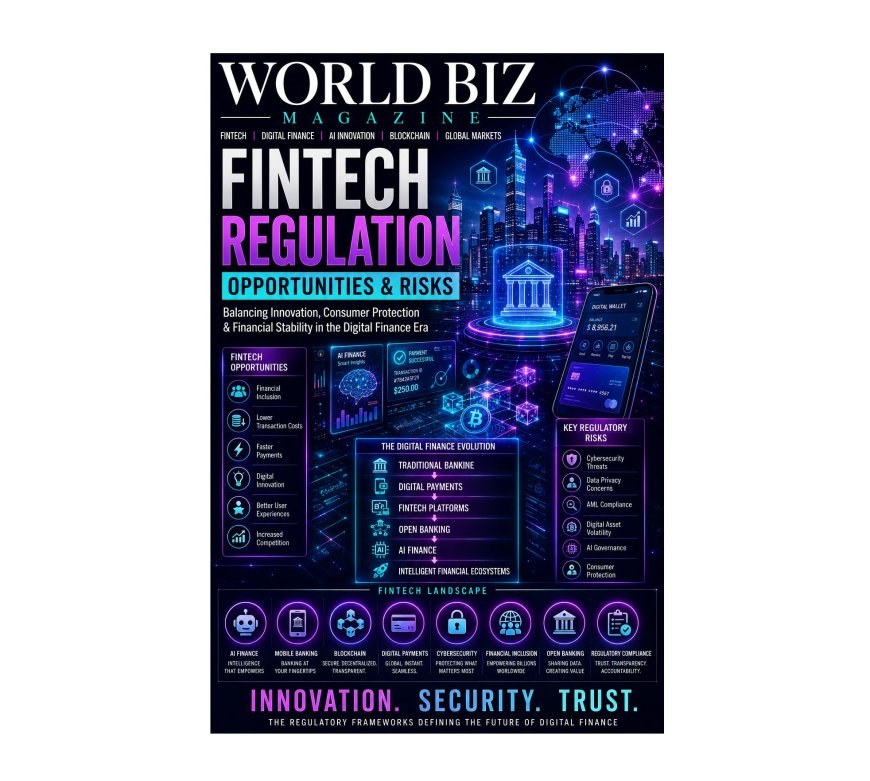
FinTech Regulation: Opportunities and Risks
Balancing Innovation, Consumer Protection, and Financial Stability in the Digital Finance Era
World Biz Magazine | FinTech, Financial Regulation & Digital Innovation
Financial technology, commonly known as FinTech, has emerged as one of the most transformative forces in the global financial services industry. Over the past decade, digital innovation has reshaped how individuals, businesses, and institutions access banking services, transfer money, obtain credit, manage investments, purchase insurance, and interact with financial markets. Powered by advances in artificial intelligence, cloud computing, blockchain technology, mobile connectivity, data analytics, and automation, FinTech companies have challenged traditional financial institutions while introducing new levels of convenience, efficiency, and accessibility.
From mobile payment platforms and digital wallets to peer-to-peer lending, robo-advisors, embedded finance, decentralized finance (DeFi), and digital asset ecosystems, FinTech innovations have expanded rapidly across global markets. These technologies have created opportunities to improve financial inclusion, reduce transaction costs, increase competition, and accelerate economic activity. At the same time, the speed of innovation has introduced complex regulatory challenges involving consumer protection, cybersecurity, financial stability, privacy rights, operational resilience, anti-money laundering compliance, and systemic risk management.
Regulators worldwide face a difficult balancing act. Excessive regulation may stifle innovation and limit economic benefits, while insufficient oversight can expose consumers and financial systems to significant risks. As digital finance continues evolving, regulatory frameworks are becoming increasingly important in determining how FinTech innovation develops and integrates into the broader financial ecosystem.
Understanding the opportunities and risks associated with FinTech regulation is essential for policymakers, financial institutions, technology companies, investors, and consumers seeking to navigate the future of finance.
Understanding FinTech and Regulatory Evolution
FinTech refers to the application of technology to financial products, services, and business models.
The sector includes a broad range of innovations such as:
- Digital payments
- Mobile banking
- Online lending
- Wealth management platforms
- InsurTech solutions
- Blockchain applications
- Digital assets
- Embedded finance services
Unlike traditional financial institutions, many FinTech companies emerged outside established regulatory structures.
This rapid growth created the need for new regulatory approaches capable of addressing emerging technologies while preserving financial stability.
Regulators have increasingly adapted frameworks to accommodate innovation while managing associated risks.
The Rise of Digital Financial Services
Consumer behavior has significantly changed over the past decade.
Customers increasingly expect:
- Instant transactions
- Mobile accessibility
- Personalized experiences
- Low-cost services
- Digital-first interactions
FinTech firms have responded by developing innovative solutions that often outperform traditional financial service delivery models in terms of speed and convenience.
Digital payments, in particular, have experienced extraordinary growth.
The widespread adoption of smartphones has accelerated demand for technology-driven financial services worldwide.
This transformation has expanded access to financial services while increasing regulatory complexity.
Why FinTech Regulation Matters
Financial services occupy a unique position within modern economies.
Failures within financial systems can affect individuals, businesses, governments, and entire markets.
As FinTech companies increasingly perform functions traditionally associated with banks and financial institutions, regulators must ensure that similar risks receive appropriate oversight.
Regulatory objectives generally include:
- Consumer protection
- Financial stability
- Market integrity
- Data privacy
- Cybersecurity
- Financial crime prevention
Effective regulation helps maintain trust while supporting sustainable innovation.
The challenge lies in achieving the appropriate balance between oversight and growth.
Opportunities Created by FinTech Innovation
FinTech has delivered significant benefits across global financial systems.
These opportunities are among the primary reasons regulators seek to encourage responsible innovation.
Financial Inclusion and Accessibility
One of FinTech's most significant contributions has been expanding financial inclusion.
Millions of individuals worldwide remain underserved by traditional banking systems.
Digital financial platforms help overcome barriers related to:
- Geographic distance
- Cost
- Infrastructure limitations
- Documentation requirements
Mobile banking and digital payment solutions have provided financial access to populations previously excluded from formal financial systems.
Greater inclusion supports economic participation and financial empowerment.
Increased Competition and Consumer Choice
FinTech innovation has increased competition across financial services.
Traditional institutions now compete with technology-driven companies offering:
- Faster payments
- Lower fees
- Improved customer experiences
- Innovative financial products
Increased competition often benefits consumers through improved service quality and pricing.
Regulators generally recognize competition as an important driver of efficiency and innovation.
Improved Efficiency and Lower Costs
Technology has significantly reduced operational costs within financial services.
Automation enables:
- Faster transactions
- Reduced processing times
- Improved accuracy
- Lower administrative expenses
Many FinTech platforms operate with leaner cost structures than traditional institutions.
These efficiencies can result in lower costs for consumers and businesses.
Cost reduction remains one of the most attractive aspects of digital financial innovation.
Innovation in Lending and Capital Access
Digital lending platforms have transformed access to credit.
Traditional lending processes can be slow and resource-intensive.
FinTech companies increasingly utilize:
- Alternative data
- AI-powered credit assessments
- Automated underwriting systems
These technologies help expand access to capital while improving decision-making efficiency.
Small businesses and underserved borrowers often benefit from expanded financing opportunities.
Open Banking and Data-Driven Services
Open banking frameworks allow consumers to share financial data securely with authorized third parties.
Potential benefits include:
- Personalized financial services
- Better product recommendations
- Increased competition
- Improved financial management tools
Open banking has become a significant area of regulatory focus in numerous jurisdictions.
It demonstrates how regulation can facilitate innovation while maintaining consumer protections.
Risks Associated with FinTech Growth
Despite significant benefits, FinTech introduces important risks that regulators must address.
The speed of innovation often creates gaps between technological capabilities and existing regulatory frameworks.
Cybersecurity Threats
Digital financial services rely heavily on technology infrastructure.
This dependence creates exposure to cybersecurity risks.
Potential threats include:
- Data breaches
- Ransomware attacks
- Identity theft
- Payment fraud
- System disruptions
Cybersecurity failures can undermine consumer confidence and financial stability.
As digital financial ecosystems expand, cybersecurity regulation continues becoming more important.
Data Privacy and Consumer Protection
FinTech companies frequently collect and process large volumes of personal and financial data.
While data analytics can improve services, privacy concerns remain significant.
Regulators increasingly focus on:
- Data collection practices
- Consent management
- Data storage
- Information sharing
- Consumer rights
Balancing innovation with privacy protection represents a major regulatory challenge.
Consumer trust depends heavily on responsible data management.
Financial Crime and AML Compliance
FinTech platforms may be vulnerable to misuse by criminal actors.
Regulatory concerns include:
- Money laundering
- Terrorism financing
- Fraud
- Sanctions evasion
FinTech companies are increasingly required to implement:
- Know Your Customer (KYC) procedures
- Transaction monitoring
- AML controls
- Reporting mechanisms
Strong compliance frameworks are essential for maintaining financial system integrity.
Operational Resilience and Systemic Risk
As FinTech firms become more integrated into financial systems, operational disruptions can have broader consequences.
Regulators are increasingly concerned about:
- Technology failures
- Third-party dependencies
- Cloud service concentration
- Critical infrastructure risks
Operational resilience requirements seek to ensure continuity during disruptions.
Systemic risk management is becoming a larger focus within FinTech regulation.
Digital Assets and Cryptocurrency Regulation
Digital assets represent one of the most challenging areas of financial regulation.
Cryptocurrencies, stablecoins, tokenized assets, and decentralized finance platforms often operate outside traditional regulatory structures.
Key concerns include:
- Investor protection
- Market volatility
- Financial crime risks
- Consumer disclosures
- Market manipulation
Regulators worldwide are developing frameworks designed to address these challenges while supporting responsible innovation.
Digital asset regulation remains one of the fastest-evolving areas of financial policy.
Regulatory Sandboxes and Innovation Frameworks
Many jurisdictions have introduced regulatory sandboxes.
These programs allow FinTech companies to test innovative products within controlled environments.
Benefits include:
- Regulatory collaboration
- Reduced barriers to entry
- Improved supervision
- Faster innovation cycles
Sandboxes help regulators better understand emerging technologies while supporting responsible experimentation.
They have become important tools for fostering innovation.
Artificial Intelligence and Automated Finance
Artificial intelligence is increasingly integrated into financial services.
Applications include:
- Credit assessments
- Fraud detection
- Investment management
- Customer support
- Compliance monitoring
While AI offers substantial benefits, regulators must address issues involving:
- Algorithmic bias
- Transparency
- Accountability
- Explainability
Future regulatory frameworks will likely devote greater attention to AI governance.
Global Regulatory Approaches
Regulatory approaches vary significantly worldwide.
United States
Emphasizes sector-specific oversight and multiple regulatory agencies.
European Union
Focuses on harmonized frameworks and consumer protection.
United Kingdom
Supports innovation through regulatory sandboxes and flexible supervision.
Asia-Pacific
Combines innovation-focused policies with varying degrees of regulatory oversight.
Despite differences, regulators increasingly collaborate on common standards and risk management approaches.
The Future of FinTech Regulation
Several trends are expected to shape future regulatory development.
These include:
- AI governance frameworks
- Digital identity systems
- Open finance expansion
- Enhanced cybersecurity requirements
- Stablecoin regulation
- Real-time compliance monitoring
- Cross-border regulatory cooperation
Regulation is likely to become more technology-enabled and adaptive.
Policymakers will continue seeking frameworks capable of supporting innovation while protecting consumers and markets.
World Biz Magazine Insights
FinTech has fundamentally transformed the financial services landscape, creating unprecedented opportunities for innovation, inclusion, efficiency, and economic growth. However, the same technologies that drive progress also introduce new forms of risk that cannot be ignored. Effective regulation will play a decisive role in determining whether FinTech's long-term impact strengthens or destabilizes financial systems. The most successful regulatory frameworks will likely be those that encourage innovation while maintaining strong standards for consumer protection, cybersecurity, transparency, and financial integrity. In an increasingly digital economy, the future of finance will depend not only on technological advancement but also on the quality of governance surrounding it.
Conclusion
FinTech regulation sits at the intersection of innovation and risk management. As digital technologies continue reshaping banking, payments, lending, investment management, and financial infrastructure, regulators face the complex task of supporting innovation while safeguarding financial stability and consumer interests.
Opportunities such as financial inclusion, operational efficiency, increased competition, and enhanced access to capital demonstrate the enormous potential of FinTech. At the same time, risks involving cybersecurity, financial crime, privacy, operational resilience, and digital assets require careful oversight.
Ultimately, effective FinTech regulation is not about restricting innovation but creating the conditions necessary for sustainable growth. By establishing balanced, adaptive, and forward-looking regulatory frameworks, policymakers can help ensure that technological innovation continues delivering benefits while protecting the integrity of the global financial system.
Disclaimer
This article is published for informational, educational, and industry analysis purposes only and does not constitute legal, regulatory, compliance, financial, investment, tax, technology, cybersecurity, or professional advice. FinTech regulations vary across jurisdictions and continue evolving. Readers should consult qualified legal, regulatory, financial, compliance, and technology professionals regarding specific regulatory obligations and business decisions.
What's Your Reaction?
 Like
1
Like
1
 Dislike
0
Dislike
0
 Love
0
Love
0
 Funny
0
Funny
0
 Angry
0
Angry
0
 Sad
0
Sad
0
 Wow
0
Wow
0