
















































































































































































































The Global Corporate Law Framework: How Modern Companies Are Governed
A comprehensive guide to corporate law covering company formation, director duties, shareholder protections, compliance, and global legal systems.

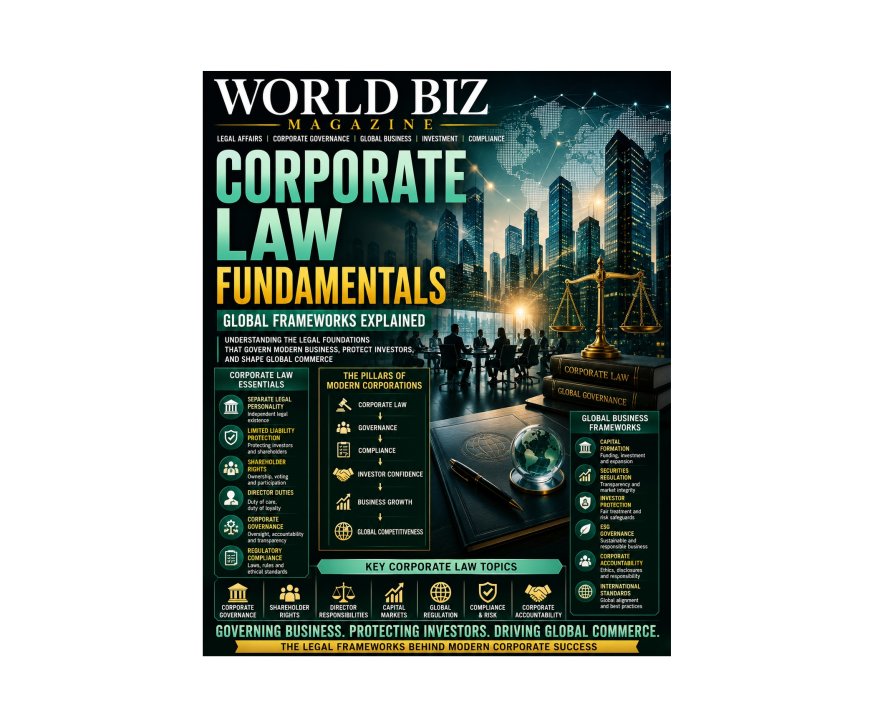
Corporate Law Fundamentals: Global Frameworks Explained
Understanding the Legal Foundations That Govern Businesses, Protect Investors, and Shape Global Commerce
World Biz Magazine | Corporate Governance, Legal Affairs & Global Business
Corporate law forms the legal foundation upon which modern business operates. Every multinational corporation, family-owned enterprise, publicly traded company, startup, private equity-backed venture, and state-owned enterprise functions within a framework of laws that define how organizations are created, governed, financed, regulated, and ultimately dissolved. While consumers often focus on products, services, brands, and financial performance, the legal structures behind corporations play an equally important role in determining how businesses operate, manage risk, attract investment, and maintain accountability.
In today's interconnected economy, corporate law has become increasingly important as businesses expand across borders, access international capital markets, engage in complex transactions, and operate within multiple regulatory jurisdictions. Investors, shareholders, directors, executives, employees, lenders, regulators, and governments all rely on corporate legal frameworks to establish rights, obligations, and mechanisms for resolving disputes. Without these legal systems, large-scale economic activity would be significantly more difficult, and investor confidence would be substantially weaker.
Although corporate law varies across jurisdictions, most legal systems share common objectives. They seek to provide legal certainty, encourage entrepreneurship, protect investors, facilitate capital formation, establish governance standards, and ensure that businesses operate responsibly within society. Understanding these fundamental principles is essential for business leaders, investors, entrepreneurs, legal professionals, and anyone seeking to navigate the modern corporate landscape.
As globalization, digital transformation, ESG regulations, shareholder activism, and corporate accountability continue reshaping business environments, corporate law remains one of the most influential forces affecting the future of commerce and investment worldwide.
What Is Corporate Law?
Corporate law is the body of legal rules governing the formation, operation, management, financing, restructuring, and dissolution of business entities.
It establishes the legal framework that allows companies to exist as separate legal persons independent from their owners.
Corporate law governs issues such as:
- Company formation
- Shareholder rights
- Board responsibilities
- Corporate governance
- Mergers and acquisitions
- Securities issuance
- Regulatory compliance
- Corporate restructuring
- Dissolution and liquidation
The primary objective of corporate law is to create a predictable environment that supports business activity while protecting stakeholders.
The Concept of Separate Legal Personality
One of the most important principles in corporate law is the doctrine of separate legal personality.
When a corporation is legally formed, it becomes a distinct legal entity separate from its shareholders, directors, and executives.
This principle allows companies to:
- Own property
- Enter contracts
- Borrow funds
- Sue and be sued
- Continue operations despite ownership changes
Separate legal personality provides stability and continuity while encouraging investment and economic growth.
Without this concept, large-scale corporate activity would be significantly more difficult to organize and finance.
Limited Liability: The Foundation of Modern Investment
Closely connected to separate legal personality is the principle of limited liability.
Limited liability protects shareholders from being personally responsible for corporate debts beyond their investment.
For example, if a corporation experiences financial difficulties, creditors generally cannot pursue shareholders' personal assets.
This protection encourages entrepreneurship and investment because investors can participate in business ventures without exposing their entire personal wealth.
The concept of limited liability is widely regarded as one of the most important innovations in modern economic development.
Corporate Governance and Organizational Structure
Corporate governance refers to the system through which corporations are directed and controlled.
Strong governance frameworks help align management decisions with shareholder interests while promoting accountability and transparency.
Most corporations operate through three primary groups:
Shareholders
Provide capital and exercise ownership rights.
Board of Directors
Oversee corporate strategy and management performance.
Executive Management
Responsible for day-to-day operations.
Corporate law establishes the responsibilities and relationships among these groups.
Effective governance contributes to long-term business sustainability and investor confidence.
Shareholder Rights and Protections
Corporate law provides shareholders with specific legal rights designed to protect their investments.
These rights often include:
- Voting rights
- Dividend entitlements
- Access to corporate information
- Participation in major corporate decisions
- Protection against unfair treatment
Minority shareholder protections are particularly important in preventing abuses by controlling shareholders or management.
Strong shareholder protections are often associated with more developed capital markets and greater investor participation.
Directors' Duties and Responsibilities
Directors play a central role in corporate governance.
Corporate law imposes fiduciary duties on directors to ensure they act in the best interests of the corporation.
These duties generally include:
Duty of Care
Making informed and reasonable decisions.
Duty of Loyalty
Avoiding conflicts of interest.
Duty of Good Faith
Acting honestly and responsibly.
Directors who breach these duties may face legal consequences.
These obligations help maintain trust in corporate governance systems.
Corporate Formation and Business Structures
Corporate law governs how business entities are created and organized.
Common structures include:
Corporations
Separate legal entities with shareholder ownership.
Limited Liability Companies (LLCs)
Flexible structures offering liability protection.
Partnerships
Businesses owned by multiple participants.
Limited Partnerships
Structures combining active managers and passive investors.
Joint Ventures
Project-specific collaborative business arrangements.
The choice of entity structure significantly affects taxation, liability exposure, governance, and financing options.
Capital Formation and Securities Regulation
One of corporate law's most important functions is facilitating capital formation.
Businesses require access to funding to support growth and expansion.
Corporate law governs:
- Share issuance
- Bond offerings
- Private placements
- Initial Public Offerings (IPOs)
- Secondary offerings
Securities regulations are designed to ensure transparency and protect investors from fraud and misinformation.
Effective capital markets depend heavily on robust legal frameworks.
Corporate Compliance and Regulatory Oversight
Corporations operate within extensive regulatory environments.
Compliance obligations may involve:
- Financial reporting
- Tax regulations
- Employment laws
- Competition rules
- Environmental regulations
- Consumer protection requirements
Failure to comply can result in:
- Fines
- Litigation
- Regulatory investigations
- Reputational damage
Corporate law provides mechanisms for enforcing these requirements and maintaining market integrity.
Mergers, Acquisitions, and Corporate Restructuring
Corporate law plays a critical role in business combinations and restructuring transactions.
Major activities include:
- Mergers
- Acquisitions
- Divestitures
- Spin-offs
- Corporate reorganizations
Legal frameworks establish procedures for:
- Due diligence
- Shareholder approvals
- Regulatory reviews
- Transaction disclosures
Well-defined rules support efficient corporate transactions while protecting stakeholders.
Corporate Law Across Different Legal Systems
Although corporate law principles are broadly similar worldwide, significant differences exist between jurisdictions.
Two major legal traditions dominate global corporate regulation.
Common Law Systems
Found in countries such as the United States, United Kingdom, Canada, Australia, and Singapore.
Common law relies heavily on judicial precedent.
Civil Law Systems
Common throughout Europe, Latin America, and many parts of Asia.
Civil law systems rely more extensively on statutory codes.
Both approaches seek to promote business stability and investor protection, though implementation methods may differ.
International Corporate Governance Standards
As businesses increasingly operate globally, international governance standards have gained importance.
Influential frameworks include:
- OECD Corporate Governance Principles
- International Financial Reporting Standards (IFRS)
- ESG reporting standards
- Anti-corruption regulations
These frameworks encourage consistency and transparency across markets.
Global investors often evaluate companies based on adherence to recognized governance standards.
The Rise of ESG and Corporate Accountability
Environmental, Social, and Governance (ESG) considerations are reshaping corporate law.
Regulators, investors, and stakeholders increasingly expect companies to address:
- Environmental sustainability
- Social responsibility
- Ethical governance
Many jurisdictions are introducing new disclosure requirements and accountability measures.
Corporate boards are increasingly expected to oversee ESG risks alongside traditional financial performance.
This trend is expanding the scope of corporate governance responsibilities.
Corporate Law and Investor Confidence
Investor confidence depends heavily on legal certainty.
Strong corporate legal systems support:
- Capital market development
- Foreign direct investment
- Business formation
- Economic growth
Investors are generally more willing to allocate capital where property rights, shareholder protections, and legal enforcement mechanisms are well established.
Corporate law therefore plays a direct role in national competitiveness and economic development.
Emerging Trends in Corporate Law
Several trends are expected to influence future legal frameworks.
These include:
- Digital corporate governance
- AI-related regulation
- ESG compliance requirements
- Cybersecurity oversight
- Shareholder activism
- Corporate transparency initiatives
- Cross-border regulatory coordination
- Sustainable finance regulations
As business models evolve, corporate law will continue adapting to address emerging challenges and opportunities.
World Biz Magazine Insights
Corporate law is often viewed as a technical legal discipline, but its influence extends far beyond boardrooms and legal departments. It shapes how businesses raise capital, manage risk, protect investors, engage with stakeholders, and compete in global markets. The most successful corporations recognize that strong governance and legal compliance are not merely regulatory requirements they are strategic assets that enhance credibility, resilience, and long-term value creation. As global business environments become increasingly complex, corporate law will remain a critical pillar supporting economic growth and investor confidence.
Conclusion
Corporate law provides the legal architecture that enables modern commerce to function effectively. Through principles such as separate legal personality, limited liability, shareholder protection, corporate governance, and regulatory compliance, corporate legal frameworks create the stability and predictability necessary for business growth and investment.
As globalization, technological innovation, ESG expectations, and regulatory complexity continue evolving, corporate law will remain central to how organizations operate and compete. Understanding its fundamental principles is essential for business leaders, investors, entrepreneurs, and policymakers seeking to navigate today's dynamic corporate environment.
Ultimately, strong corporate legal systems benefit not only individual companies but entire economies by fostering trust, accountability, transparency, and sustainable economic development.
Disclaimer
This article is published for informational, educational, and industry analysis purposes only and does not constitute legal, financial, tax, regulatory, investment, or professional advice. Corporate laws, governance requirements, securities regulations, and compliance obligations vary by jurisdiction and may change over time. Readers should consult qualified legal and professional advisors regarding specific corporate, governance, compliance, or investment matters.
What's Your Reaction?
 Like
0
Like
0
 Dislike
0
Dislike
0
 Love
0
Love
0
 Funny
0
Funny
0
 Angry
0
Angry
0
 Sad
0
Sad
0
 Wow
0
Wow
0