
































































































































































































Corporate Transparency and Beneficial Ownership Rules: Understanding Global Disclosure Requirements
Understand the global regulatory landscape surrounding beneficial ownership disclosure, corporate governance, and financial transparency initiatives.

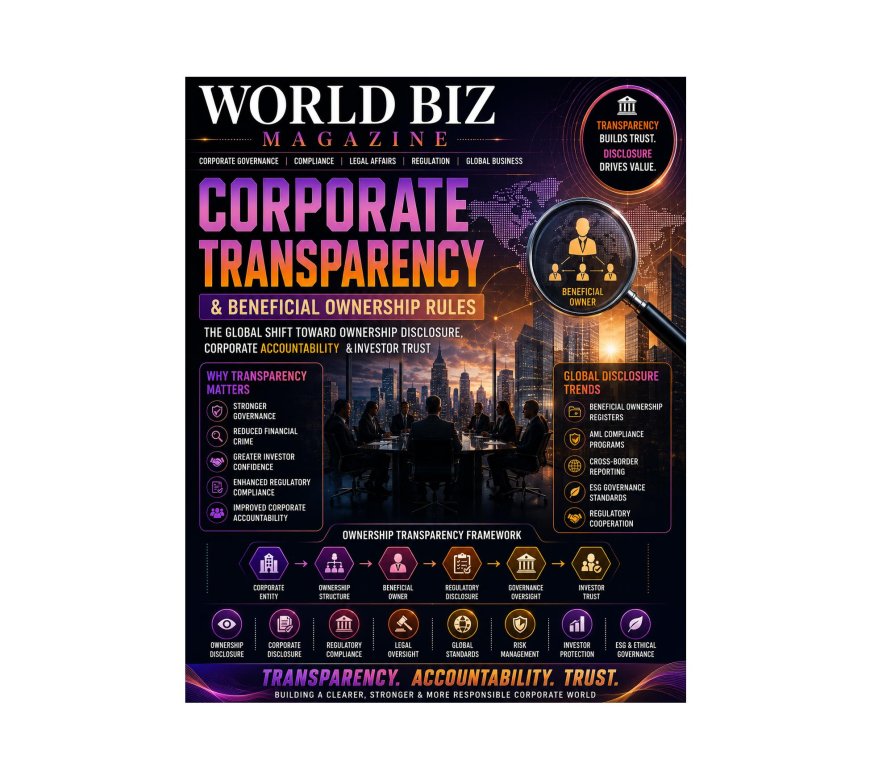
Corporate Transparency and Beneficial Ownership Rules
How Global Disclosure Requirements Are Reshaping Corporate Governance, Financial Integrity, and Business Accountability
World Biz Magazine | Corporate Governance, Compliance & Global Business
In an increasingly interconnected global economy, transparency has become one of the most important pillars of modern corporate governance. Governments, regulators, financial institutions, investors, and international organizations are placing unprecedented emphasis on understanding who ultimately owns, controls, and benefits from corporate entities. While corporations have long served as essential vehicles for investment, entrepreneurship, asset management, and economic growth, concerns regarding financial crime, money laundering, tax evasion, corruption, sanctions avoidance, and illicit financial flows have driven a global movement toward greater corporate transparency.
At the center of this transformation lies the concept of beneficial ownership. Traditionally, corporate ownership structures could involve multiple layers of holding companies, trusts, nominee shareholders, partnerships, and offshore entities spread across numerous jurisdictions. While many of these structures serve legitimate commercial purposes, they can also obscure the identities of the individuals who ultimately control or benefit from corporate assets. In response, regulators worldwide have introduced beneficial ownership disclosure frameworks designed to increase transparency and improve accountability within corporate ecosystems.
Today, beneficial ownership reporting requirements affect companies of all sizes across a wide range of industries. Financial institutions, multinational corporations, investment funds, professional service providers, and privately held businesses increasingly operate within regulatory environments that demand greater disclosure of ownership and control structures. As enforcement efforts intensify and international cooperation expands, understanding beneficial ownership rules has become essential for businesses seeking to maintain compliance and preserve stakeholder trust.
Corporate transparency is no longer viewed solely as a regulatory obligation. It has evolved into a strategic business consideration that influences investor confidence, market integrity, access to capital, and long-term corporate reputation.
Understanding Corporate Transparency
Corporate transparency refers to the disclosure of information regarding a company's ownership, governance, operations, and decision-making structures.
The objective is to ensure that relevant stakeholders can understand:
- Who owns the company
- Who controls the company
- How decisions are made
- Who benefits from corporate activities
Transparency supports accountability while reducing opportunities for misuse of corporate entities.
Modern transparency initiatives seek to balance legitimate privacy interests with the need for regulatory oversight and financial integrity.
As global commerce becomes increasingly complex, transparency has become a cornerstone of responsible corporate governance.
What Is Beneficial Ownership?
Beneficial ownership refers to the natural person who ultimately owns, controls, or benefits from a legal entity, regardless of the formal ownership structure.
This distinction is important because legal ownership and beneficial ownership are not always the same.
For example:
A company may be legally owned by another corporation, which is owned by a trust, which is controlled by an individual.
In such cases, the individual may be considered the beneficial owner even though their name does not appear directly on corporate records.
Beneficial ownership frameworks seek to identify these ultimate controlling individuals.
The goal is to increase transparency and reduce opportunities for misuse of legal entities.
Why Beneficial Ownership Matters
Understanding who ultimately controls a company is critical for multiple reasons.
Beneficial ownership information supports:
- Anti-money laundering efforts
- Counter-terrorism financing initiatives
- Anti-corruption enforcement
- Tax compliance
- Sanctions enforcement
- Financial crime prevention
Regulators and financial institutions rely on beneficial ownership data to evaluate risk and identify suspicious activities.
Without accurate ownership information, illicit actors may exploit corporate structures to conceal assets and financial transactions.
As a result, beneficial ownership disclosure has become a major policy priority globally.
The Global Push for Ownership Transparency
The movement toward corporate transparency has gained momentum over the past two decades.
Several high-profile investigations involving offshore entities, hidden ownership arrangements, and illicit financial flows highlighted weaknesses in existing disclosure frameworks.
International organizations have responded by promoting stronger transparency standards.
Key contributors include:
- The Financial Action Task Force (FATF)
- The Organisation for Economic Co-operation and Development (OECD)
- The World Bank
- The International Monetary Fund (IMF)
- The United Nations
These organizations have encouraged jurisdictions to establish beneficial ownership registries and disclosure mechanisms.
Global cooperation has significantly accelerated transparency reforms.
Beneficial Ownership Thresholds
Most jurisdictions define beneficial ownership based on ownership percentages or control rights.
Common thresholds include:
- 25% ownership
- Significant voting rights
- Effective control over management decisions
However, thresholds vary between jurisdictions.
Some regulations require disclosure even when ownership percentages fall below traditional thresholds if control can be demonstrated through other means.
Control may be exercised through:
- Voting agreements
- Trust arrangements
- Contractual rights
- Board influence
Regulators increasingly focus on substance rather than formal ownership structures.
Corporate Transparency and Anti-Money Laundering (AML)
Beneficial ownership requirements are closely connected to AML frameworks.
Financial institutions are generally required to perform customer due diligence (CDD) and know-your-customer (KYC) procedures.
These processes involve identifying:
- Legal owners
- Beneficial owners
- Control structures
- Risk profiles
Ownership transparency improves the ability of financial institutions to detect suspicious activities and comply with regulatory requirements.
AML regulations have become one of the primary drivers of beneficial ownership reporting worldwide.
Beneficial Ownership Registries
Many jurisdictions have established beneficial ownership registries.
These databases typically collect information regarding:
- Ownership interests
- Control rights
- Beneficial owner identities
- Corporate structures
Registry models vary significantly.
Some jurisdictions maintain:
Public Registries
Accessible to investors, journalists, and the general public.
Restricted Registries
Accessible only to regulators and authorized authorities.
Hybrid Models
Providing varying levels of public access.
Registry implementation remains an evolving area of regulatory policy.
Transparency and Corporate Governance
Ownership transparency contributes directly to stronger governance practices.
Clear ownership structures help:
- Reduce conflicts of interest
- Improve board accountability
- Enhance shareholder oversight
- Strengthen decision-making transparency
Investors often view transparent ownership arrangements as indicators of governance quality.
Organizations that maintain clear ownership disclosures may benefit from greater stakeholder confidence.
Transparency can therefore serve as a competitive advantage.
Investor Perspectives on Beneficial Ownership
Institutional investors increasingly evaluate transparency as part of investment due diligence.
Investors seek to understand:
- Ownership concentration
- Control mechanisms
- Governance risks
- Related-party relationships
Opaque ownership structures may create concerns regarding accountability and decision-making processes.
Transparency enhances investor confidence and supports more informed investment decisions.
As ESG considerations gain importance, ownership transparency is becoming increasingly relevant within responsible investment frameworks.
Corporate Structures and Transparency Challenges
Modern corporations often utilize complex ownership structures for legitimate business reasons.
Examples include:
- Holding companies
- Joint ventures
- Investment funds
- Trusts
- Cross-border subsidiaries
While these structures can improve efficiency and risk management, they may also complicate ownership identification.
Determining beneficial ownership often requires detailed analysis of multiple legal entities and jurisdictions.
This complexity remains one of the greatest challenges facing regulators.
International Variations in Disclosure Requirements
Beneficial ownership regulations differ significantly across countries.
Differences may involve:
- Ownership thresholds
- Reporting deadlines
- Registry accessibility
- Verification standards
- Enforcement mechanisms
Multinational corporations must navigate diverse disclosure obligations across multiple jurisdictions.
Compliance programs often require coordination among legal, compliance, governance, and risk management functions.
Global consistency remains an ongoing challenge.
Privacy Considerations and Regulatory Balance
Transparency initiatives have generated debate regarding privacy rights.
Some stakeholders argue that public disclosure requirements may expose beneficial owners to:
- Security risks
- Privacy concerns
- Commercial sensitivities
Others emphasize the importance of transparency for combating financial crime.
Policymakers continue seeking appropriate balances between privacy protections and public accountability.
Future regulatory developments will likely continue addressing these competing interests.
The Role of Technology in Beneficial Ownership Compliance
Technology is increasingly supporting ownership transparency efforts.
Digital tools assist with:
- Ownership mapping
- Entity relationship analysis
- Data verification
- Regulatory reporting
- Ongoing monitoring
Artificial intelligence and advanced analytics are helping organizations identify complex ownership relationships more efficiently.
Technology is expected to play a growing role in transparency compliance.
Enforcement and Regulatory Penalties
Regulators are increasingly focused on enforcement.
Failure to comply with beneficial ownership requirements may result in:
- Financial penalties
- Regulatory investigations
- Criminal liability
- Operational restrictions
- Reputational damage
Organizations must establish processes to ensure accurate reporting and timely updates.
Compliance failures can significantly affect stakeholder confidence.
As enforcement intensifies, transparency programs are becoming strategic governance priorities.
Beneficial Ownership and ESG Considerations
Transparency is increasingly linked to ESG performance.
Governance remains one of the three core ESG pillars.
Ownership disclosure supports:
- Accountability
- Ethical governance
- Stakeholder trust
- Responsible business conduct
Investors, rating agencies, and regulators are paying closer attention to transparency practices.
Organizations with strong governance frameworks may benefit from improved ESG evaluations.
This trend is reinforcing the business case for transparency.
Emerging Trends in Corporate Transparency
Several trends are shaping the future of beneficial ownership regulation.
These include:
- Expanded registry requirements
- Enhanced verification standards
- Increased international cooperation
- Digital reporting platforms
- Cross-border information sharing
- Greater enforcement activity
- Integration with ESG reporting
As regulatory frameworks continue evolving, ownership transparency is expected to become increasingly sophisticated and comprehensive.
Organizations must remain adaptable to changing requirements.
World Biz Magazine Insights
Corporate transparency and beneficial ownership disclosure have become central elements of modern corporate governance. Regulators, investors, and stakeholders increasingly expect organizations to demonstrate clear ownership structures, responsible governance practices, and effective compliance controls. While transparency requirements may increase administrative responsibilities, they also contribute to stronger market integrity, enhanced investor confidence, and improved corporate accountability. In a business environment characterized by growing regulatory scrutiny and stakeholder expectations, transparency is evolving from a compliance requirement into a strategic business asset.
Conclusion
Beneficial ownership rules and corporate transparency frameworks are reshaping the global corporate landscape. By increasing visibility into ownership and control structures, these regulations help combat financial crime, strengthen governance, support investor confidence, and enhance regulatory oversight.
For businesses operating across international markets, compliance with transparency requirements has become an essential component of governance and risk management. Organizations must understand applicable disclosure obligations, maintain accurate ownership records, and establish robust compliance procedures to meet evolving regulatory expectations.
As global transparency initiatives continue expanding, businesses that embrace openness, accountability, and responsible governance will be better positioned to navigate future regulatory developments while strengthening stakeholder trust and long-term organizational resilience.
Disclaimer
This article is published for informational, educational, and industry analysis purposes only and does not constitute legal, regulatory, compliance, tax, financial, investment, or professional advice. Beneficial ownership rules, transparency requirements, disclosure obligations, and corporate governance regulations vary significantly across jurisdictions and may change over time. Readers should consult qualified legal, compliance, regulatory, and professional advisors regarding specific ownership reporting obligations and governance requirements.
What's Your Reaction?
 Like
0
Like
0
 Dislike
0
Dislike
0
 Love
0
Love
0
 Funny
0
Funny
0
 Angry
0
Angry
0
 Sad
0
Sad
0
 Wow
0
Wow
0