


























































































Impact of Fashion Week on Brand Equity | World Biz Magazine
World Biz Magazine examines how Fashion Week shapes brand equity through creativity, celebrity influence, digital media, consumer loyalty, and retail strategy.

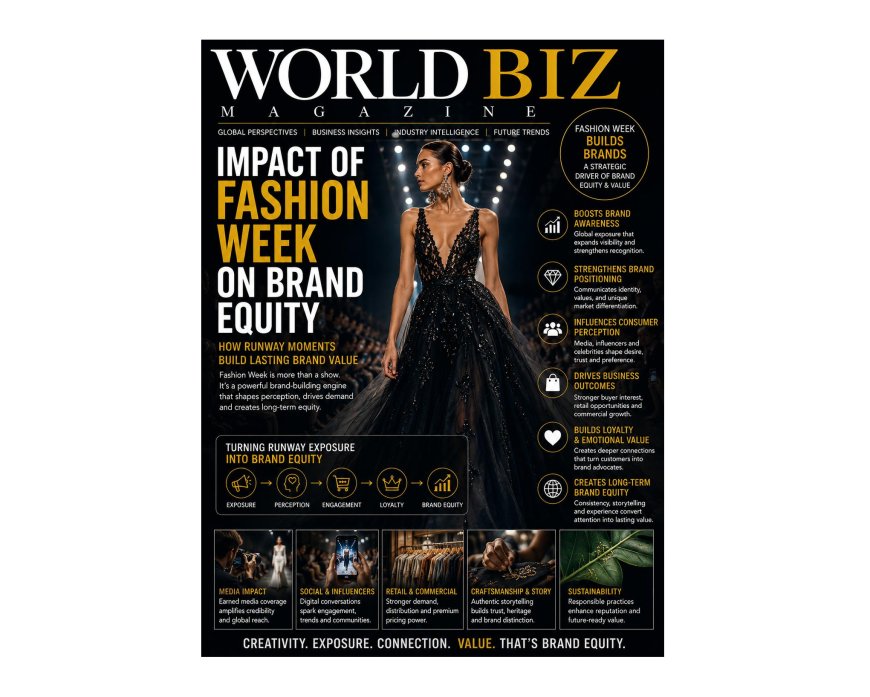
Impact of Fashion Week on Brand Equity
How Global Fashion Weeks Shape Brand Value, Consumer Perception, Market Positioning, and Long-Term Business Growth
World Biz Magazine | Fashion Business | Brand Strategy | Luxury | Retail | Marketing
Fashion Week is often presented as a celebration of creativity, design, celebrity culture, and seasonal trends. Behind the runway, however, lies a sophisticated business mechanism capable of influencing one of the most valuable intangible assets a fashion company can possess: brand equity.
Brand equity represents the additional value a company receives from the strength, recognition, reputation, associations, and loyalty attached to its brand. In fashion, where products can be imitated and consumers have numerous alternatives, a powerful brand can command premium prices, attract loyal customers, generate media attention, secure retail relationships, and maintain relevance across generations.
Fashion Week contributes to this process by placing brands at the center of an international ecosystem involving designers, buyers, editors, celebrities, influencers, photographers, retailers, investors, and consumers. A successful presentation can strengthen a brand's identity and create enormous cultural visibility. A poorly received collection, on the other hand, can generate negative discussion and weaken perceptions of relevance or quality.
The impact of Fashion Week should therefore not be measured simply by the number of people attending a show. Its real value lies in how effectively the event strengthens the brand's position in the minds of its target audiences and translates creative attention into long-term commercial value.
Understanding Brand Equity in Fashion
Brand equity is built through the cumulative experiences and perceptions associated with a brand.
For fashion companies, major components include:
- Brand awareness
- Brand recognition
- Brand associations
- Perceived quality
- Customer loyalty
- Cultural relevance
- Exclusivity
- Reputation
- Emotional connection
- Distinctive identity
A Fashion Week presentation can influence nearly all of these dimensions simultaneously.
When a collection communicates a clear creative identity and receives strong industry and consumer response, the brand can become more recognizable and desirable. Over time, repeated successful appearances can transform Fashion Week participation into an important part of the company's broader brand-building strategy.
Fashion Week as a Global Brand-Building Platform
Fashion Week provides brands with a concentrated period of international attention.
Instead of communicating individually with consumers throughout the year, a fashion house can create a powerful narrative around a single collection and generate coverage across multiple channels.
A major presentation can result in:
- Editorial coverage
- Social media discussions
- Celebrity exposure
- Influencer content
- Buyer interest
- Search activity
- Video engagement
- Consumer conversations
- Retail opportunities
This concentration of attention can significantly increase brand visibility.
For established luxury houses, Fashion Week reinforces existing brand equity. For emerging designers, it can provide an opportunity to build recognition among influential industry audiences.
Strengthening Brand Awareness
Brand awareness is one of the most immediate benefits of Fashion Week participation.
Consumers may not purchase a collection immediately, but repeated exposure to a designer's visual identity can increase familiarity.
Runway imagery, campaign photographs, celebrity appearances, interviews, and social media content allow consumers to recognize:
- Brand logos
- Signature silhouettes
- Design language
- Color palettes
- Creative direction
- Distinctive products
Greater recognition can influence future purchasing decisions, particularly when consumers encounter the brand through retail platforms or digital advertising.
Creating a Distinctive Brand Identity
Fashion is fundamentally connected to visual identity.
A successful Fashion Week presentation can communicate a brand's personality through:
- Clothing
- Styling
- Music
- Lighting
- Set design
- Casting
- Location
- Photography
- Invitations
- Digital content
Every element can contribute to a coherent brand narrative.
Luxury brands in particular use Fashion Week to reinforce their heritage, craftsmanship, modernity, cultural positioning, or exclusivity.
When all elements work together, the runway becomes an extension of the brand rather than simply a presentation of products.
Reinforcing Brand Positioning
Brand positioning defines how a company wants to be perceived relative to competitors.
A Fashion Week presentation can help establish whether a brand is perceived as:
- Luxury
- Contemporary
- Avant-garde
- Minimalist
- Sustainable
- Youth-oriented
- Heritage-focused
- Experimental
- Commercial
- Streetwear-driven
This positioning is important because consumers do not purchase fashion products based solely on functional characteristics. They also purchase the identity and meaning associated with the brand.
Building Emotional Connections
Strong fashion brands frequently create emotional relationships with consumers.
Fashion Week provides an opportunity to tell stories that go beyond product specifications.
A collection may explore themes related to:
- Identity
- Culture
- History
- Freedom
- Technology
- Sustainability
- Social change
- Personal expression
These narratives can make a collection more memorable and create emotional associations with the brand.
When consumers feel connected to a brand's story, they may become more willing to remain loyal even when competing products are available.
The Role of Creative Directors
Creative directors have significant influence over brand equity.
A new creative director can completely change the visual and cultural direction of a fashion house.
Fashion Week provides one of the first major opportunities to demonstrate that new direction.
A successful transition can modernize a heritage brand while preserving its core identity. However, excessive changes may alienate existing customers if the new creative direction appears disconnected from the brand's historical positioning.
The challenge is therefore to balance innovation with continuity.
Celebrity Influence on Brand Equity
Celebrity attendance and celebrity dressing can dramatically expand Fashion Week exposure.
When influential public figures wear a brand, images can travel rapidly across:
- News publications
- Social media
- Entertainment platforms
- Fan communities
- Search engines
Celebrity associations can strengthen brand desirability, particularly among younger consumers.
However, celebrity exposure does not automatically create sustainable brand equity. The association must remain consistent with the brand's identity and target audience.
A celebrity partnership that generates attention but lacks authenticity may create short-term visibility without producing meaningful long-term value.
Influencers and the Creator Economy
The fashion communication system has expanded beyond traditional magazines and newspapers.
Influencers and independent creators can interpret Fashion Week collections for highly specific communities.
Their content may include:
- Collection reviews
- Styling ideas
- Behind-the-scenes content
- Fashion commentary
- Designer interviews
- Product recommendations
- Street-style coverage
This decentralized media environment allows brands to reach niche audiences that traditional advertising may not reach effectively.
Social Media and the Speed of Brand Perception
Social media has dramatically accelerated the Fashion Week feedback cycle.
A runway collection can be photographed, published, reviewed, criticized, and discussed globally within minutes.
This creates both opportunities and risks.
Positive reactions can generate:
- Viral visibility
- Increased searches
- Consumer interest
- Media coverage
- Product demand
Negative reactions can create:
- Reputation challenges
- Public criticism
- Questions about creative direction
- Reduced consumer enthusiasm
Brands therefore need strong communication strategies before, during, and after Fashion Week.
Fashion Editors and Professional Credibility
Traditional fashion media continues to play an important role in building credibility.
Editors and industry journalists provide professional interpretation of collections and can influence how designers are perceived within the broader fashion ecosystem.
Editorial coverage can strengthen associations around:
- Creativity
- Quality
- Innovation
- Cultural relevance
- Luxury
- Industry leadership
A brand that consistently receives meaningful editorial attention may strengthen its position as an influential industry participant.
Fashion Buyers and Commercial Brand Equity
Fashion Week is also a commercial environment.
Buyers assess collections based on their potential to generate consumer demand.
Their decisions can influence:
- Retail distribution
- Wholesale relationships
- Market reach
- Product visibility
- Sales opportunities
Strong buyer interest can therefore translate creative recognition into commercial distribution.
A collection that generates attention but fails to achieve commercial adoption may produce limited financial value for the brand.
Fashion Week and Premium Pricing
Strong brand equity allows fashion companies to charge prices that exceed the basic functional value of materials and manufacturing.
Consumers may pay premium prices because they value:
- Brand reputation
- Exclusivity
- Design
- Heritage
- Craftsmanship
- Cultural status
- Emotional connection
Fashion Week contributes to these perceptions by reinforcing the idea that a brand occupies a distinctive position within the fashion ecosystem.
The stronger the brand's perceived value, the greater its ability to defend premium pricing.
Creating Scarcity and Exclusivity
Scarcity is an important component of luxury branding.
Limited collections, exclusive runway pieces, invitation-only presentations, and restricted availability can reinforce perceptions of rarity.
Fashion Week naturally creates an environment where access can be carefully controlled.
However, brands must manage exclusivity carefully. Excessive accessibility can weaken perceptions of rarity, while excessive restriction can limit commercial growth.
Fashion Week and Consumer Loyalty
Brand equity becomes especially valuable when awareness develops into loyalty.
Fashion Week can help existing customers feel connected to the continuing evolution of a brand.
Customers may follow:
- Seasonal collections
- Creative directors
- Designer collaborations
- Runway trends
- Brand campaigns
- Fashion Week events
This recurring engagement can transform customers into long-term brand advocates.
The Economic Value of Fashion Week Exposure
Fashion Week generates value beyond direct clothing sales.
Brand exposure can influence:
- Licensing
- Accessories
- Fragrances
- Beauty products
- Collaborations
- Retail partnerships
- Digital products
- Brand extensions
A strong fashion identity can therefore create opportunities across multiple business categories.
For major fashion houses, the runway can serve as a marketing investment supporting an entire brand ecosystem.
How Brands Can Use Fashion Week to Increase Brand Equity
Participating in Fashion Week does not automatically increase brand equity. A runway show can generate enormous attention, but that attention only becomes meaningful brand value when it is strategically converted into stronger awareness, positive associations, customer engagement, loyalty, and commercial performance.
Brands should therefore approach Fashion Week as a complete brand-building campaign rather than a single event. The runway should be the central moment within a broader strategy that begins before the collection is presented and continues long after the show ends.
1. Build a Clear Brand Story Before Fashion Week
Brand equity starts with a recognizable and differentiated identity.
Before Fashion Week, brands should clearly define what they want audiences to remember about the collection and the company.
The brand story may focus on:
· Heritage and craftsmanship
· Innovation
· Sustainability
· Cultural identity
· Modern luxury
· Individual expression
· New creative leadership
· Technological innovation
A strong narrative gives journalists, influencers, buyers, and consumers something meaningful to associate with the brand.
The objective should not simply be to make people notice the collection. It should be to make them understand what the brand stands for.
2. Create a Distinctive Fashion Week Experience
A memorable Fashion Week presentation can become a powerful brand asset.
Brands can strengthen the experience through carefully integrated:
· Venue selection
· Runway design
· Music
· Lighting
· Casting
· Styling
· Visual effects
· Photography
· Invitations
· Digital experiences
Every element should reinforce the same brand identity.
A luxury heritage brand, for example, may emphasize craftsmanship and history, while an emerging technology-focused label may create a more experimental digital environment.
The goal is to create an experience that audiences immediately associate with the brand.
3. Turn the Collection Into a Content Ecosystem
One runway show can generate months of content when properly planned.
Instead of publishing only runway photographs, brands can create a broader content ecosystem containing:
· Designer interviews
· Behind-the-scenes videos
· Collection stories
· Short-form videos
· Product details
· Styling content
· Creative director commentary
· Interviews with models
· Manufacturing stories
· Sustainability information
This allows the Fashion Week investment to continue generating visibility after the event has ended.
The strongest brands treat Fashion Week as a content engine, not a one-day marketing activity.
4. Use Social Media to Expand the Audience
Fashion Week historically depended heavily on editors and industry professionals.
Today, social platforms allow brands to communicate directly with global consumers.
Brands can use:
· Instagram
· TikTok
· YouTube
· Pinterest
· LinkedIn
· Short-form video platforms
· Livestreaming
to extend runway exposure.
However, social media should not simply reproduce runway photographs. Content should be adapted to each platform and audience.
Behind-the-scenes storytelling, designer commentary, creator collaborations, interactive content, and short videos can make the collection more accessible.
5. Work With the Right Influencers and Creators
Influencer partnerships can significantly expand Fashion Week's reach.
However, brands should prioritize relevance over follower count.
A creator whose audience closely matches the brand's target customers may generate more valuable engagement than a celebrity with a much larger but unrelated audience.
Brands should evaluate creators based on:
· Audience relevance
· Engagement quality
· Brand compatibility
· Credibility
· Content quality
· Geographic reach
· Previous partnerships
The objective should be to create authentic conversations rather than simply purchase exposure.
6. Build Relationships With Fashion Editors and Media
Editorial credibility can strengthen brand equity significantly.
Brands should develop relationships with journalists, editors, publishers, photographers, and specialized fashion media before Fashion Week.
Providing meaningful access to:
· Designers
· Creative directors
· Collection information
· Behind-the-scenes stories
· Craftsmanship details
· Business perspectives
can help media organizations develop deeper stories around the brand.
Strong editorial narratives often create more lasting brand value than short-term advertising exposure.
7. Connect Fashion Week With Retail and E-Commerce
Brand equity becomes more commercially valuable when consumers can act on their interest.
Brands should therefore connect Fashion Week exposure with:
· E-commerce
· Retail stores
· Product launches
· Pre-orders
· Limited releases
· Waitlists
· Exclusive collections
Depending on the brand strategy, selected products may be made available immediately or released according to the traditional seasonal calendar.
The key is to provide consumers with a clear path from discovery to engagement to purchase.
8. Create Limited and Exclusive Products
Fashion Week can be used to strengthen perceptions of exclusivity.
Brands may introduce:
· Limited-edition products
· Runway-only pieces
· Special collaborations
· Numbered products
· Exclusive accessories
· Early-access collections
Scarcity can increase desirability when it is authentic and strategically managed.
However, artificial scarcity should not replace genuine product quality. Long-term brand equity depends on credibility.
9. Use Celebrity Partnerships Strategically
Celebrity relationships can create significant visibility, but brands should select ambassadors whose identity aligns naturally with the brand.
The strongest partnerships create a connection between:
Celebrity identity + brand identity + target consumer
Rather than simply seeking the biggest possible celebrity, brands should consider cultural relevance, audience demographics, credibility, and long-term compatibility.
A well-aligned celebrity relationship can strengthen brand associations over multiple seasons.
10. Communicate Craftsmanship and Product Quality
Fashion Week creates an opportunity to demonstrate what exists behind the runway.
Brands can highlight:
· Materials
· Construction
· Artisan techniques
· Manufacturing
· Design development
· Product testing
· Creative research
This is particularly valuable for luxury brands because craftsmanship helps justify premium positioning.
When consumers understand the work behind a product, they may perceive greater value beyond the visual appearance alone.
11. Make Sustainability Part of the Brand Story
Sustainability can contribute to positive brand associations when supported by genuine business practices.
Brands can communicate:
· Responsible material sourcing
· Production improvements
· Circular design
· Recycling initiatives
· Supply-chain transparency
· Reduced waste
· Product longevity
The communication should be specific and evidence-based.
Sustainability claims that cannot be supported may create reputational risk and weaken trust.
12. Use Data to Measure Brand Equity Growth
Fashion Week performance should be measured beyond attendance and social-media impressions.
Brands can establish measurable indicators before and after the event, including:
Awareness
Did brand searches increase?
Recognition
Are consumers more familiar with the brand?
Engagement
Did meaningful interactions increase?
Sentiment
Did consumer perception improve?
Consideration
Are more consumers considering purchasing the brand?
Loyalty
Did existing customers become more engaged?
Commercial Performance
Did sales, traffic, inquiries, or retail demand increase?
Media Impact
Did high-quality editorial coverage increase?
These measurements help management determine whether Fashion Week produced genuine brand-equity growth or merely temporary publicity.
13. Maintain Momentum After Fashion Week
One of the biggest mistakes brands make is treating Fashion Week as the end of a campaign.
The weeks and months following the event are equally important.
Brands should continue developing:
· Editorial stories
· Product launches
· Social content
· Creator partnerships
· Retail activations
· Customer campaigns
· Designer interviews
· Collection-related experiences
The objective is to transform a short period of intense attention into sustained consumer engagement.
14. Build a Long-Term Fashion Week Strategy
Brand equity is accumulated over time.
A brand should therefore evaluate Fashion Week participation across multiple seasons rather than judging success from one event.
Management can compare:
· Brand awareness
· Consumer sentiment
· Media visibility
· Retail relationships
· Social engagement
· Customer loyalty
· Sales performance
· International recognition
over several seasons.
This allows brands to identify which creative and marketing strategies consistently strengthen their position.
Turning Fashion Week Attention Into Brand Equity
The central principle is simple:
Fashion Week creates attention. Strategy converts attention into brand equity.
A successful brand should move consumers through a continuous journey:
Fashion Week → Awareness → Interest → Engagement → Brand Association → Trust → Purchase → Loyalty → Advocacy
When this process is strategically managed, Fashion Week becomes more than a runway event. It becomes an integrated brand-building platform capable of strengthening reputation, customer relationships, pricing power, cultural relevance, and long-term enterprise value.
For brands, the ultimate objective should not be to generate the loudest Fashion Week moment. It should be to create the most valuable and sustainable relationship with the consumer.
Fashion Week and Investor Perception
Although investors should not evaluate a fashion company based solely on runway success, Fashion Week can influence broader perceptions of brand momentum.
Investors may observe:
- Media visibility
- Consumer engagement
- Retail interest
- Brand positioning
- Product innovation
- International expansion
Strong creative momentum can contribute to perceptions of future growth potential.
However, brand visibility must ultimately be supported by sound financial performance, operational execution, and sustainable commercial demand.
The Risk of Negative Brand Equity
Fashion Week can strengthen a brand, but it can also expose vulnerabilities.
Negative reactions may arise from:
- Poor product reception
- Inconsistent creative direction
- Cultural controversies
- Sustainability concerns
- Poor event execution
- Celebrity-related controversies
- Production issues
- Communication failures
Because digital platforms amplify both positive and negative conversations, brands must carefully manage reputational risks.
Measuring Fashion Week's Impact
Companies should evaluate Fashion Week using more than media impressions.
A comprehensive measurement framework could include:
Brand Awareness
Did searches and recognition increase?
Engagement
How many meaningful interactions occurred?
Media Value
What level of editorial coverage was generated?
Consumer Sentiment
Was public perception positive, neutral, or negative?
Retail Impact
Did buyer interest and distribution opportunities increase?
Digital Performance
Did website traffic, social followers, and online engagement grow?
Commercial Performance
Did collection demand and sales improve?
Long-Term Brand Health
Did the event strengthen brand preference and loyalty?
This approach allows businesses to distinguish temporary attention from genuine brand equity creation.
The Importance of Consistency
Brand equity is rarely built through a single successful Fashion Week.
It develops through consistency over time.
Consumers need to repeatedly encounter a coherent brand identity across:
- Fashion Week
- Advertising
- Retail
- E-commerce
- Packaging
- Social media
- Customer service
- Celebrity partnerships
When every channel communicates the same fundamental identity, brand recognition and trust become stronger.
Emerging Designers and Brand Equity
Fashion Week can be particularly valuable for emerging designers.
A young brand may lack the advertising budget of a major luxury house but can use a compelling collection to attract:
- Editors
- Buyers
- Investors
- Influencers
- Stylists
- Retailers
- International partners
A successful Fashion Week appearance can therefore accelerate the development of a new brand.
However, visibility must be followed by strong production, distribution, financial planning, and customer experience.
Sustainability and Brand Reputation
Sustainability is increasingly connected to brand perception.
Consumers, investors, retailers, and industry stakeholders are paying greater attention to:
- Material sourcing
- Manufacturing conditions
- Waste
- Carbon emissions
- Supply-chain transparency
- Product longevity
Fashion Week gives brands an important platform to communicate sustainability initiatives.
However, environmental claims must be supported by credible evidence. Overstated or misleading sustainability messaging can damage rather than strengthen brand equity.
Artificial Intelligence and the Future of Fashion Branding
Artificial Intelligence is increasingly influencing fashion design, marketing, trend forecasting, personalization, and consumer analytics.
Brands may use AI to understand:
- Emerging consumer preferences
- Search behavior
- Product demand
- Market trends
- Customer segmentation
AI-generated creative content may also become increasingly common.
However, the growing use of AI creates a strategic challenge: brands must maintain human creativity and authenticity while using technology to improve efficiency.
The strongest future fashion brands are likely to combine advanced technology with distinctive human creative identity.
The Future of Fashion Week and Brand Equity
Fashion Week is likely to become increasingly hybrid.
Future presentations may combine:
- Physical runway shows
- Livestreaming
- Virtual environments
- Augmented Reality
- AI-powered personalization
- Creator partnerships
- Direct commerce
- Interactive digital experiences
This transformation will allow brands to communicate simultaneously with industry professionals and global consumers.
The most successful brands will not simply generate attention. They will convert attention into meaningful relationships, commercial opportunities, and long-term brand value.
Executive Perspective
Fashion Week should be understood as a strategic brand-building platform rather than simply an event.
Its influence extends from creative identity and media visibility to retail relationships, consumer perception, pricing power, loyalty, and international market positioning.
For established fashion houses, Fashion Week reinforces heritage and communicates continued relevance. For emerging brands, it can provide a launchpad into international markets. For retailers and buyers, it provides signals about future consumer demand. For consumers, it offers a window into the creative direction of the fashion industry.
However, the true value of Fashion Week cannot be measured by publicity alone. A collection may receive millions of views without creating sustainable commercial value. Conversely, a strategically positioned collection with strong industry support may create significant long-term brand equity even without becoming an immediate viral phenomenon.
The central challenge for fashion executives is therefore to transform visibility into value.
Brands that combine creative excellence, consistent identity, digital engagement, commercial discipline, cultural relevance, and responsible business practices will be best positioned to convert Fashion Week exposure into lasting brand equity.
In an increasingly competitive global fashion market, the runway is only the beginning. The real measure of success is what happens afterward—how consumers remember the brand, how retailers respond, how communities engage, and how effectively the organization converts cultural attention into sustainable business growth.
World Biz Magazine Insights
Fashion Week has evolved from a seasonal industry gathering into a powerful global brand-building and business platform. Its influence now extends across fashion, luxury, retail, media, entertainment, technology, social commerce, and consumer culture.
World Biz Magazine believes that the greatest opportunity for fashion brands is not simply gaining attention during Fashion Week, but converting that attention into measurable and sustainable brand equity.
1. Visibility Alone Does Not Create Brand Equity
A runway show can generate millions of impressions, but visibility by itself does not guarantee stronger brand value.
The real opportunity begins when exposure leads to greater brand recognition, positive associations, consumer consideration, trust, loyalty, and ultimately commercial performance.
Brands should therefore evaluate Fashion Week based on the quality of the relationships created rather than simply the size of the audience reached.
2. Fashion Week Should Be Treated as a Strategic Business Investment
Fashion brands should view Fashion Week as an integrated business and marketing investment rather than an isolated event.
The strongest strategies connect the runway with:
· Brand storytelling
· Media relations
· Social media
· Influencer partnerships
· Retail
· E-commerce
· Customer engagement
· Product launches
· Public relations
When these activities are coordinated, Fashion Week can create significantly greater value than a standalone runway presentation.
3. Strong Brand Identity Is More Valuable Than Temporary Virality
Digital platforms can make a Fashion Week moment viral within minutes. However, viral attention can disappear just as quickly.
Long-term brand equity requires consistency.
Brands that repeatedly communicate a distinctive identity, recognizable design language, credible values, and high product quality are more likely to convert short-term attention into lasting consumer preference.
The objective should therefore be recognition and relevance, not virality alone.
4. Authenticity Will Become Increasingly Important
Consumers have access to more information than ever before. They can investigate brand history, manufacturing practices, sustainability claims, celebrity partnerships, and customer experiences almost instantly.
This makes authenticity increasingly important.
Brands that communicate genuine craftsmanship, responsible practices, cultural relevance, and meaningful creative direction are better positioned to develop trust.
Fashion Week should therefore reflect the brand's actual identity rather than create an artificial image that cannot be sustained after the event.
5. Data Will Change How Fashion Week Success Is Measured
Traditional Fashion Week measurement has often focused on attendance, media coverage, impressions, and celebrity visibility.
Future measurement will become more sophisticated.
Brands will increasingly evaluate:
· Brand-search growth
· Consumer sentiment
· Engagement quality
· Audience growth
· Customer consideration
· Website traffic
· Product demand
· Retail inquiries
· Sales conversion
· Customer retention
This shift will help executives distinguish between publicity and genuine brand-equity creation.
6. Digital Commerce Will Shorten the Distance Between Inspiration and Purchase
Consumers increasingly discover fashion through social platforms, video content, creators, and digital media.
The next generation of Fashion Week strategies will increasingly connect runway exposure with direct consumer journeys.
A consumer may see a collection, watch a designer interview, explore a product digitally, join a waiting list, and eventually purchase the product without ever attending the physical event.
This creates an opportunity for brands to transform Fashion Week from a primarily promotional event into an integrated discovery and commerce ecosystem.
7. Emerging Brands Have an Opportunity to Compete Through Creativity
Fashion Week can reduce some of the traditional barriers faced by emerging brands.
A distinctive collection can attract international attention even when a young company does not possess the advertising resources of a major fashion conglomerate.
However, creative attention must be supported by:
· Production capacity
· Financial planning
· Distribution
· Customer service
· Marketing
· Supply-chain management
Creative visibility can open the door, but operational execution determines whether the brand can remain competitive.
8. The Future Will Be Hybrid
The future of Fashion Week is unlikely to be entirely physical or entirely digital.
Instead, brands are likely to combine:
Physical runway + livestreaming + social media + creators + virtual experiences + digital commerce + data analytics
This hybrid approach can provide both the exclusivity of physical fashion events and the global reach of digital platforms.
Conclusion
Fashion Week remains one of the most influential platforms for building and communicating fashion brands in the global marketplace. Its importance, however, extends far beyond the runway.
A successful Fashion Week strategy can strengthen brand awareness, differentiate positioning, create emotional connections, increase media visibility, attract buyers, reinforce premium pricing, support customer loyalty, and generate commercial opportunities.
But the relationship between Fashion Week and brand equity is not automatic.
A collection may attract substantial attention without creating lasting value. Conversely, a strategically designed presentation supported by strong storytelling, product quality, media relations, digital engagement, retail execution, and consistent brand positioning can become a long-term asset.
The most effective brands therefore understand that the runway is the beginning of the brand-equity journey, not the end of it.
The future of Fashion Week will increasingly be defined by the ability to connect creativity with data, technology with human expression, exclusivity with accessibility, and cultural relevance with commercial performance.
For fashion executives, the central question should no longer be simply:
“How much attention did our Fashion Week show receive?”
The more important question is:
“What did that attention do for our brand?”
Brands that can answer that question with measurable evidence will be better positioned to transform Fashion Week into sustainable brand equity and long-term business value.
Disclaimer
This article is published by World Biz Magazine for editorial, educational, and informational purposes only. The analysis and observations presented are based on publicly available industry information, established fashion and marketing practices, and independent editorial analysis.
The impact of Fashion Week on brand equity varies significantly according to the brand, market, target audience, collection, creative strategy, economic environment, media coverage, consumer response, distribution network, and broader business performance. No specific level of brand-equity growth, sales increase, market performance, or financial return should be assumed from Fashion Week participation.
This article does not constitute financial, investment, legal, marketing, valuation, management, or professional consulting advice. Businesses should conduct their own research and consider their individual objectives, resources, market conditions, and risk factors before making strategic decisions.
References to fashion houses, designers, retailers, celebrities, technology, platforms, organizations, business models, or industry practices are provided for editorial and informational purposes and do not constitute endorsement, sponsorship, certification, or commercial affiliation with World Biz Magazine.
World Biz Magazine supports responsible brand management, ethical marketing, authentic communication, sustainable business practices, consumer transparency, creative innovation, and responsible use of emerging technologies within the global fashion industry.
What's Your Reaction?
 Like
0
Like
0
 Dislike
0
Dislike
0
 Love
0
Love
0
 Funny
0
Funny
0
 Angry
0
Angry
0
 Sad
0
Sad
0
 Wow
0
Wow
0