













































































































































































































The Business Behind Freelance Proposal Credits and Rejected Applications
Understand how freelance platforms monetize visibility, proposal systems, and worker activity in the modern remote work economy.

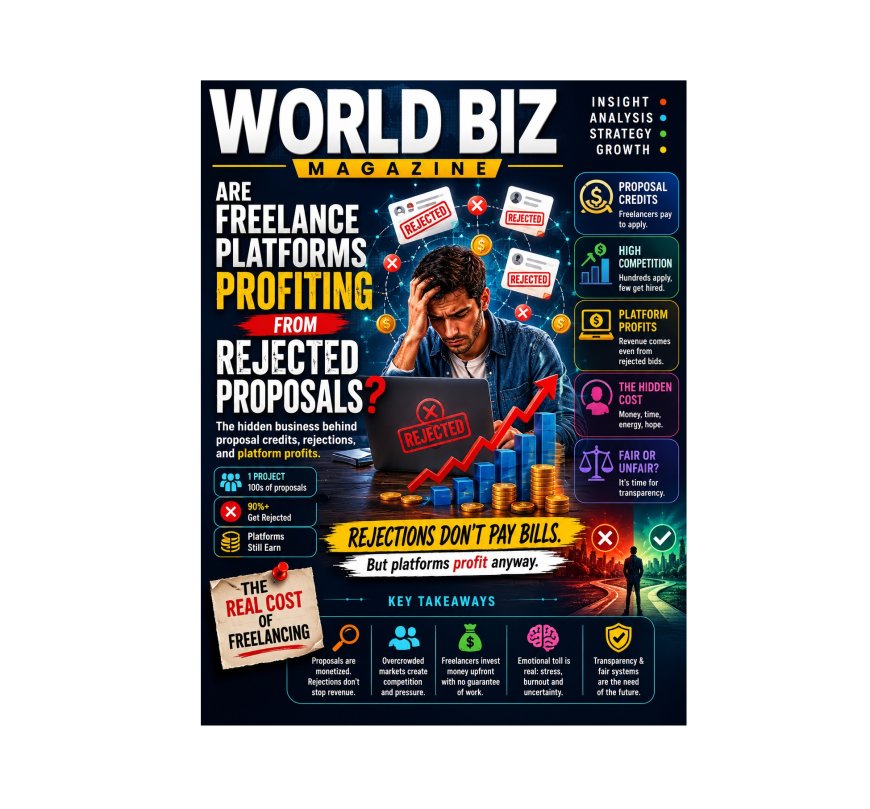
Are Freelance Platforms Profiting From Rejected Proposals?
Understanding the Economics, Incentives, and Controversies Behind Proposal-Based Freelance Marketplaces
World Biz Magazine | Global Freelance & Digital Economy Intelligence | Remote Work | Platform Economics
The Hidden Revenue Model Behind the Freelance Economy
The global freelance economy has rapidly evolved into one of the defining workforce transformations of the digital age. Millions of professionals now rely on online labor marketplaces to access international clients, secure remote work opportunities, build careers, and generate income independently. Designers, developers, writers, marketers, video editors, consultants, AI specialists, and countless other digital professionals participate daily in online ecosystems that promise flexibility, global access, and entrepreneurial freedom.
However, as the freelance economy has expanded, so too has the complexity of the business models powering these platforms. While most people assume freelance marketplaces primarily profit through commissions on completed projects, many digital labor ecosystems have quietly developed additional monetization systems tied directly to freelancer activity itself — particularly proposal submissions and job applications.
This has created growing debate across the freelance community surrounding an increasingly controversial question: are freelance platforms profiting not only from successful work transactions, but also from the massive volume of rejected proposals submitted by freelancers every day?
In many modern freelance ecosystems, workers spend digital credits, application tokens, boosts, subscriptions, or paid visibility tools simply to apply for projects. Yet the majority of proposals submitted across highly competitive marketplaces are never accepted. In some categories, freelancers may send dozens or even hundreds of proposals before securing a single project. This means platforms may generate substantial revenue from proposal activity regardless of whether freelancers actually secure work.
For freelancers, this raises difficult economic and ethical concerns. Workers increasingly feel they are participating not only in labor marketplaces, but also in highly monetized attention economies where visibility, opportunity, and access itself have become products. Freelancers often invest time, emotional energy, and direct financial resources into proposal systems without any guarantee of income or project success.
At the same time, platforms argue these systems help reduce spam, improve marketplace quality, optimize hiring efficiency, and support infrastructure costs associated with managing global labor ecosystems involving millions of users and billions of interactions.
As artificial intelligence, algorithmic ranking systems, platform monetization strategies, and digital labor marketplaces continue evolving, the relationship between rejected proposals, platform revenue, freelancer competition, and economic incentives has become one of the most important and controversial conversations shaping the future of remote work.
Understanding this issue is essential for freelancers, economists, technology companies, policymakers, labor analysts, and digital entrepreneurs seeking insight into how modern platform economies increasingly monetize labor participation itself.
The Rise of Proposal-Based Freelance Economies
Traditional employment systems generally allow workers to apply for jobs freely.
However, many digital labor platforms now operate using proposal-based systems where freelancers may need:
- Application credits
- Proposal tokens
- Membership subscriptions
- Visibility boosts
- Paid profile exposure
before they can compete for opportunities.
This transforms job applications into monetized marketplace activity.
Instead of earning revenue solely from completed projects, platforms may also profit from freelancer participation itself.
Why Proposal Systems Were Introduced
Freelance marketplaces grew rapidly over the past decade, creating operational challenges including:
- Proposal spam
- Low-quality applications
- Marketplace overcrowding
- Automated bidding
- Excessive competition
To manage these issues, some platforms introduced proposal-based systems intended to:
- Reduce spam submissions
- Encourage selective applications
- Improve project quality
- Increase marketplace efficiency
While these systems may improve operational control, they also create recurring revenue streams tied directly to freelancer activity.
The Economics of Rejected Proposals
One of the core controversies surrounding proposal systems is simple mathematics.
In highly competitive freelance categories:
- Hundreds of workers may apply for one project
- Only one or a few freelancers are hired
- The vast majority of proposals are rejected or ignored
Yet if freelancers spend credits or paid resources on each proposal, platforms may generate revenue regardless of hiring outcomes.
This creates a system where unsuccessful applications themselves may contribute to platform profitability.
Freelancers Pay Before They Earn
Unlike traditional job markets, freelancers increasingly spend money before generating income.
Common costs may include:
- Proposal credits
- Monthly memberships
- Visibility upgrades
- Featured profile systems
- AI-assisted bidding tools
- Marketplace promotion features
For many freelancers, especially beginners, there is no guarantee these investments will result in paid work.
This transforms job seeking itself into an economic risk.
Proposal Volume as a Revenue Driver
As freelancer competition increases globally, proposal volume rises dramatically.
In large marketplaces:
- Millions of proposals may be submitted monthly
- Most applications receive no response
- Many projects never hire anyone at all
Yet proposal systems may still generate revenue from:
- Credits spent
- Application fees
- Visibility purchases
- Sponsored bidding activity
This creates concern that proposal activity itself has become a monetizable product within digital labor economies.
The Psychology Behind the Proposal Economy
The proposal-based freelance economy creates strong emotional and behavioral pressure.
Fear of Missing Opportunities
Freelancers often feel pressure to apply quickly because:
- Jobs may disappear rapidly
- Early applicants may gain advantage
- Visibility windows may be limited
This urgency can increase proposal spending behavior.
The Gambling-Like Behavioral Pattern
Some critics compare proposal systems to behavioral reward loops because freelancers:
- Spend credits repeatedly
- Chase opportunities continuously
- Occasionally secure projects
- Experience unpredictable outcomes
Intermittent success may encourage ongoing proposal activity even during repeated rejection.
Emotional Burnout
Repeatedly paying for rejected proposals may create:
- Financial frustration
- Emotional exhaustion
- Self-doubt
- Anxiety
- Burnout
Freelancers often invest not only money, but also significant emotional energy into proposal writing and client outreach.
Platform Incentives and Marketplace Dynamics
A central debate involves understanding platform incentives.
Critics argue platforms may financially benefit from:
- High freelancer competition
- Increased proposal volume
- Worker visibility anxiety
- Continuous bidding behavior
This creates concern that overcrowded marketplaces may remain economically beneficial for platforms even when workers struggle.
Supporters counter that platforms also need successful hiring outcomes to maintain marketplace trust and long-term growth.
Both dynamics may coexist simultaneously.
Visibility as a Paid Commodity
Modern freelance ecosystems increasingly monetize visibility itself.
Freelancers may pay for:
- Search ranking boosts
- Sponsored profiles
- Priority proposal placement
- Featured visibility
This shifts labor marketplaces closer to digital advertising economies where exposure becomes a product.
Workers are no longer competing only through:
- Skill
- Experience
- Reputation
but also through paid visibility systems.
The Burden on New Freelancers
New freelancers are often most vulnerable within proposal economies.
Beginners frequently face:
- Limited reviews
- Low visibility
- Minimal ranking history
- High competition
To gain traction, they may feel pressured to:
- Apply more aggressively
- Spend more on proposals
- Lower pricing
- Purchase visibility tools
This creates structural barriers for new entrants into digital labor ecosystems.
The Role of Algorithms in Proposal Systems
Algorithms heavily influence proposal visibility and hiring outcomes.
Platforms may analyze:
- Freelancer activity
- Response speed
- Proposal quality
- Historical performance
- Client engagement
- Reputation metrics
Algorithmic systems may determine:
- Which proposals clients see first
- Which freelancers gain exposure
- Which profiles remain hidden
This creates labor environments where opportunity is increasingly controlled by automated infrastructure.
Are Rejected Proposals a Business Asset?
One of the most controversial questions involves whether rejected proposals themselves function as part of the platform business model.
Because platforms may profit from:
- Application systems
- Marketplace subscriptions
- Engagement activity
- Visibility tools
high proposal rejection rates may still produce substantial revenue.
This creates ethical concerns surrounding:
- Marketplace fairness
- Worker sustainability
- Incentive structures
- Labor monetization
Freelancers increasingly question whether platforms are optimizing primarily for:
- Successful work relationships
or - Continuous worker engagement
The Data Economy Behind Freelance Platforms
Freelancers generate more than labor within digital marketplaces.
Platforms also collect:
- Behavioral data
- Application patterns
- Pricing trends
- Skill demand analytics
- Engagement statistics
This data helps optimize:
- Algorithms
- Marketplace monetization
- Recommendation systems
- Revenue strategies
In many ways, freelancer behavior itself becomes a platform asset.
The Financial Reality of Repeated Rejection
Many freelancers experience:
- Dozens of ignored proposals
- High competition
- Low response rates
- Significant unpaid time investment
When proposal systems carry direct cost, rejection becomes both:
- Emotional
and - Financial
Workers may calculate losses not only through time wasted, but through direct spending on unsuccessful applications.
AI and the Future of Proposal Economies
Artificial intelligence may intensify these dynamics further.
AI tools may soon:
- Generate automated proposals
- Optimize bidding behavior
- Predict hiring outcomes
- Personalize visibility systems
This could increase proposal volume even further, potentially escalating marketplace competition.
At the same time, AI may improve:
- Matching accuracy
- Client-worker compatibility
- Marketplace efficiency
The long-term impact remains uncertain.
Ethical Questions Surrounding Freelance Monetization
The proposal economy raises major ethical debates about digital labor systems.
Key concerns include:
- Should workers pay heavily to access opportunity?
- Are proposal systems transparent enough?
- Do algorithms unfairly favor established workers?
- Are freelancers becoming monetized users rather than valued professionals?
Supporters argue proposal systems:
- Reduce spam
- Improve quality
- Sustain infrastructure costs
Critics argue they:
- Exploit labor oversupply
- Increase worker instability
- Monetize rejection itself
The debate reflects broader tensions shaping the future of digital work.
The Future of Freelance Platforms
Future freelance ecosystems may evolve toward:
- AI-driven matching systems
- Reputation portability
- Decentralized labor networks
- Blockchain verification systems
- Alternative platform ownership models
Freelancers increasingly demand:
- Greater transparency
- Lower application costs
- Fairer visibility systems
- More sustainable marketplace structures
The future sustainability of digital labor economies may depend on balancing:
- Platform profitability
- Worker fairness
- Marketplace quality
- Economic accessibility
World Biz Magazine Insights
At World Biz Magazine, we view the rise of proposal-based monetization systems as one of the most important structural shifts within the modern freelance economy. Digital labor platforms are increasingly evolving beyond simple marketplaces into highly sophisticated engagement ecosystems where freelancer participation itself generates economic value.
While proposal systems may help reduce spam and improve marketplace management, they also introduce new concerns surrounding worker sustainability, economic fairness, visibility dependency, and the monetization of labor competition. Freelancers today often navigate environments where opportunity itself carries financial cost, even when no work is secured.
As artificial intelligence, algorithmic management, and remote work ecosystems continue expanding globally, the long-term future of freelancing may depend heavily on how digital labor markets balance profitability, transparency, accessibility, and ethical workforce design.
The future of work will likely be shaped not only by who performs labor, but by who controls access to economic opportunity within digital systems.
Conclusion
The growing proposal economy has transformed freelancing into a labor system where workers increasingly spend money simply to compete for opportunity. While platforms argue proposal systems improve marketplace quality and reduce spam, critics question whether rejected proposals themselves have become a profitable business model within digital labor ecosystems.
As competition, AI integration, and platform monetization continue evolving, freelancers face increasing pressure to invest financially in visibility, applications, and engagement without guaranteed outcomes.
Understanding the economics behind rejected proposals is essential for evaluating the future sustainability, fairness, and structure of the modern freelance economy.
Disclaimer
This article is published for informational, educational, and editorial purposes only and does not constitute legal, financial, labor policy, employment, or professional business advice. Readers should consult qualified legal professionals, labor experts, financial advisors, or business consultants regarding specific freelance, contractual, or platform-related matters. World Biz Magazine and its affiliates are not responsible for financial outcomes, employment disputes, or professional decisions based on the information presented in this publication.
What's Your Reaction?
 Like
0
Like
0
 Dislike
0
Dislike
0
 Love
0
Love
0
 Funny
0
Funny
0
 Angry
0
Angry
0
 Sad
0
Sad
0
 Wow
0
Wow
0