




























































































































































































Freelancer Rights in the Digital Gig Economy: Are Online Workers Truly Protected?
A detailed World Biz Magazine analysis explaining freelancer protections, worker classification, payment disputes, and digital labor rights.

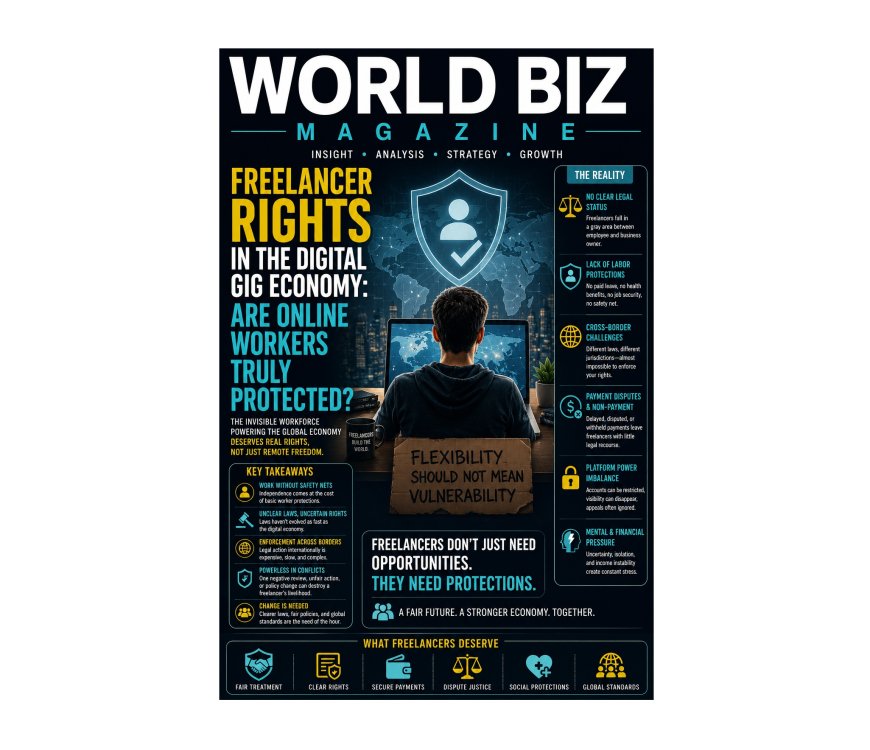
Freelancer Rights in the Digital Gig Economy: Are Online Workers Truly Protected?
Understanding the Legal Gaps, Cross-Border Challenges, and Power Imbalances Facing Freelancers in the Modern Digital Workforce
World Biz Magazine | Global Freelance & Digital Economy Intelligence | Remote Workforce Technology & Platform Analysis
The Rise of a Borderless Workforce Without Borders of Protection
The global workforce is experiencing one of the most significant transformations in modern economic history. Millions of professionals now operate independently through digital labor platforms, remote work systems, online marketplaces, and global freelance ecosystems that allow workers to provide services across international borders without traditional office employment. Software developers, designers, writers, consultants, marketers, video editors, AI specialists, animators, and digital entrepreneurs increasingly participate in what is now widely known as the digital gig economy.
The appeal of freelancing is powerful. Workers gain flexibility, remote freedom, entrepreneurial independence, access to global clients, and opportunities previously unavailable through traditional local employment systems. Businesses also benefit through lower operational costs, scalable staffing, global talent access, and flexible hiring structures.
However, beneath the promise of flexibility lies a growing concern that millions of digital workers may be operating within one of the least legally protected labor systems in the modern economy.
Unlike traditional employees, freelancers often lack many fundamental labor protections including:
- Minimum wage guarantees
- Paid leave
- Healthcare benefits
- Job security
- Unemployment protections
- Workplace safety systems
- Collective bargaining rights
- Clear dispute enforcement mechanisms
At the same time, freelancers increasingly work inside highly centralized digital ecosystems controlled by algorithms, platform policies, automated moderation systems, and complex terms of service agreements. Many workers feel that while platforms benefit enormously from freelance labor activity, independent professionals themselves remain legally vulnerable, economically unstable, and largely unprotected during disputes, payment conflicts, account restrictions, or cross-border legal disagreements.
The situation becomes even more complicated because the digital gig economy operates globally while labor laws remain largely national. A freelancer in one country may work for a client located in another country through a platform headquartered elsewhere entirely. When disputes occur, questions surrounding jurisdiction, legal enforcement, taxation, intellectual property rights, payment recovery, worker classification, and contractual accountability become extremely difficult to resolve.
As artificial intelligence, algorithmic management, remote work infrastructure, and platform-based labor economies continue expanding globally, concerns surrounding freelancer rights, legal protections, worker classification, and digital labor governance are becoming some of the most important workforce debates of the 21st century.
Understanding whether online workers are truly protected requires examining the structural realities, legal gray areas, economic pressures, and systemic power imbalances shaping the modern digital labor economy.
What Is the Digital Gig Economy?
The digital gig economy refers to labor systems where workers provide short-term, freelance, project-based, or independent services through digital platforms and remote work infrastructure.
This may include:
- Freelancing
- Remote consulting
- Creative services
- App-based work
- On-demand labor
- Digital contracting
- AI-assisted services
Workers typically operate independently rather than as traditional employees.
The gig economy has expanded rapidly due to:
- Internet accessibility
- Remote work adoption
- Global outsourcing
- Platform technology
- Startup ecosystems
- Digital entrepreneurship
Millions now depend on these systems for full-time income.
The Legal Classification Problem
One of the biggest challenges facing freelancers involves worker classification.
Most freelancers are legally categorized as:
- Independent contractors
rather than - Employees
This distinction has enormous consequences.
Employees typically receive:
- Labor protections
- Benefits
- Legal safeguards
- Workplace rights
Independent contractors usually do not.
Platforms often classify workers as independent because:
- It reduces legal liability
- Limits labor obligations
- Increases operational flexibility
- Reduces employment costs
Critics argue this creates a workforce that generates enormous economic value while remaining legally vulnerable.
Why Freelancers Often Lack Traditional Labor Protections
Freelancers typically operate outside traditional employment systems.
As a result, they often lack:
- Health insurance
- Paid vacation
- Sick leave
- Retirement contributions
- Workplace protections
- Minimum wage guarantees
- Overtime protections
- Employment stability
Many freelancers function as one-person businesses responsible for managing:
- Taxes
- Contracts
- Legal disputes
- Insurance
- Financial planning
- Income volatility
This creates significant economic pressure and instability.
Payment Disputes and Financial Vulnerability
One of the most common freelancer concerns involves payment protection.
Freelancers may face:
- Delayed payments
- Non-payment
- Refund disputes
- Charge reversals
- Contract disagreements
Unlike traditional employees who often have stronger labor enforcement mechanisms, freelancers may struggle to recover unpaid earnings.
This becomes especially difficult across international borders.
Cross-Border Enforcement Challenges
The digital gig economy is global, but legal systems remain national.
A freelancer may:
- Live in one country
- Work for a client in another country
- Use a platform headquartered elsewhere
When disputes occur, major complications arise regarding:
- Jurisdiction
- Applicable law
- Tax obligations
- Contract enforcement
- Intellectual property ownership
Cross-border enforcement is often expensive, slow, and legally complicated.
For many freelancers, pursuing legal action internationally is financially unrealistic.
Why Many Freelancers Feel Powerless During Conflicts
Freelancers often feel structurally disadvantaged during disputes because:
- Platforms control marketplace access
- Algorithms influence visibility
- Accounts may be restricted
- Reputation systems affect income
- Legal enforcement is difficult
Workers may feel they have limited negotiating power compared to:
- Large clients
- Global platforms
- Corporate legal teams
This imbalance contributes to growing frustration within the freelance economy.
Reputation Systems and Economic Dependency
Digital labor platforms heavily rely on reputation systems.
Freelancers depend on:
- Ratings
- Reviews
- Visibility scores
- Algorithmic rankings
A single dispute may affect:
- Future hiring
- Search visibility
- Income stability
- Client trust
Because reputation is economically tied to survival, freelancers often feel pressured to accept unfair situations to avoid negative consequences.
Account Restrictions and Platform Control
Many freelancers rely heavily on a single platform ecosystem for income.
Platforms may control:
- Marketplace visibility
- Account status
- Payment processing
- Communication systems
- Search rankings
Workers may fear:
- Account suspensions
- Algorithmic penalties
- Reduced visibility
- Lost access to clients
This creates significant dependency on systems workers do not fully control.
Terms of Service and Legal Complexity
Most freelance platforms operate through extensive terms of service agreements.
These contracts may include:
- Arbitration clauses
- Liability limitations
- Platform discretion rights
- Content ownership rules
- Payment policies
Many freelancers:
- Do not fully understand these agreements
- Have little negotiating power
- Must accept terms to participate
This creates legal asymmetry between workers and large technology platforms.
Intellectual Property and Ownership Disputes
Freelancers frequently create:
- Software
- Designs
- Media
- Content
- Branding
- AI-generated assets
Disputes may arise regarding:
- Ownership rights
- Licensing terms
- Commercial usage
- Copyright enforcement
Cross-border IP disputes are especially difficult because laws vary between countries.
The Emotional and Psychological Impact
The lack of legal clarity creates ongoing stress for freelancers.
Workers may experience:
- Anxiety
- Burnout
- Financial insecurity
- Fear of disputes
- Emotional exhaustion
- Isolation
Unlike traditional workplaces, freelancers often lack:
- HR departments
- Legal support
- Union representation
- Workplace protections
This leaves many workers feeling individually exposed inside highly competitive digital systems.
Are Freelancers Employees or Entrepreneurs?
The freelance economy creates a blurred identity problem.
Platforms often market freelancing as:
- Entrepreneurship
- Independence
- Freedom
However, critics argue many freelancers operate under conditions resembling employment because:
- Platforms influence pricing
- Algorithms shape visibility
- Rules govern participation
- Reputation systems control access
This has triggered global debate regarding whether some gig workers should receive stronger labor protections.
Government and Regulatory Responses
Governments worldwide are increasingly examining gig economy regulation.
Key debates include:
- Worker classification
- Minimum earnings standards
- Social protections
- Taxation systems
- Platform accountability
- AI transparency
Some regions are exploring laws that would grant freelancers:
- Greater labor protections
- Portable benefits
- Stronger legal rights
However, global regulation remains inconsistent and fragmented.
The Role of Artificial Intelligence
AI is increasingly reshaping digital labor systems.
Algorithms now influence:
- Hiring visibility
- Reputation systems
- Account moderation
- Project recommendations
- Productivity tracking
Workers often have limited transparency into:
- How decisions are made
- Why visibility changes
- How rankings operate
This creates new concerns regarding:
- Algorithmic fairness
- Automated bias
- Worker autonomy
The future of freelancer rights may increasingly involve AI governance and algorithmic accountability.
Why Freelancers Want Greater Transparency
Freelancers increasingly demand:
- Clearer dispute systems
- Fairer moderation policies
- Better payment protections
- Algorithm transparency
- Stronger worker rights
- More predictable enforcement
Trust and transparency are becoming central issues within the future of digital labor economies.
The Future of Digital Labor Rights
The future freelance economy may evolve toward:
- Portable benefits systems
- Cross-border labor frameworks
- Decentralized reputation systems
- Blockchain contracts
- AI accountability laws
- Stronger platform regulation
At the same time, platforms will likely continue balancing:
- Scalability
- Profitability
- Automation
- Workforce flexibility
The long-term sustainability of the gig economy may depend heavily on whether worker protections evolve alongside technological growth.
World Biz Magazine Insights
At World Biz Magazine, we view freelancer rights as one of the defining workforce issues of the modern digital economy. Millions of professionals now participate in borderless labor systems that generate enormous economic value while often operating outside many traditional legal protections and employment structures.
While digital labor platforms have unlocked unprecedented global opportunity and entrepreneurial flexibility, they have also introduced new forms of vulnerability related to payment enforcement, worker classification, platform dependency, algorithmic control, and cross-border legal complexity.
As artificial intelligence, remote work, and platform economies continue reshaping global labor markets, the future of digital work may increasingly depend on how effectively societies balance innovation, flexibility, worker protections, transparency, and ethical labor governance.
The future workforce may no longer be defined primarily by offices or geography, but by the systems governing digital access to opportunity itself.
Conclusion
Freelancers operating within the digital gig economy often face significant legal uncertainty, limited labor protections, cross-border enforcement challenges, and economic dependency on platform-controlled systems. While remote work ecosystems provide flexibility and global access to opportunity, many workers remain vulnerable during disputes, payment conflicts, account restrictions, and legal disagreements.
As digital labor continues expanding globally through AI, platform economics, and remote work infrastructure, the question of whether freelancers are truly protected will become increasingly important for governments, platforms, businesses, and workers alike.
The future of the digital workforce may ultimately depend on whether technological innovation is matched by equally modern systems of labor rights, accountability, and worker protection.
Disclaimer
This article is published for informational, educational, and editorial purposes only and does not constitute legal, labor policy, employment, financial, or professional business advice. Readers should consult qualified legal professionals, labor experts, tax advisors, or business consultants regarding specific freelance, contractual, employment, or platform-related matters. World Biz Magazine and its affiliates are not responsible for legal outcomes, financial losses, employment disputes, or professional decisions based on the information presented in this publication.
What's Your Reaction?
 Like
0
Like
0
 Dislike
0
Dislike
0
 Love
0
Love
0
 Funny
0
Funny
0
 Angry
0
Angry
0
 Sad
0
Sad
0
 Wow
0
Wow
0