











































































































































































































How Payment Gateways Power E-Commerce Transactions | World Biz Magazine
Understand how payment gateways connect merchants, banks, and customers while supporting secure, scalable, and seamless online transactions.

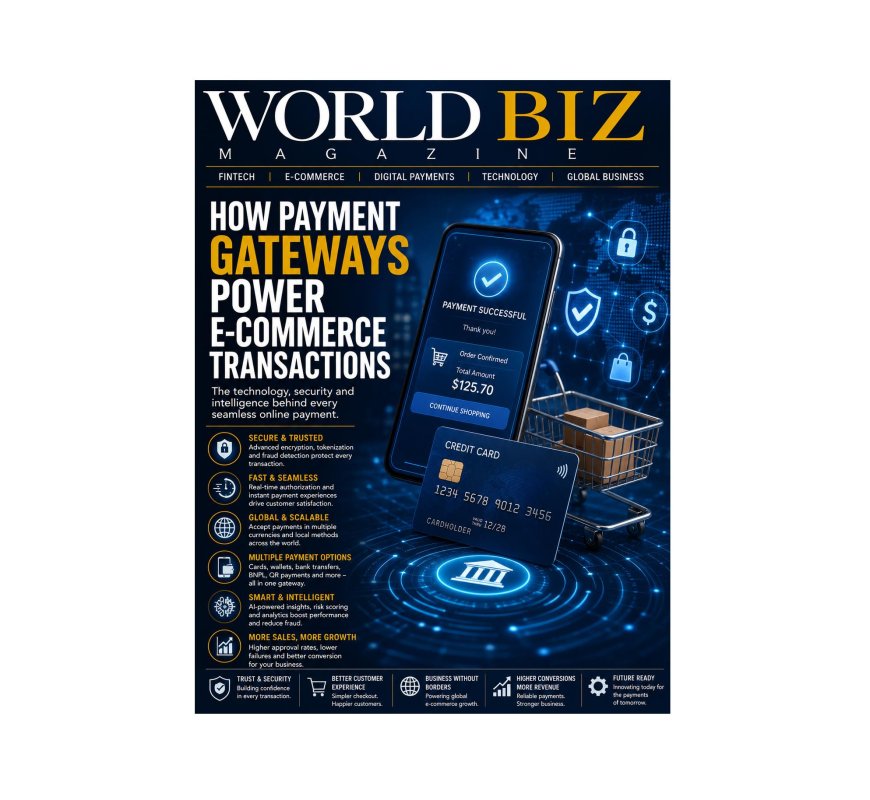
How Payment Gateways Power E-Commerce Transactions
The Digital Infrastructure Behind Secure Online Payments, Global Commerce, and the Future of Financial Technology
World Biz Magazine | FinTech | E-Commerce | Digital Payments | Financial Technology
The Invisible Engine Behind Digital Commerce
The explosive growth of e-commerce has fundamentally transformed the global retail landscape. Consumers can now purchase products and services from virtually anywhere in the world using smartphones, laptops, tablets, and connected devices. Behind every successful online transaction lies an advanced financial technology ecosystem that enables money to move securely between customers, merchants, financial institutions, and payment networks within seconds.
At the center of this ecosystem is the payment gateway a technology platform that securely authorizes, encrypts, processes, and manages digital payments. Although consumers typically experience payment gateways as a simple checkout page, these systems perform highly sophisticated functions involving authentication, fraud prevention, data encryption, transaction routing, and settlement across multiple financial institutions.
As digital commerce continues expanding through online marketplaces, subscription services, mobile applications, social commerce, and international trade, payment gateways have become one of the most critical infrastructures supporting the global digital economy.
Today, payment gateways are no longer simply payment processors. They have evolved into intelligent financial platforms that improve customer experience, enhance security, reduce fraud, support regulatory compliance, and enable businesses to compete in increasingly global markets.
Understanding Payment Gateways
A payment gateway is a secure technology service that facilitates electronic payment transactions between customers, merchants, acquiring banks, issuing banks, and payment networks.
Its primary responsibility is to securely transmit payment information, verify transaction authenticity, request authorization, and return an approval or decline response to the merchant.
Payment gateways support various payment methods including:
- Credit cards
- Debit cards
- Digital wallets
- Mobile payments
- Bank transfers
- Buy Now, Pay Later (BNPL)
- QR code payments
- Contactless payments
- Cryptocurrency payments (where supported)
- Alternative local payment methods
By acting as an intermediary between merchants and financial institutions, payment gateways make online commerce fast, secure, and scalable.
How a Payment Gateway Works
Although payment processing appears nearly instantaneous to customers, several complex steps occur behind the scenes.
Step 1: Customer Initiates Payment
The customer selects products or services, proceeds to checkout, and enters payment credentials through a secure payment interface.
Step 2: Data Encryption
Sensitive payment information is encrypted before transmission to prevent unauthorized access during communication.
Modern gateways employ advanced encryption technologies and secure communication protocols to protect financial data.
Step 3: Fraud Screening
Before authorization, the payment gateway performs automated security checks that may include:
- Address Verification (AVS)
- CVV verification
- Device fingerprinting
- Behavioral analytics
- Geolocation analysis
- Velocity monitoring
- AI-powered fraud detection
- Risk scoring
Potentially suspicious transactions may be declined or subjected to additional authentication.
Step 4: Authorization Request
The gateway securely forwards the transaction request to the acquiring bank, which communicates with the relevant card network and issuing bank.
The issuing bank verifies:
- Card validity
- Available funds
- Spending limits
- Security controls
- Fraud indicators
Step 5: Authorization Response
The issuing bank returns an approval or decline response through the payment network back to the merchant.
Successful authorization confirms that funds have been reserved for the purchase.
Step 6: Settlement
Following authorization, the transaction enters settlement, where funds are transferred between financial institutions before reaching the merchant's account.
Settlement timelines vary depending on payment methods, financial institutions, and regional banking systems.
Key Components of the Payment Ecosystem
Several participants work together to complete digital payment transactions.
These include:
- Customers
- Merchants
- Payment Gateway Providers
- Payment Processors
- Acquiring Banks
- Issuing Banks
- Card Networks
- Digital Wallet Providers
- Fraud Prevention Systems
- Regulatory Authorities
The seamless coordination among these entities enables secure and efficient global commerce.
Security at the Core of Digital Payments
Security represents the most important function of modern payment gateways.
To protect sensitive financial information, gateways utilize:
- End-to-end encryption
- Tokenization
- PCI DSS compliance
- Secure Socket Layer (SSL)
- Transport Layer Security (TLS)
- Multi-factor authentication
- 3-D Secure authentication
- AI-based fraud detection
- Real-time transaction monitoring
These technologies significantly reduce fraud while protecting both consumers and merchants.
Payment Methods Continue to Evolve
Consumer payment preferences are changing rapidly.
Modern payment gateways increasingly support:
Digital Wallets
Consumers increasingly prefer digital wallets that enable faster, password-protected transactions across devices.
Buy Now, Pay Later (BNPL)
Flexible installment payments have become increasingly popular in retail, particularly among younger consumers.
Account-to-Account Payments
Direct bank transfers reduce dependence on traditional card networks while lowering transaction costs.
QR Code Payments
Widely adopted across Asia and expanding globally, QR payments provide convenient mobile checkout experiences.
Cryptocurrency Payments
Although adoption remains limited compared to traditional methods, certain industries increasingly support digital asset payments through specialized gateways.
Cross-Border Commerce
Global e-commerce requires payment gateways capable of handling international transactions.
Advanced gateways support:
- Multiple currencies
- Local payment methods
- Dynamic currency conversion
- Cross-border settlement
- Tax calculation
- Regional compliance
- International fraud prevention
- Multi-language checkout
These capabilities allow merchants to expand internationally while providing localized customer experiences.
The Role of Artificial Intelligence
Artificial Intelligence is transforming payment processing.
AI systems increasingly assist with:
- Fraud detection
- Transaction monitoring
- Behavioral analysis
- Identity verification
- Customer authentication
- Risk management
- Payment routing optimization
- Predictive analytics
Machine learning enables payment platforms to identify fraudulent activity in real time while minimizing false declines that negatively affect customer experience.
Subscription Commerce
Recurring billing has become central to modern digital business models.
Payment gateways now support:
- Automatic recurring payments
- Subscription management
- Free trial conversion
- Membership billing
- Invoice automation
- Payment retries
- Customer account management
These features simplify revenue collection for subscription-based businesses across software, media, education, healthcare, and professional services.
Mobile Commerce
Smartphones have become primary shopping devices for millions of consumers.
Payment gateways therefore optimize checkout experiences through:
- Mobile-responsive design
- One-click payments
- Biometric authentication
- Digital wallet integration
- Contactless technology
- In-app purchases
Reducing checkout friction improves customer satisfaction while increasing conversion rates.
Regulatory Compliance
Payment providers operate within highly regulated financial environments.
Compliance requirements commonly include:
- Anti-Money Laundering (AML)
- Know Your Customer (KYC)
- Payment Card Industry Data Security Standard (PCI DSS)
- Consumer protection regulations
- Data privacy legislation
- Financial reporting requirements
- Cross-border payment regulations
Strong compliance frameworks help maintain trust throughout the digital payments ecosystem.
Challenges Facing Payment Gateways
Despite continuous innovation, payment providers face ongoing challenges.
These include:
- Cybersecurity threats
- Payment fraud
- Chargebacks
- Identity theft
- Regulatory complexity
- Cross-border compliance
- Currency fluctuations
- Operational resilience
- System downtime
- Increasing customer expectations
Addressing these challenges requires continuous investment in technology, security, and infrastructure.
Emerging Technologies
The future of payment gateways is being shaped by several technological trends.
These include:
- Artificial Intelligence
- Open Banking
- Embedded Finance
- Blockchain
- Real-Time Payments
- Central Bank Digital Currencies (CBDCs)
- Biometric authentication
- Tokenized payments
- Voice commerce
- Internet of Things (IoT) payments
These innovations are expected to make digital transactions even faster, more secure, and increasingly seamless.
The Future of Digital Payments
The next generation of payment gateways will become intelligent financial ecosystems rather than simple transaction processors.
Future capabilities are expected to include:
- Predictive fraud prevention
- Personalized payment experiences
- Autonomous payment routing
- AI-driven customer support
- Global instant settlement
- Embedded lending
- Smart contract integration
- Digital identity verification
- Hyper-personalized checkout
- Fully integrated financial services
As commerce becomes increasingly digital, payment gateways will continue evolving into strategic platforms supporting global economic activity.
Executive Perspective
Payment gateways have become one of the most important pillars of the digital economy. Every successful online purchase depends upon a sophisticated network of financial institutions, security technologies, regulatory frameworks, and intelligent payment infrastructure operating behind the scenes.
Beyond processing transactions, modern payment gateways enhance customer experience, reduce fraud, improve operational efficiency, facilitate international expansion, and strengthen trust between businesses and consumers.
As Artificial Intelligence, embedded finance, open banking, and real-time payment technologies continue reshaping financial services, payment gateways will play an even greater role in enabling seamless global commerce.
For businesses competing in today's digital marketplace, selecting the right payment infrastructure is no longer simply an operational decision it has become a strategic investment that directly influences customer satisfaction, revenue growth, operational resilience, and long-term competitive advantage.
In the future of commerce, payment gateways will not merely move money they will power the next generation of intelligent, secure, and borderless digital economies.
The Future of Payment Gateways
The evolution of payment gateways is accelerating as digital commerce expands across every industry. What began as simple transaction-processing technology has transformed into an intelligent financial ecosystem capable of managing security, fraud prevention, compliance, customer experience, and global payment connectivity.
Over the next decade, payment gateways are expected to become significantly more autonomous, predictive, and deeply integrated into business operations. Artificial Intelligence, Open Banking, Real-Time Payments, Embedded Finance, digital identity verification, blockchain technologies, and programmable financial services will fundamentally redefine how businesses and consumers exchange value.
Several trends are expected to shape the future of payment gateways:
Artificial Intelligence Will Power Intelligent Payments
AI will become central to payment authorization, fraud detection, customer authentication, and transaction routing. Instead of relying solely on predefined rules, payment systems will continuously learn from billions of transactions to identify unusual behavior, reduce fraud, minimize false payment declines, and personalize checkout experiences.
AI-powered payment orchestration will enable merchants to automatically select the most efficient payment route, improving authorization rates while reducing processing costs.
Embedded Finance Will Become Standard
Financial services are increasingly being integrated directly into digital platforms.
Rather than redirecting customers to banks or third-party financial providers, businesses will increasingly offer:
- Embedded payments
- Embedded lending
- Instant financing
- Digital wallets
- Business banking
- Insurance products
- Buy Now, Pay Later (BNPL)
- Merchant financing
Payment gateways will evolve into complete financial service platforms rather than simple payment processors.
Real-Time Payments Will Replace Traditional Settlement
Consumers and businesses increasingly expect immediate payment confirmation and faster access to funds.
As national real-time payment infrastructures expand, payment gateways will support:
- Instant bank transfers
- Immediate merchant settlement
- Real-time payroll
- Faster supplier payments
- Cross-border instant transfers
This transformation will improve liquidity while reducing settlement delays across global commerce.
Open Banking Will Expand Payment Choice
Open Banking enables secure sharing of financial information through standardized application programming interfaces (APIs).
Future payment gateways will increasingly support direct account-to-account payments, reducing dependence on traditional card networks while lowering transaction costs for merchants.
Consumers will benefit from greater payment flexibility, faster transactions, and improved financial transparency.
Digital Identity Will Strengthen Security
Passwords and traditional authentication methods are gradually giving way to more sophisticated identity verification systems.
Future payment gateways are expected to integrate:
- Biometric authentication
- Facial recognition
- Fingerprint verification
- Behavioral biometrics
- Passkeys
- Digital identity wallets
These technologies will improve security while simplifying customer checkout experiences.
Cross-Border Commerce Will Become Seamless
Global businesses increasingly require payment systems capable of supporting international expansion without operational complexity.
Future payment gateways will provide:
- Multi-currency acceptance
- Automatic currency conversion
- Local payment methods
- International tax calculation
- Global compliance automation
- Real-time foreign exchange optimization
These capabilities will make international commerce more accessible for businesses of all sizes.
Blockchain and Tokenization Will Improve Efficiency
Blockchain technologies and advanced tokenization are expected to enhance transaction security, transparency, and traceability.
Although widespread adoption will depend on regulatory developments, these technologies may reduce reconciliation costs, improve settlement efficiency, and strengthen payment security in certain commercial environments.
Hyper-Personalized Checkout Experiences
Payment systems will increasingly tailor checkout experiences according to individual customer preferences.
Future capabilities may include:
- Preferred payment recommendations
- Dynamic financing offers
- Personalized loyalty rewards
- Context-aware authentication
- Localized payment methods
- Intelligent subscription management
Reducing checkout friction will continue improving conversion rates and customer satisfaction.
World Biz Magazine Insights
The global payments industry is entering one of the most significant periods of transformation since the introduction of online banking. Digital commerce continues to expand beyond traditional websites into mobile applications, social commerce, connected devices, subscription platforms, embedded financial ecosystems, and Artificial Intelligence-driven services.
World Biz Magazine believes that payment gateways are no longer simply transactional technologies they have become strategic digital infrastructure supporting global commerce, financial inclusion, innovation, and economic growth.
Our editorial analysis identifies five major trends that will shape the next generation of digital payments:
1. Payment Gateways Will Become Intelligent Commerce Platforms
Future payment gateways will integrate payments, fraud prevention, customer analytics, subscription management, financing, tax automation, and financial reporting into unified commerce ecosystems. Businesses will increasingly select payment partners based on the overall value they provide rather than transaction processing alone.
2. Trust Will Become the Primary Competitive Advantage
Consumers are increasingly aware of cybersecurity risks, digital fraud, and data privacy concerns. Payment providers that demonstrate strong security, regulatory compliance, transparency, and reliable performance will earn greater consumer confidence and long-term market leadership.
3. Data Will Drive Smarter Business Decisions
Payment data represents one of the richest sources of commercial intelligence. Businesses will increasingly use payment analytics to understand customer behavior, improve marketing strategies, optimize inventory, personalize customer experiences, and enhance operational efficiency.
4. Financial Inclusion Will Expand Digital Economies
Modern payment gateways are making digital commerce accessible to millions of individuals and small businesses that previously lacked access to traditional financial services. Mobile payments, QR-based transactions, digital wallets, and alternative payment methods will continue driving economic participation across both developed and emerging markets.
5. Collaboration Will Shape the Future of FinTech
Banks, financial technology companies, merchants, regulators, payment networks, cloud providers, cybersecurity firms, and AI developers will increasingly collaborate to create more secure, interoperable, and customer-centric payment ecosystems. Strategic partnerships will become a defining characteristic of future financial innovation.
World Biz Magazine believes that payment infrastructure is evolving into a strategic business capability rather than a back-office operational function. Organizations that invest in secure, scalable, customer-focused payment technologies will be better positioned to compete in an increasingly digital and interconnected global marketplace.
Conclusion
Payment gateways have become indispensable to the modern digital economy, enabling secure, efficient, and seamless financial transactions across borders, industries, and digital platforms. They connect consumers, merchants, financial institutions, and payment networks while protecting sensitive financial information and supporting trust throughout the e-commerce ecosystem.
As digital commerce continues evolving through Artificial Intelligence, Open Banking, Embedded Finance, Real-Time Payments, mobile commerce, and emerging financial technologies, payment gateways will play an increasingly strategic role in shaping the future of global business.
Organizations must therefore view payment infrastructure not merely as a transactional necessity but as a critical component of customer experience, operational resilience, cybersecurity, international expansion, and long-term business growth.
Businesses that embrace secure payment innovation, regulatory compliance, intelligent fraud prevention, and customer-centric financial technologies will be better prepared to compete in the next generation of digital commerce.
Ultimately, payment gateways are no longer simply moving money—they are enabling trust, accelerating innovation, strengthening digital economies, and powering the future of global commerce.
Disclaimer
This article is published by World Biz Magazine for editorial, educational, and informational purposes only. The content reflects independent editorial analysis based on publicly available information, industry practices, financial technology developments, and emerging trends within the global digital payments ecosystem.
This publication should not be interpreted as financial, banking, legal, regulatory, tax, cybersecurity, investment, or professional advice. Payment regulations, licensing requirements, data protection laws, financial compliance obligations, and payment processing standards vary across jurisdictions and are subject to continuous change. Businesses should consult qualified financial institutions, payment service providers, legal counsel, cybersecurity specialists, and regulatory advisors before selecting, implementing, or modifying payment technologies or financial infrastructure.
References to payment gateways, financial institutions, payment networks, digital wallets, technologies, or commercial practices are provided solely for educational and informational purposes and do not constitute endorsement, certification, commercial affiliation, or product recommendation by World Biz Magazine. The magazine supports responsible innovation, secure financial technologies, regulatory compliance, consumer protection, and ethical digital commerce as essential foundations for sustainable global economic growth.
What's Your Reaction?
 Like
0
Like
0
 Dislike
0
Dislike
0
 Love
0
Love
0
 Funny
0
Funny
0
 Angry
0
Angry
0
 Sad
0
Sad
0
 Wow
0
Wow
0