




























































































































































































Q-Commerce vs Traditional E-Commerce: Key Differences, Benefits and Future Trends
From AI-powered logistics to smart fulfillment centers, discover how Q-Commerce and traditional e-commerce are reshaping the future of global retail.

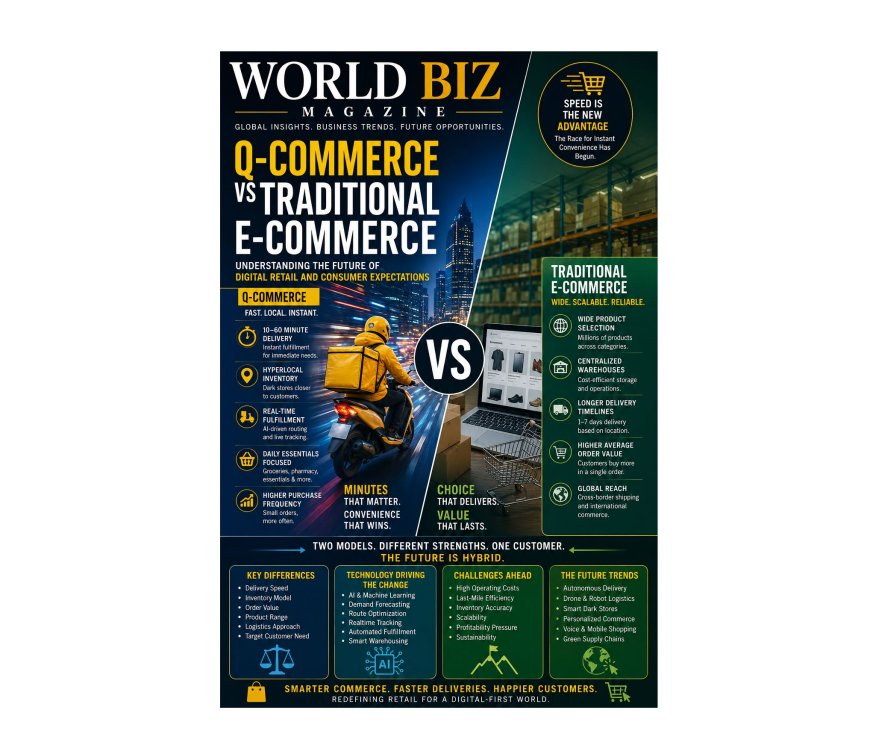
Q-Commerce vs Traditional E-Commerce
Understanding the Future of Digital Retail, Instant Delivery, and Consumer Expectations
World Biz Magazine | Digital Commerce, Retail Innovation & Consumer Markets
The global retail landscape is undergoing one of the fastest transformations in history. While traditional e-commerce revolutionized how consumers purchase products online, a new model Quick Commerce (Q-Commerce) is redefining customer expectations by prioritizing speed, convenience, and hyper-local fulfillment. As consumers increasingly demand deliveries within minutes rather than days, retailers, logistics companies, technology firms, and investors are rapidly adapting to this new era of digital commerce. Understanding the differences between Q-Commerce and traditional e-commerce has become essential for businesses seeking long-term competitiveness in the evolving retail economy.
The Evolution of Digital Commerce
Online shopping has evolved significantly over the past two decades. Initially, consumers accepted delivery times ranging from several days to even weeks in exchange for convenience and product variety. Traditional e-commerce transformed retail by enabling customers to purchase products from anywhere in the world through digital marketplaces and online stores.
However, changing consumer behavior, urbanization, smartphone adoption, and advances in logistics technology have accelerated demand for much faster delivery experiences. Today's consumers increasingly expect groceries, pharmaceuticals, electronics, household essentials, and daily necessities to arrive within minutes or hours rather than days.
This shift has given rise to Quick Commerce, commonly known as Q-Commerce, a business model focused on ultra-fast fulfillment through localized inventory, intelligent logistics, and technology-driven operations.
What Is Traditional E-Commerce?
Traditional e-commerce refers to the buying and selling of goods and services through online platforms where products are typically shipped from centralized warehouses, distribution centers, or retailers.
Delivery generally ranges from one day to several days depending on inventory location, shipping methods, and customer preferences.
Traditional e-commerce businesses prioritize product selection, competitive pricing, national or international distribution, and operational efficiency.
Examples include:
- Online marketplaces
- Brand-owned online stores
- B2B e-commerce platforms
- Cross-border retail platforms
- Wholesale e-commerce
- Subscription commerce
Traditional e-commerce remains the foundation of the global online retail industry.
What Is Q-Commerce?
Quick Commerce is the next evolution of online retail focused on delivering products in an extremely short period often within 10 to 60 minutes.
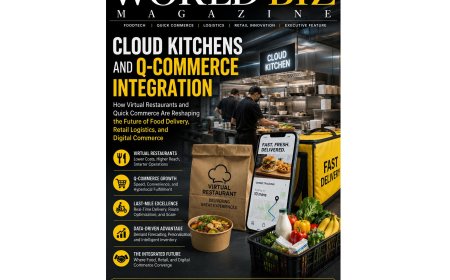
Instead of shipping products from large centralized warehouses, Q-Commerce companies use small urban fulfillment centers, commonly known as dark stores or micro-fulfillment centers, strategically located near customers.
Orders are processed immediately and delivered through optimized logistics networks using bicycles, motorcycles, electric vehicles, or autonomous delivery systems.
Q-Commerce emphasizes speed rather than extensive product selection.
Core Differences Between Q-Commerce and Traditional E-Commerce
Although both operate digitally, their business models differ substantially.
|
Feature |
Traditional E-Commerce |
Q-Commerce |
|
Delivery Time |
1-7 Days |
10-60 Minutes |
|
Inventory |
Large Warehouses |
Local Dark Stores |
|
Product Range |
Extensive |
Curated Essentials |
|
Delivery Area |
Regional & Global |
Hyper-Local |
|
Customer Need |
Planned Purchases |
Immediate Needs |
|
Logistics |
Scheduled Shipping |
Real-Time Fulfillment |
|
Order Value |
Medium to High |
Usually Smaller |
|
Technology Focus |
Marketplace Management |
Logistics Optimization |
Consumer Behavior Driving Q-Commerce
Consumer expectations have changed dramatically.
People increasingly prioritize:
- Immediate convenience
- Time savings
- Mobile ordering
- Contactless delivery
- Real-time order tracking
- Personalized shopping
- Flexible payment methods
Busy urban lifestyles and increasing smartphone usage have accelerated demand for rapid delivery services.
For many consumers, waiting several days for frequently used products no longer aligns with modern expectations.
Product Categories Best Suited for Q-Commerce
Not every product requires ultra-fast delivery.
Q-Commerce performs particularly well for:
Groceries
Fresh produce, dairy products, beverages, snacks, and household essentials represent one of the largest Q-Commerce categories.
Pharmaceuticals
Prescription refills, over-the-counter medicines, personal healthcare products, and medical essentials benefit from immediate delivery.
Convenience Products
Batteries, chargers, personal care items, office supplies, baby products, and cleaning products are common Q-Commerce purchases.
Food Delivery
Restaurants increasingly integrate with Q-Commerce logistics to deliver prepared meals more efficiently.
Consumer Electronics
Accessories such as headphones, charging cables, computer peripherals, and mobile accessories often fit rapid delivery models.
Products Better Suited for Traditional E-Commerce
Traditional e-commerce remains superior for:
- Furniture
- Home appliances
- Fashion collections
- Luxury goods
- Industrial equipment
- Automotive components
- Heavy machinery
- Large electronics
- Customized products
- International purchases
These purchases generally involve greater research and less urgency.
Technology Behind Q-Commerce
Q-Commerce depends heavily on advanced technologies.
These include:
- Artificial Intelligence
- Predictive Demand Forecasting
- Route Optimization
- Real-Time Inventory Management
- Machine Learning
- GPS Tracking
- Automated Order Management
- Digital Payments
- Cloud Computing
- Mobile Commerce
Technology enables companies to reduce delivery times while maintaining operational efficiency.
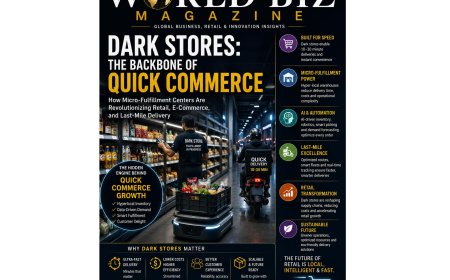
Dark Stores: The Backbone of Q-Commerce
Unlike supermarkets serving walk-in customers, dark stores function exclusively as fulfillment centers.
These facilities are strategically positioned within urban neighborhoods to minimize delivery distances.
Benefits include:
- Faster picking times
- Reduced delivery costs
- Better inventory control
- Higher operational efficiency
- Optimized urban logistics
Dark stores have become a defining feature of modern Q-Commerce.
Economics of Q-Commerce
Although consumers appreciate speed, ultra-fast delivery creates significant operational challenges.
Major cost drivers include:
- Local warehousing
- Delivery personnel
- Fleet management
- Technology infrastructure
- Inventory forecasting
- Customer acquisition
- Packaging
- Last-mile logistics
Achieving long-term profitability requires careful optimization of these costs while maintaining customer satisfaction.
Traditional E-Commerce: Advantages
Traditional e-commerce continues to offer significant strengths.
Wider Product Selection
Large warehouses support millions of product listings across numerous categories.
Better Economies of Scale
Centralized operations reduce storage and logistics costs.
Lower Delivery Costs
Scheduled shipping allows more efficient transportation planning.
International Reach
Businesses can serve customers across countries and continents.
Higher Average Order Values
Consumers often purchase multiple products simultaneously.
Q-Commerce: Advantages
Q-Commerce offers unique competitive benefits.
Exceptional Convenience
Consumers receive products almost immediately.
Strong Customer Loyalty
Fast delivery encourages repeat purchases.
Higher Purchase Frequency
Customers place smaller but more frequent orders.
Urban Market Penetration
Hyper-local operations perform well in densely populated cities.
Competitive Differentiation
Delivery speed itself becomes a unique selling proposition.
Challenges Facing Q-Commerce
Despite rapid growth, Q-Commerce faces several obstacles.
These include:
- High operational costs
- Thin profit margins
- Delivery workforce management
- Inventory forecasting complexity
- Urban congestion
- Sustainability concerns
- Customer acquisition expenses
- Scalability challenges
Balancing speed with profitability remains one of the industry's greatest challenges.
Sustainability Considerations
Environmental sustainability is becoming increasingly important.
Companies are investing in:
- Electric delivery vehicles
- Bicycle delivery networks
- Eco-friendly packaging
- Route optimization
- Carbon reduction initiatives
- Renewable-powered fulfillment centers
Consumers increasingly evaluate brands based on environmental performance as well as convenience.
Artificial Intelligence Transforming Both Models
AI is improving both traditional e-commerce and Q-Commerce.
Applications include:
- Product recommendations
- Dynamic pricing
- Inventory optimization
- Customer service chatbots
- Fraud detection
- Predictive purchasing
- Warehouse automation
- Demand forecasting
Artificial intelligence enables businesses to improve operational efficiency while enhancing customer experiences.
Future Market Trends
Several trends are expected to shape the future of digital retail.
Autonomous Delivery
Delivery robots and drones may significantly reduce last-mile costs.
Smart Warehousing
Automation will accelerate fulfillment speed.
Personalized Commerce
AI will create increasingly customized shopping experiences.
Omnichannel Integration
Retailers will combine physical stores, e-commerce, and Q-Commerce into unified customer experiences.
Hyperlocal Retail Networks
Localized fulfillment centers will continue expanding across major urban markets.
Which Model Will Win?
Rather than replacing one another, Q-Commerce and traditional e-commerce are likely to coexist.
Traditional e-commerce remains ideal for planned purchases, large product catalogs, and international retail.
Q-Commerce excels in urgent purchases, convenience products, groceries, and urban delivery.
Many retailers are integrating both models into hybrid commerce ecosystems that provide customers with multiple fulfillment options based on urgency and purchasing behavior.
World Biz Magazine Insights
The future of retail will not be defined by a competition between Q-Commerce and traditional e-commerce, but by the intelligent integration of both. Businesses that successfully combine rapid fulfillment, advanced technology, customer personalization, and efficient supply chains will be best positioned to meet evolving consumer expectations. As digital commerce continues to mature, speed, convenience, and operational excellence will become as important as price and product selection.
Conclusion
Q-Commerce represents the latest evolution in digital retail, responding to growing consumer demand for instant gratification and hyper-local convenience. Traditional e-commerce, meanwhile, continues to dominate large-scale online retail through extensive product offerings, global reach, and cost-efficient logistics. Rather than competing directly, these two models serve different customer needs and purchasing behaviors. Organizations capable of integrating both approaches into a unified commerce strategy will be better equipped to compete in the increasingly dynamic global retail marketplace. The future of commerce will belong to businesses that can deliver not only products, but also speed, flexibility, and exceptional customer experiences.
Disclaimer
This article is published by World Biz Magazine for informational, educational, and editorial purposes only. The content reflects general industry analysis of Q-Commerce, traditional e-commerce, digital retail, logistics, and consumer market trends. It should not be interpreted as legal, financial, investment, tax, or professional business advice. Market conditions, technologies, regulations, and commercial practices vary by country and industry and may evolve over time. Readers should conduct independent research and consult qualified professionals before making strategic, operational, investment, or commercial decisions. World Biz Magazine, its publisher, editors, contributors, and affiliates accept no liability for any decisions or actions taken based on the information presented in this publication.
What's Your Reaction?
 Like
0
Like
0
 Dislike
0
Dislike
0
 Love
0
Love
0
 Funny
0
Funny
0
 Angry
0
Angry
0
 Sad
0
Sad
0
 Wow
0
Wow
0