






























































































































































Dark Stores: The Backbone of Quick Commerce | World Biz Magazine
Discover how dark stores are transforming quick commerce through AI, automation, micro-fulfillment, inventory optimization, and faster last-mile delivery.

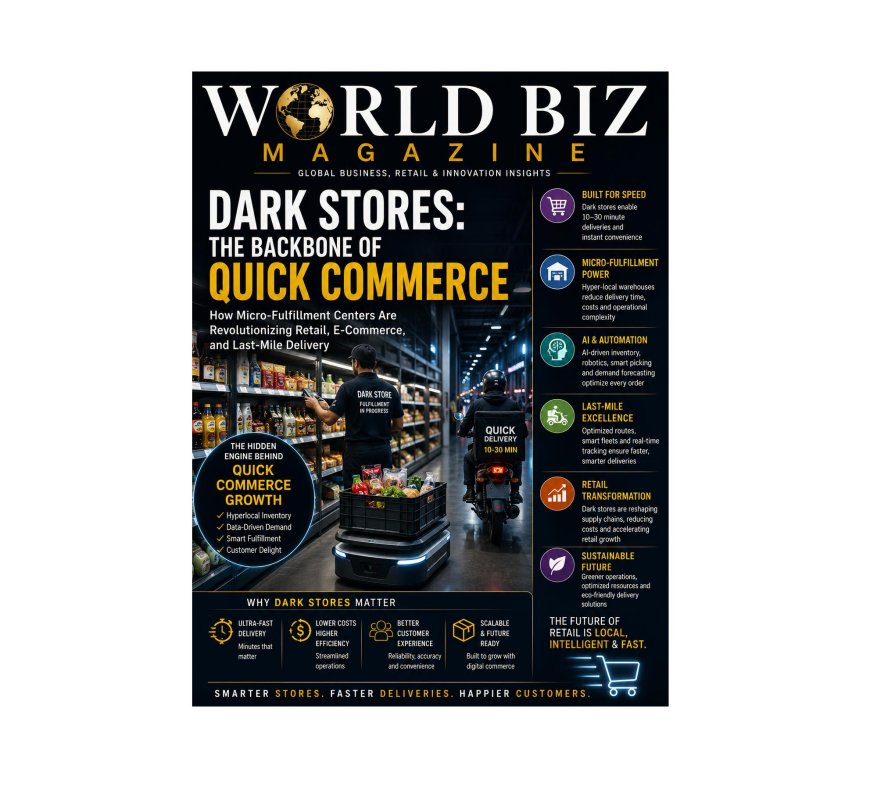
Dark Stores: The Backbone of Quick Commerce
How Micro-Fulfillment Centers Are Revolutionizing Retail, E-Commerce, and Last-Mile Delivery
World Biz Magazine | Retail | E-Commerce | Supply Chain | Logistics | Executive Feature
Retail is undergoing one of the most profound transformations in its history. Over the past decade, consumer expectations have shifted dramatically from traditional in-store shopping and standard e-commerce delivery toward instant fulfillment. Today's consumers increasingly expect groceries, pharmaceuticals, electronics, fashion products, household essentials, and restaurant meals to arrive within minutes rather than days. This growing demand for speed has given rise to Quick Commerce (Q-Commerce) a new retail model built around ultra-fast deliveries, advanced logistics, and technology-driven fulfillment.
At the center of this revolution lies the Dark Store.
Unlike conventional retail stores designed for walk-in shoppers, dark stores operate exclusively as fulfillment centers for online orders. They are strategically located close to residential neighborhoods, allowing retailers to prepare and dispatch orders within minutes. These facilities combine inventory management, warehouse automation, artificial intelligence, predictive analytics, and last-mile logistics into highly efficient micro-distribution hubs capable of supporting delivery times as short as 10 to 30 minutes.
Dark stores are rapidly becoming one of the most important innovations in modern retail. Companies operating in grocery delivery, pharmaceuticals, convenience retail, consumer goods, and e-commerce increasingly rely on dark store networks to improve customer experience while optimizing inventory and operational efficiency.
As global urbanization accelerates and digital commerce expands, dark stores are redefining how products move from manufacturers to consumers, creating new opportunities for retailers, logistics providers, investors, and technology companies.
What Is a Dark Store?
A dark store is a retail fulfillment facility designed exclusively for processing online customer orders. While it resembles a traditional supermarket or retail outlet in terms of product assortment, it is closed to the general public and operates solely for digital commerce.
Customers place orders through mobile applications or websites. Instead of visiting a physical store, employees or increasingly autonomous robots collect products from shelves, pack them efficiently, and hand them over to delivery riders or autonomous delivery systems.
Because these facilities eliminate customer-facing operations such as checkout counters, merchandising displays, and shopping aisles designed for browsing, dark stores maximize operational efficiency and significantly reduce order processing times.
The Evolution of Quick Commerce
Traditional retail focused on customer visits.
E-commerce introduced home delivery.
Quick Commerce introduced immediate delivery.
This evolution reflects changing consumer behavior driven by smartphones, mobile payments, urban lifestyles, and increasing convenience expectations.
Consumers increasingly purchase:
- Groceries
- Fresh food
- Pharmaceuticals
- Personal care products
- Baby products
- Pet supplies
- Electronics
- Office supplies
- Household essentials
with the expectation that they arrive within minutes.
Meeting these expectations requires an entirely different logistics infrastructure than conventional retail.
Dark stores provide that infrastructure.
How a Dark Store Operates
A typical dark store follows a streamlined operational workflow:
- A customer places an order through a mobile application or online platform.
- The order is instantly transmitted to the nearest dark store.
- Warehouse Management Systems (WMS) assign the picking task.
- Staff members or autonomous robots collect products from optimized shelf layouts.
- Items are scanned and verified for accuracy.
- Orders are packed according to delivery requirements.
- Delivery personnel receive optimized delivery routes.
- Customers receive real-time tracking updates.
- Orders are delivered within a targeted time window, often between 10 and 30 minutes.
This process relies on sophisticated software, real-time inventory visibility, AI-powered demand forecasting, and efficient last-mile logistics.
Why Dark Stores Are Growing Rapidly
Several trends are accelerating the adoption of dark stores worldwide.
Urbanization
Growing urban populations create dense customer clusters that make rapid delivery economically viable.
Digital Shopping Habits
Consumers increasingly prefer mobile shopping over physical store visits.
Demand for Speed
Fast delivery has become a competitive differentiator rather than a premium service.
Smartphone Adoption
Mobile applications enable seamless ordering, digital payments, and real-time order tracking.
Pandemic-Driven Behavioral Changes
COVID-19 accelerated online grocery shopping, contactless delivery, and digital retail adoption, reinforcing long-term consumer behavior.
Types of Dark Stores
Dark store models vary depending on business strategy and product categories.
Grocery Dark Stores
Operate similarly to supermarkets but serve online grocery customers exclusively.
Pharmacy Dark Stores
Store prescription medications, healthcare products, and personal care items for rapid delivery.
Convenience Dark Stores
Focus on everyday essentials such as beverages, snacks, household supplies, and personal products.
E-Commerce Micro-Fulfillment Centers
Support online retailers by storing high-demand products close to consumers.
Hybrid Dark Stores
Combine traditional retail operations with dedicated fulfillment areas for online orders.
Technology Powering Dark Stores
Modern dark stores rely heavily on digital technologies.
Warehouse Management Systems (WMS)
Manage inventory, picking routes, replenishment, and order fulfillment.
Artificial Intelligence
AI predicts customer demand, optimizes inventory levels, recommends stock allocation, and improves picking efficiency.
Internet of Things (IoT)
Connected sensors monitor inventory, refrigeration, environmental conditions, and equipment performance.
Robotics
Automated robots transport inventory, assist order picking, and improve warehouse productivity.
Computer Vision
Cameras and AI monitor operations, verify order accuracy, and improve security.
Route Optimization
AI algorithms determine the fastest delivery routes considering traffic, weather, and rider availability.
Inventory Optimization
Dark stores maintain smaller inventories than traditional warehouses but replenish stock more frequently.
AI analyzes:
- Customer purchasing behavior
- Seasonal demand
- Local events
- Weather conditions
- Historical sales
- Promotional campaigns
to ensure the right products remain available.
Efficient inventory management minimizes stockouts while reducing waste and storage costs.
Last-Mile Delivery
The final stage of delivery represents one of the most expensive components of modern logistics.
Dark stores reduce last-mile costs by positioning inventory close to customers.
Delivery fleets may include:
- Motorcycles
- Electric bikes
- Bicycles
- Electric scooters
- Vans
- Autonomous delivery robots
- Delivery drones (future deployments)
Reducing delivery distance improves profitability while enabling faster service.
Business Models
Dark stores support multiple commercial models.
Retail-Owned Networks
Major retailers operate proprietary dark store networks serving their existing customer base.
Quick Commerce Platforms
Dedicated delivery companies operate independent dark stores supplying multiple brands.
Third-Party Fulfillment Providers
Logistics companies manage fulfillment operations for retailers lacking their own infrastructure.
Franchise Networks
Independent operators manage local dark stores under a common brand.
White-Label Fulfillment
Dark stores provide logistics services for multiple retailers behind the scenes.
Economic Benefits
Dark stores generate significant operational advantages.
Retailers benefit from:
- Lower operating costs
- Faster fulfillment
- Better inventory control
- Higher delivery accuracy
- Reduced labor requirements
- Improved customer satisfaction
- Increased sales frequency
Consumers benefit from:
- Rapid delivery
- Greater convenience
- Real-time tracking
- Better product availability
Cities benefit through more efficient distribution systems.
Challenges Facing Dark Stores
Despite rapid growth, dark stores face several operational challenges.
High Real Estate Costs
Urban locations offer faster delivery but command premium rental prices.
Thin Profit Margins
Ultra-fast delivery requires significant investment in logistics and technology.
Inventory Complexity
Managing thousands of SKUs while maintaining rapid fulfillment requires sophisticated forecasting.
Labor Availability
Recruiting warehouse staff and delivery personnel remains challenging in many markets.
Sustainability Concerns
Frequent small deliveries increase transportation activity unless optimized using electric fleets and route planning.
Regulatory Issues
Cities increasingly regulate warehouse zoning, delivery traffic, and labor practices.
Sustainability and Green Logistics
Environmental sustainability is becoming increasingly important.
Dark store operators are investing in:
- Electric delivery vehicles
- Bicycle delivery fleets
- Renewable energy
- Smart packaging
- Recyclable materials
- Carbon footprint monitoring
- AI route optimization
Green logistics reduces operational costs while supporting corporate sustainability goals.
Artificial Intelligence and Automation
AI continues transforming dark store operations.
Applications include:
- Predictive inventory planning
- Dynamic pricing
- Automated replenishment
- Customer demand forecasting
- Personalized product recommendations
- Workforce scheduling
- Delivery optimization
- Fraud detection
Future dark stores may operate with minimal human intervention through autonomous robotics and intelligent warehouse automation.
Global Market Trends
The dark store industry continues expanding rapidly due to:
- Growth in Quick Commerce
- Urban population increases
- Smartphone penetration
- AI adoption
- Cloud computing
- Digital payments
- Consumer demand for convenience
Retailers increasingly integrate dark stores into omnichannel strategies, combining physical retail with digital fulfillment.
The Future of Dark Stores
Over the next decade, dark stores will become increasingly intelligent, automated, and interconnected.
Future developments are expected to include:
- Fully robotic fulfillment centers
- AI-managed inventory
- Autonomous mobile robots
- Drone deliveries
- Autonomous delivery vehicles
- Digital twin warehouse simulations
- Hyper-local predictive inventory
- Edge AI logistics
- Real-time customer demand forecasting
- Sustainable zero-emission fulfillment networks
Dark stores will increasingly function as intelligent urban distribution hubs supporting not only retail but healthcare, food delivery, pharmaceuticals, and same-day commerce.
World Biz Magazine Insights
Dark stores represent far more than an operational innovation they symbolize the next evolution of retail infrastructure. As consumers increasingly prioritize speed, convenience, and digital experiences, retailers are redesigning supply chains around localized fulfillment, intelligent automation, and data-driven decision-making. The competitive advantage will no longer depend solely on product selection or pricing but on the ability to deliver the right product to the right customer at the right time with maximum efficiency.
Artificial Intelligence, robotics, IoT, and advanced logistics are transforming dark stores into intelligent micro-fulfillment ecosystems capable of supporting the future of urban commerce. Businesses that successfully integrate these technologies with sustainable logistics and customer-centric operations will define the next generation of global retail.
Conclusion
Dark stores have become a foundational component of the Quick Commerce ecosystem, enabling retailers to meet rising consumer expectations for rapid, reliable, and convenient delivery. By combining localized inventory, intelligent technology, and efficient last-mile logistics, these facilities are reshaping how products move through modern supply chains.
As digital commerce continues to evolve, dark stores will play an increasingly strategic role in retail operations, supporting omnichannel strategies, improving inventory utilization, reducing delivery times, and enhancing customer satisfaction. Their integration with Artificial Intelligence, automation, robotics, and sustainable logistics will further strengthen their position as essential infrastructure within the future retail economy.
For retailers, investors, technology providers, and logistics companies, the expansion of dark stores presents significant opportunities for innovation, operational efficiency, and long-term growth in an increasingly competitive global marketplace.
Disclaimer
This article has been prepared by World Biz Magazine for informational, educational, and editorial purposes only. The analysis, opinions, forecasts, and insights presented are based on publicly available information, industry research, market developments, and the editorial assessment of the publication at the time of writing.
The content should not be interpreted as financial, investment, legal, operational, or professional business advice. Readers are encouraged to conduct independent research and consult qualified advisors before making strategic, investment, or commercial decisions.
References to companies, technologies, products, logistics models, or business practices are made solely for editorial and educational purposes and do not constitute endorsement, partnership, or recommendation by World Biz Magazine. As retail technologies, market dynamics, regulations, and consumer behaviors continue to evolve, readers should verify current information through official and authoritative sources before relying on it for business or investment decisions.
What's Your Reaction?
 Like
1
Like
1
 Dislike
0
Dislike
0
 Love
0
Love
0
 Funny
0
Funny
0
 Angry
0
Angry
0
 Sad
0
Sad
0
 Wow
0
Wow
0